
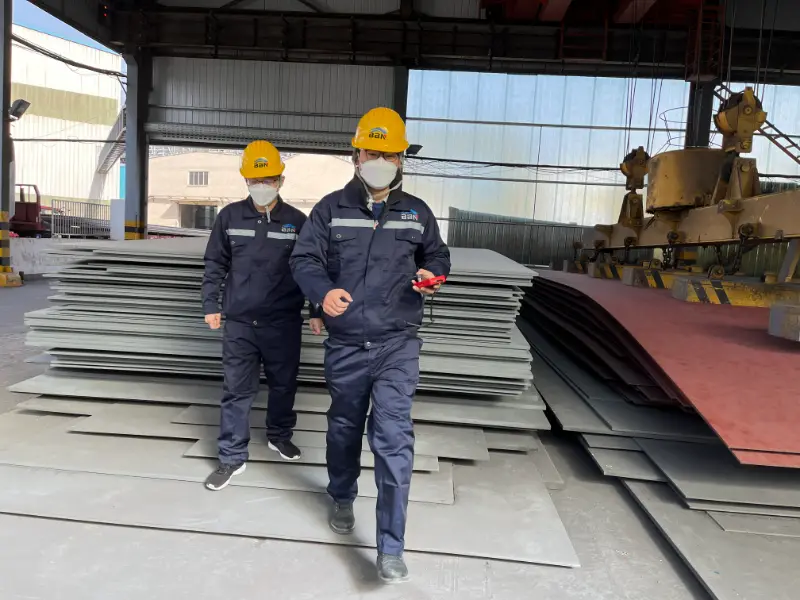
RINA Grade F550 High-Strength Shipbuilding Steel Plate
RINA Grade F550 Steel Plate: High Strength, Low-Temperature Toughness for Shipbuilding
Comprehensive data on RINA F550 high-strength shipbuilding steel: chemical composition, mechanical & physical properties, international equivalents, and application guidance.
Suitable for welding (preheating may be required), hot forming (with post-forming heat treatment), cold forming (limited by thickness), flame cutting, and machining.
- Phone : +8618037372205
- Email : [email protected]
- WhatsApp: Contact via Whtsapp
- WeChat: +8618037372205
RINA Grade F550 High-Strength Shipbuilding Steel Plate Introduction
RINA Grade F550 is a high-strength, quenched and tempered structural steel plate primarily used in shipbuilding and offshore engineering. It is certified by the Italian Register of Shipping (RINA) in compliance with its Rules for the Classification of Ships. The 'F' designation indicates guaranteed impact toughness at temperatures as low as -60°C, while '550' denotes a minimum yield strength of 550 MPa. This steel combines high load-bearing capacity with excellent low-temperature toughness, weldability, and resistance to brittle fracture. Typical thicknesses range from 5 mm to 100 mm, with the delivered condition being quenched and tempered (Q+T). It is widely adopted for critical structural components in ships, offshore platforms, heavy lift vessels, and ice-class vessels where safety and reliability under extreme conditions are paramount.
RINA Grade F550 High-Strength Shipbuilding Steel Plate Chemical Composition
The chemical composition of RINA Grade F550 is strictly controlled to achieve high strength, good weldability, and excellent low-temperature toughness. Typical ladle analysis limits according to RINA rules are listed below. Trace elements such as niobium, vanadium, and titanium are added for grain refinement and precipitation strengthening. Carbon equivalent (CEV) is usually specified to ensure weldability; for this grade, CEV is generally ≤ 0.53% (typical). Actual values may be adjusted by the manufacturer within the limits.
| Element | Specified Value (max) | Remarks |
|---|---|---|
| Carbon (C) | ≤0.20 | Ladle analysis |
| Silicon (Si) | ≤0.50 | |
| Manganese (Mn) | ≤1.70 | |
| Phosphorus (P) | ≤0.025 | |
| Sulfur (S) | ≤0.025 | |
| Chromium (Cr) | ≤1.50 | |
| Nickel (Ni) | ≤2.50 | May be up to 2.50 for improved toughness |
| Molybdenum (Mo) | ≤0.70 | |
| Copper (Cu) | ≤0.50 | |
| Vanadium (V) | ≤0.12 | |
| Titanium (Ti) | ≤0.05 | |
| Niobium (Nb) | ≤0.06 | |
| Nitrogen (N) | ≤0.020 | |
| Boron (B) | ≤0.005 | |
| Aluminium (Al) | ≥0.015 (min) | Total aluminium, usually for grain refinement |
RINA Grade F550 High-Strength Shipbuilding Steel Plate Thermal and Electrical Physical Properties
Physical properties are representative of quenched and tempered low-alloy steels of this strength class. Values are for room temperature unless otherwise stated and may vary slightly with heat treatment and composition.
| Property | Typical Value | Unit | Test Condition / Remarks |
|---|---|---|---|
| Density (ρ) | 7850 | kg/m³ | At 20°C |
| Elastic Modulus (E) | 205 – 210 | GPa | At 20°C |
| Shear Modulus (G) | ~80 | GPa | At 20°C, calculated from E and v |
| Poisson's Ratio (ν) | 0.30 | – | At 20°C |
| Thermal Expansion Coefficient (α) | 12.0 | 10⁻⁶/K | Between 20°C and 100°C |
| Thermal Expansion Coefficient (α) | 12.5 | 10⁻⁶/K | Between 20°C and 200°C |
| Thermal Conductivity (λ) | 42 | W/(m·K) | At 20°C |
| Thermal Conductivity (λ) | 40 | W/(m·K) | At 100°C |
| Specific Heat Capacity (cp) | 460 | J/(kg·K) | At 20°C |
| Electrical Resistivity (ρe) | 0.25 | μΩ·m | At 20°C |
RINA Grade F550 High-Strength Shipbuilding Steel Plate Mechanical Properties
Mechanical properties are verified on transverse specimens in the as-delivered quenched and tempered condition. The values below are in accordance with RINA rules for thicknesses up to 50 mm. For thicker sections, yield and tensile strength may be slightly reduced by agreement. Impact test temperature is -60°C for the F550 grade.
| Property | Required Value | Unit | Test Condition / Remarks |
|---|---|---|---|
| Yield Strength (ReH) | ≥550 | MPa | Transverse; thickness ≤ 50 mm |
| Tensile Strength (Rm) | 670 – 830 | MPa | Transverse; thickness ≤ 50 mm |
| Elongation (A) | ≥17 | % | Gauge length L0=5.65√S0 (transverse) |
| Impact Energy (KV2) – longitudinal | ≥27 | J | At -60°C; average of 3 tests, min. single value 70% of average |
| Impact Energy (KV2) – transverse | ≥20 | J | At -60°C; average of 3 tests, min. single value 70% of average |
| Bend Test (t ≤ 30 mm) | d = 3a | 180° bending, no cracks; d=madrel diameter, a=thickness | |
| Bend Test (30 < t ≤ 50 mm) | d = 4a | 180° bending, no cracks |
RINA Grade F550 High-Strength Shipbuilding Steel Plate Completely Equivalent Standards and Replaceable Grades
| Country / Region | Standard / Classification Society | Grade | Remarks |
|---|---|---|---|
| USA | ABS (American Bureau of Shipping) | ABS FH550 | Same strength and -60°C impact toughness |
| Norway / Germany | DNV (Det Norske Veritas) | DNV FH550 | In DNV ship/offshore standards |
| UK | LR (Lloyd's Register) | LR FH550 | Recognised equivalent |
| France | BV (Bureau Veritas) | BV FH550 | Equivalent high-strength Q&T grade |
| China | CCS (China Classification Society) | CCS FH550 | Identical mechanical requirements |
| Europe | EN 10025-6 | S550QL (with option 11: -60°C impact) | Closest EN standard; requires supplementary agreement for -60°C testing |
| International | ISO 24314 | FH550 | Structural steels for ships; mechanical properties match |
RINA Grade F550 High-Strength Shipbuilding Steel Plate Application Introduction
RINA F550 steel is designed for demanding marine and offshore applications where high strength must be combined with excellent toughness at very low temperatures. Its quenched and tempered microstructure provides a good balance of strength, ductility, and weldability. Proper welding procedures, including preheating and interpass temperature control, are essential to maintain mechanical properties in the heat-affected zone. Post-weld heat treatment is generally not required for thicknesses up to 50 mm, but may be considered for relief of residual stresses.
Product Applications: Hull plates and stiffeners, Deck and bottom structures, Ice belt and bow plates for arctic service, Legs and spudcans of jack-up drilling platforms, Support frames for offshore wind substations, Lifting equipment such as crane booms and pedestals
Processed into products: Welded girders and box sections, Stiffened panels, Pinions and rack connectors, Flame-cut shaped parts (brackets, gussets), Fatigue-critical details that require high yield strength, Bolted and riveted connections in primary structures
Application industries: Shipbuilding (container ships, bulk carriers, tankers, ice-class vessels), Offshore oil & gas (jack-up rigs, semi-submersibles, floating production units), Heavy engineering (crane construction, heavy lifts), Renewable energy (offshore wind turbine foundations, substructures), Military and coast guard vessels
RINA Grade F550 High-Strength Shipbuilding Steel Plate Similar / Alternative Material Recommendations
| Country / Region | Standard / Classification Society | Grade | Remarks |
|---|---|---|---|
| Europe | EN 10025-6 | S550QL | Similar strength and toughness, but default min. temp. -40°C; can be ordered with -60°C option |
| Europe | EN 10025-6 | S550QL1 | Modified composition with even higher toughness; often used as alternative |
| USA | ASTM A514 / A517 | Grade Q | Quenched and tempered alloy steel plate with comparable strength; impact temperature not identical, needs verification |
| USA | ASTM A131 / A131M | Grade FH550 (if included) | Not a standard ASTM A131 grade; use A514 with supplementary specification for shipbuilding |
| Europe | EN 10025-6 | S500QL | Lower yield strength (500 MPa) but same toughness class; may be used in less demanding sections |
| Various | Various Classification Societies | FH460, FH500, FH620 | Other strength levels with same low-temperature capability for optimization |
Notes:
RINA F550 plate is normally supplied with certification to RINA rules, including mechanical testing and ultrasonic examination as per class requirements. Thickness tolerances and flatness comply with EN 10029 or applicable RINA requirements. For welding, low-hydrogen processes and filler metals matching the base metal strength are recommended; preheat temperature (typically 150-200°C) should be determined based on plate thickness and CEV. The material can be delivered with additional through-thickness testing (Z-quality) if required (e.g., Grade F550 Z25/Z35 per EN 10164).
- Share



