
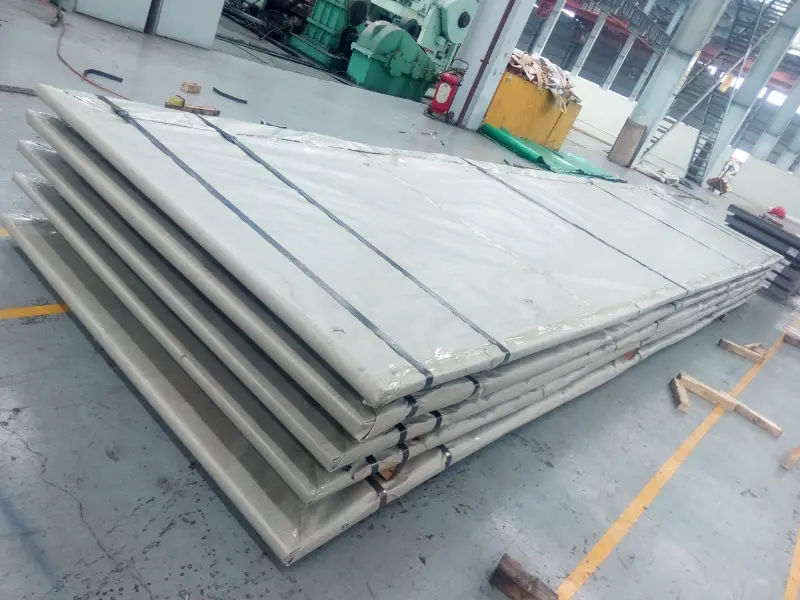
RINA Grade E550 Shipbuilding Steel Plate
RINA Grade E550 Shipbuilding Steel Plate – High-Strength Quenched and Tempered Steel for Offshore Structures
Complete material data for RINA Grade E550 shipbuilding steel plate: chemical composition, mechanical and physical properties, international equivalents, and application guidelines for marine and offshore engineering.
Hot rolling, controlled rolling, quenching + tempering, welding, hot forming (with subsequent heat treatment), cold forming (limited), machining, gas cutting
- Phone : +8618037372205
- Email : [email protected]
- WhatsApp: Contact via Whtsapp
- WeChat: +8618037372205
RINA Grade E550 Shipbuilding Steel Plate Introduction
RINA Grade E550 is a high-strength, quenched and tempered structural steel plate certified by the Registro Italiano Navale (Italian Classification Society) for shipbuilding and offshore applications. With a minimum yield strength of 550 MPa and guaranteed impact toughness at -40°C, E550 combines excellent weldability, good formability, and reliable low-temperature performance. It is typically supplied in normalized or quenched and tempered condition, primarily used in critical welded components such as hull structures, jack-up rig legs, and heavy offshore platforms where weight reduction and high load-bearing capacity are essential. The 'E' designation indicates that Charpy V-notch impact tests are performed at -40°C, ensuring reliable service in cold climates and ice-going vessels.
RINA Grade E550 Shipbuilding Steel Plate Chemical Composition
The chemical composition follows the RINA Rules for high-strength quenched and tempered steels, closely aligned with EN 10025-6 for grade S550Q. Micro-alloying elements such as Nb, V, Ti, and Al are added to achieve fine grain structure and strength. Limits are defined for product thickness typically up to 150 mm. The values below represent the maximum permissible content unless a range is given.
| Element | Standard Value (max, wt.%) | Remarks |
|---|---|---|
| Carbon (C) | 0.20 | |
| Silicon (Si) | 0.55 | |
| Manganese (Mn) | 1.70 | |
| Phosphorus (P) | 0.020 | Lower P typically guaranteed (≤0.015% on product) |
| Sulfur (S) | 0.010 | Lower S typically guaranteed (≤0.005% on product) |
| Chromium (Cr) | 0.80 | May be increased by agreement |
| Nickel (Ni) | 1.00 | May be increased by agreement |
| Molybdenum (Mo) | 0.70 | May be increased by agreement |
| Copper (Cu) | 0.50 | |
| Vanadium (V) | 0.12 | Total V+Nb+Ti ≤ 0.22% per EN 10025-6 |
| Niobium (Nb) | 0.06 | |
| Titanium (Ti) | 0.05 | |
| Aluminium (Al, acid soluble) | ≥0.015 | Fine grain practice, usually 0.020–0.040% |
| Nitrogen (N) | 0.015 | If sufficient Al, Ti, or other binding elements present |
| Boron (B) | 0.005 | If specifically agreed, e.g., for additional hardenability |
RINA Grade E550 Shipbuilding Steel Plate Thermal and Electrical Physical Properties
Physical properties are representative of quenched and tempered low-alloy steel similar to S550Q. These values are not specified in RINA rules but are provided for design purposes and are taken from published data for comparable grades. Slight variations may occur depending on exact chemical composition and heat treatment.
| Property | Typical Value | Unit | Test Conditions / Remarks |
|---|---|---|---|
| Density (ρ) | 7.85 | g/cm³ | At 20°C |
| Young's modulus (E) | 205 – 210 | GPa | At 20°C; slightly decreases with temperature |
| Shear modulus (G) | 80 | GPa | Approximate, from E and Poisson's ratio |
| Poisson's ratio (ν) | 0.30 | — | At 20°C, within elastic range |
| Thermal expansion coefficient (α) | 11.5 – 12.5 | ×10−⁸/K | 20–100°C (typical 12.0); at 20–200°C ~12.5; at 20–300°C ~13.0 |
| Thermal conductivity (λ) | 48 – 55 | W/(m·K) | At 20°C; decreases with increasing temperature |
| Specific heat capacity (cₚ) | 460 | J/(kg·K) | At 20°C; increases to ~550 at 300°C |
| Electrical resistivity (ρₑ) | 0.18 – 0.25 | μΩ·m | At 20°C |
RINA Grade E550 Shipbuilding Steel Plate Mechanical Properties
Mechanical properties are guaranteed for plates in Q+T condition with thickness usually ≤ 50 mm (thicker sections may be agreed with adjusted minimums). All tests are performed in accordance with RINA Rules. Impact tests are carried out on longitudinal Charpy V-notch specimens at -40°C. The minimum single impact energy value is 70% of the specified average.
| Property | Standard Requirement Value | Unit | Test Condition |
|---|---|---|---|
| Yield strength (ReH) | ≥ 550 | MPa | Ambient, plate thickness ≤ 50 mm |
| Yield strength (ReH) | ≥ 530 | MPa | Plate thickness > 50 mm ≤ 100 mm |
| Yield strength (ReH) | ≥ 510 | MPa | Plate thickness > 100 mm ≤ 150 mm (agreed) |
| Tensile strength (Rm) | 670 – 830 | MPa | Plate thickness ≤ 50 mm |
| Tensile strength (Rm) | 650 – 810 | MPa | Plate thickness > 50 mm ≤ 100 mm |
| Tensile strength (Rm) | 630 – 780 | MPa | Plate thickness > 100 mm ≤ 150 mm |
| Elongation (A5) | ≥ 16 | % | Gauge length 5.65√Sₒ, thickness ≤ 50 mm |
| Elongation (A5) | ≥ 15 | % | Thickness > 50 mm ≤ 100 mm |
| Elongation (A5) | ≥ 14 (typical) | % | Thickness > 100 mm ≤ 150 mm |
| Bend test (transverse) | No cracks or defects | — | Bend angle 180°, mandrel diameter = 3×t (t = thickness) |
| Impact energy (KV, longitudinal) | ≥ 27 (average of 3) | J | -40°C, Charpy V-notch; single min. 19 J |
| Impact energy (KV, transverse) | ≥ 20 (average of 3) | J | -40°C, Charpy V-notch; single min. 14 J (if required) |
RINA Grade E550 Shipbuilding Steel Plate Fully Equivalent Material Standards & Substitutable Grades
| Country / Region | Standard | Grade / Designation | Remarks |
|---|---|---|---|
| European Union | EN 10025-6:2019 | S550Q (+ quenched and tempered) | Very close match in chemistry and mechanicals; -40°C impact designated as S550QL if 27 J at -40°C |
| Norway / DNV | DNV Rules Pt.2 Ch.2 Sec.3 | NVE550 (NV E550) | Direct equivalent for offshore and marine use; E indicates -40°C impact testing |
| USA / ABS | ABS Rules Part 2, Chapter 1 | AQE550 (ABS E550) | Same strength level with -40°C impact requirements |
| UK / LR | Lloyd's Register Rules | LRE550 | Grade E550 with similar chemical and mechanical requirements |
| Korea / KR | Korean Register Rules | KRE550 (or KI55 for quenching and tempering) | Corresponds to the same strength category and test temperature |
| France / BV | Bureau Veritas Rules | BVE550 | E550 designation with identical property thresholds |
RINA Grade E550 Shipbuilding Steel Plate Application Introduction
RINA Grade E550 is engineered for demanding marine and offshore environments. Its combination of high strength and excellent low-temperature toughness makes it ideal for structural weight optimization without sacrificing safety. The steel is typically used in as-delivered Q+T condition but developers should verify that welding procedures are qualified according to RINA Rules. Post-weld heat treatment is not normally required for thicknesses up to 50 mm, but thicker sections may need stress relieving.
Product Applications: Hull shell plates and stiffeners in high-stress regions, Deck plating and longitudinal bulkheads, Offshore platform topside modules and substructures, Leg sections and rack materials for self-elevating units, Crane pedestals and heavy brackets, Padeyes, lifting lugs, and towing pads
Processed into products: Lower-strake plates and ice belt reinforcement, Web frames and deep girders, Column joints and node connections, Mudmat and spudcan structural parts, Transition pieces for offshore wind tetrapods, Box girder webs and flanges in crane booms, Highly stressed pins, pin retainer plates, and bolted connectors
Application industries: Shipbuilding (commercial and naval vessels), Offshore oil & gas platforms (jackets, decks, flare booms), Renewable offshore wind energy (monopiles, transition pieces, substructures), Heavy-lift crane construction (mobile harbor cranes, floating sheerlegs), Jack-up rig components (leg chords, racks, spudcans), Arctic and ice-class ship hulls
RINA Grade E550 Shipbuilding Steel Plate Similar / Comparable Substitutable Materials
| Country / Region | Standard | Grade | Remarks |
|---|---|---|---|
| European Union | EN 10025-6 | S690Q / S690QL | Higher strength (min YS 690 MPa), but often considered as an upgrade; similar Q+T condition and low-temperature notch toughness |
| USA | ASTM A514/A514M | Grade B / H / F / Q (modified) | Similar Q+T high-strength steels; YS min 690 MPa, but chemistry and impact test temperature may differ; requires careful qualification |
| International | ISO 4950-2 | S550Q (ISO standard, withdrawn but widely used) | Predecessor to EN 10025-6 S550Q; near identical requirements |
| Japan | JIS G 3128 | SHY685 / SHY685N | Japanese high-strength shipbuilding steel; YS min 685 MPa, yet often used in similar heavy constructions |
| China | GB/T 16270 | Q550D (or Q550E for -40°C impact) | Chinese quenched and tempered high-strength steel plate with comparable properties |
| Germany / DIN | DIN EN 10025-6 (now superseded) | DIN 10025-6 S550Q | Identical to EN S550Q, previously defined under DIN standards |
Notes:
- Welding: Low-alloy Q+T steels require strict control of heat input and cooling time (t8/5). Matching filler metals with low hydrogen potential (e.g., AWS A5.28 ER100S-G, E110C-G, or equivalent) are recommended. Preheating temperature typically 50–150°C depending on thickness and carbon equivalent. Post-weld heat treatment may soften the heat-affected zone; special attention needed if stress relief is demanded.
- Hot forming: Heating above 650°C will alter mechanical properties. Any hot forming must be followed by a new Q+T treatment unless otherwise agreed with the classification society.
- Inspection and testing: Ultrasonic testing according to EN 10160 Class S1/E1 or equivalent is normally required. Marking includes RINA stamp, steel grade, heat number, and plate identity.
- Corrosion protection: Shop priming with an approved scheme (e.g., inorganic zinc silicate) is common. Additional paint systems compatible with the primer may be applied by the yard.
- Certification: All plates are supplied with RINA certificate 3.1 (or 3.2 if required) per EN 10204, stating chemical composition, mechanical test results, and non-destructive test results.
- Share



