
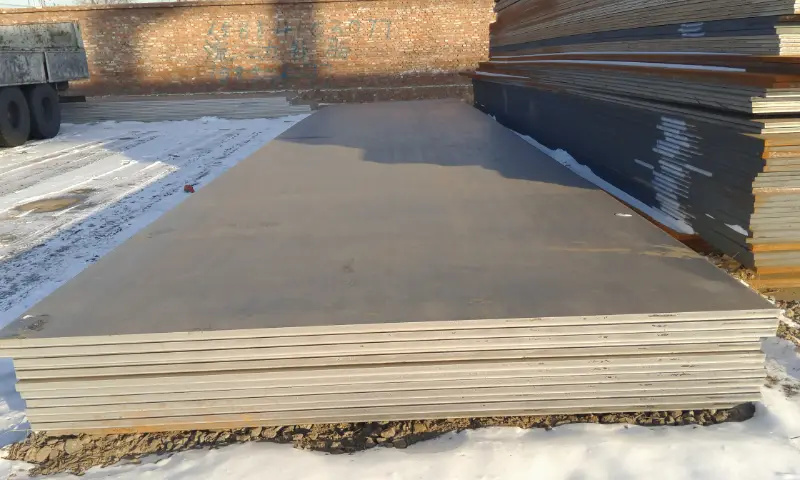
RINA Grade D550 Shipbuilding Steel Plate
RINA Grade D550 Shipbuilding Steel Plate - High Strength Marine Steel for Offshore & Hull Structures
Comprehensive material data sheet for RINA Grade D550 shipbuilding steel plate: chemical composition, mechanical properties, thermal & electrical characteristics, international equivalents and application details.
Hot rolling, normalizing rolling, TMCP, quenching and tempering; cutting, cold forming, bending, welding (with preheat and low hydrogen procedures)
- Phone : +8618037372205
- Email : [email protected]
- WhatsApp: Contact via Whtsapp
- WeChat: +8618037372205
RINA Grade D550 Shipbuilding Steel Plate Introduction
RINA Grade D550 is a high strength shipbuilding steel plate certified by the Registro Italiano Navale (RINA). Designed for critical structural components in ship and offshore constructions, it offers a minimum yield strength of 550 MPa. The steel is supplied in a quenched and tempered or thermo-mechanically controlled processed (TMCP) condition, providing an excellent combination of high strength, good toughness and weldability. The "D" designation indicates guaranteed impact toughness down to -20 °C, making it suitable for moderately cold environments. Typical thicknesses range from 5 mm to 100 mm. Compliant with IACS UR W11 and RINA Rules Part D, this grade is widely adopted for hull girders, decks, bottom shells and heavy offshore structures where weight savings and structural integrity are paramount.
RINA Grade D550 Shipbuilding Steel Plate Chemical Composition
Typical chemical requirements for RINA Grade D550 according to IACS UR W11 for YS550 grade and RINA Rules. Values are maximum unless a range is given. Fine grain practice is mandatory with sufficient aluminium content. Microalloying elements such as Nb, V, Ti may be added to achieve the required strength and toughness.
| Element | Specified Value (max, %) | Remarks |
|---|---|---|
| Carbon (C) | 0.18 | Depending on thickness, carbon equivalent (Ceq) restricted |
| Silicon (Si) | 0.10 – 0.55 | Killed steel, fine grain practice |
| Manganese (Mn) | 0.90 – 1.60 | Higher Mn improves strength and hardenability |
| Phosphorus (P) | 0.025 | Low P for ductility and weldability |
| Sulfur (S) | 0.025 | Low S to avoid hot cracking |
| Aluminium (Al, total) | ≥ 0.015 | Acid soluble or total; grain refinement |
| Niobium (Nb) | 0.05 | Microalloying for grain refinement and precipitation strengthening |
| Vanadium (V) | 0.10 | Optional microalloying |
| Titanium (Ti) | 0.02 | Optional, also used for HAZ toughness |
| Copper (Cu) | 0.35 | If specified; may be used for atmospheric corrosion resistance |
| Chromium (Cr) | 0.20 | Residual or intentional addition |
| Nickel (Ni) | 0.40 | May be added for toughness |
| Molybdenum (Mo) | 0.08 | Minor element for hardenability |
| Nitrogen (N) | 0.012 | Bound by Al/Ti |
| Carbon Equivalent (Ceq) | 0.43 – 0.47 (depending on thickness) | Ceq = C + Mn/6 + (Cr+Mo+V)/5 + (Ni+Cu)/15 |
RINA Grade D550 Shipbuilding Steel Plate Thermal & Electrical Physical Properties
The following physical properties are typical for high-strength low-alloy steel grades similar to D550 and are provided as general reference. Actual values may vary slightly with exact chemical composition and heat treatment. These data are not part of the RINA certification but are helpful for design calculations involving thermal loads, heat transfer and electrical conductivity.
| Property | Typical Value | Unit | Test Condition / Remarks |
|---|---|---|---|
| Density (ρ) | 7.85 | g/cm³ | At room temperature |
| Modulus of Elasticity (E) | 205 | GPa | At ambient temperature |
| Shear Modulus (G) | 80 | GPa | Calculated from E and Poisson ratio |
| Poisson Ratio (ν) | 0.3 | - | Elastic range |
| Thermal Expansion Coefficient (α) | 12.0 | 10⁻⁶/K | Range 20 °C – 100 °C |
| Thermal Conductivity (λ) | 50 | W/(m·K) | At 20 °C |
| Specific Heat Capacity | 460 | J/(kg·K) | At 20 °C |
| Electrical Resistivity (ρₑ) | 0.25 | μΩ·m | At 20 °C |
RINA Grade D550 Shipbuilding Steel Plate Mechanical Properties
Mechanical properties are based on IACS UR W11 and RINA specifications for thicknesses up to 100 mm (unless otherwise noted). Tensile testing is performed in the transverse direction for plates. Charpy V‑notch impact tests are conducted on longitudinal specimens at -20 °C, with minimum absorbed energy of 31 J for thickness ≤ 50 mm. Bend tests using a mandrel diameter of 3 to 4 times the specimen thickness (180° bending) are required to prove ductility and freedom from defects.
| Property | Specified Value | Unit | Test Condition / Remarks |
|---|---|---|---|
| Yield Strength (ReH) | ≥ 550 | MPa | Thickness ≤ 100 mm; transverse direction |
| Tensile Strength (Rm) | 670 – 830 | MPa | Transverse; for t ≤ 50 mm (slightly wider range for thicker plates) |
| Elongation after fracture (A) | ≥ 16 | % | Gauge length L₀ = 5.65√S₀; transverse; t ≤ 50 mm |
| Charpy Impact Energy (KV) | ≥ 31 | J | Longitudinal; at -20 °C; t ≤ 50 mm; average of 3 specimens, single min 70% of average |
| Bend Test (mandrel diameter) | d = 3a (t ≤ 25 mm); d = 4a (25 mm < t ≤ 50 mm) | - | 180° bend; no cracks or defects; transverse specimen |
RINA Grade D550 Shipbuilding Steel Plate Completely Equivalent Material Standards & Substitutable Grades
| Country/Region | Standard | Grade | Remarks |
|---|---|---|---|
| International (IACS) | UR W11, YS550 | D550 | Identical base requirements; D indicates impact test at -20 °C |
| American Bureau of Shipping | ABS Rules, Part 2 | DH550 | ABS equivalent with D (-20 °C) toughness |
| Bureau Veritas | BV Rules, Part II | DH550 | BV approved high strength hull steel |
| China Classification Society | CCS Rules, Part 9 | DH550 | CCS material grade for ships |
| DNV GL (now DNV) | DNV Rules, Pt.2 Ch.2 | DH550 | DNV class notation for 550 MPa hull steel |
| Lloyd's Register | LR Rules, Part II | DH550 | LR Grade D (high strength) with YP550 |
| Nippon Kaiji Kyokai | NK Rules, Part K | KD550 | NK equivalent; K denotes high tensile, D temperature |
| Korean Register | KR Rules, Pt.2 | RD550 | KR high strength grade for marine structures |
RINA Grade D550 Shipbuilding Steel Plate Application Introduction
RINA D550 steel plate is engineered for demanding marine and offshore structures where high strength, low weight and reliable low-temperature toughness are critical. It is typically used in thicknesses from 5 mm up to 80–100 mm. The steel can be processed by all conventional fabrication methods: cutting (plasma, laser, flame), cold forming (with adequate minimum radii), welding (low hydrogen fillers, preheat may be required), and final machining. Surface protection (painting, cathodic protection) is recommended for corrosion resistance in seawater environments.
Product Applications: Ship hull plates (deck, bottom, side shell, bulkhead), Girder webs and flanges for longitudinal strength members, Transverse frames, stringers and stiffeners, Helicopter decks, heavy lift crane pedestals, Ice belts and ice strengthening plates, Offshore module support structures and helidecks
Processed into products: Hull plate blanks ready for cutting and rolling, Stiffened panel assemblies (frames + plate), Brackets and gusset plates, Weld-on lifting padeyes and structural nodes, Machinery seatings and foundations, Bollard and fairlead reinforcements
Application industries: Shipbuilding (container ships, bulk carriers, tankers, LNG carriers), Offshore oil & gas (jack-up rigs, semi-submersibles, FPSO hulls), Marine engineering (dredgers, pipe-lay vessels, crane barges), Naval defence (frigates, icebreakers, patrol vessels), Renewable energy (offshore wind turbine foundations, substructures), Heavy civil engineering (bridges, locks, flood gates)
RINA Grade D550 Shipbuilding Steel Plate Similar / Alternative Materials
| Country/Region | Standard | Grade | Remarks |
|---|---|---|---|
| European Union | EN 10025-6 | S550QL/S550QL1 | Quenched and tempered structural steel; min YS 550 MPa, comparable toughness; may lack ship classification approval |
| United States | ASTM A514 / A517 | Grade Q | High strength quenched & tempered alloy steel plate; similar strength; requires separate assessment for hull applications |
| Japan | JIS G 3106 | SM570 | Rolled steels for welded structures; YS 460 MPa upper range; slightly lower strength; often used in similar heavy structures |
| Germany (historical) | DIN EN 10025-6 | S550Q | Predecessor of EN S550QL; same mechanical properties; shipyard pre-qualification needed |
| China | GB/T 712 | DH550 | Chinese standard for hull structural steel; very similar chemical and mechanical requirements; can be considered interchangeable after approval |
Notes:
- All values refer to as-delivered condition (Q+T or TMCP); for TMCP material, mechanical properties may be slightly different but shall still meet the specified minima.
- Weldability assessment: Carbon equivalent and Pcm values should be reported by the steelmaker. Preheat and interpass temperature control is recommended to avoid cold cracking.
- Through-thickness properties (Z‑grade) can be ordered according to RINA Rules if required for highly restrained welded joints.
- Supplementary impact testing at -40 °C or lower is possible with special agreement (E550 or F550 designations).
- Surface condition: plates are generally delivered as rolled, descaled, or shot blasted and shop primed.
- Share



