
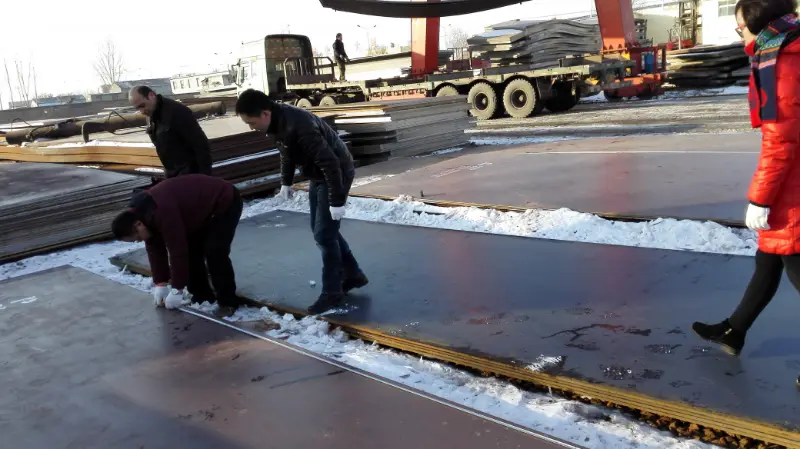
RINA Grade A550 Shipbuilding Steel
RINA Grade A550 Shipbuilding Steel | High-Strength Hull Structural Plate
Detailed material data sheet for RINA Grade A550 high-strength shipbuilding steel plate per RINA Rules Part D. Includes chemical composition, mechanical properties, thermal and electrical properties, international equivalents, and application guidance.
Cutting, cold and hot forming, welding (SAW, SMAW, GMAW, FCAW), machining
- Phone : +8618037372205
- Email : [email protected]
- WhatsApp: Contact via Whtsapp
- WeChat: +8618037372205
RINA Grade A550 Shipbuilding Steel Introduction
RINA Grade A550 (often designated AH550) is a high-strength, weldable structural steel plate for shipbuilding and offshore applications, certified by the Registro Italiano Navale (RINA). It offers a minimum yield strength of 550 MPa in the as-delivered condition, typically produced by thermo-mechanically controlled processing (TMCP) or quenching and tempering (Q&T).
- High strength-to-weight ratio enabling thinner sections and weight reduction
- Excellent toughness at 0 °C (class A) with guaranteed Charpy V-notch energy
- Good weldability when using appropriate procedures and low-hydrogen consumables
- Suitable for critical structural members in harsh marine environments
RINA Grade A550 Shipbuilding Steel Chemical Composition
The chemical composition must comply with the limits of RINA Rules Part D, Section 3. The steel is microalloyed to achieve the required strength and toughness. Maximum values apply unless a range is indicated.
- Carbon equivalent (CEV) is usually restricted to guarantee weldability; typical CEV ≤ 0.45 % for thicknesses up to 50 mm.
- Fine-grain elements (Nb, V, Ti, Al) are added and the sum Nb+V+Ti may be limited.
| Element | Specified Value (%) | Remarks |
|---|---|---|
| C (Carbon) | ≤ 0.21 | Maximum |
| Si (Silicon) | ≤ 0.50 | Maximum |
| Mn (Manganese) | 1.00 – 1.60 | Range |
| P (Phosphorus) | ≤ 0.035 | Maximum |
| S (Sulphur) | ≤ 0.035 | Maximum |
| Al (Aluminium, acid soluble) | ≥ 0.015 | Minimum for grain refining |
| Nb (Niobium) | 0.02 – 0.05 | Typical microalloy addition |
| V (Vanadium) | 0.05 – 0.12 | Typical microalloy addition |
| Ti (Titanium) | ≤ 0.02 | Microalloy / deoxidation |
| Cu (Copper) | ≤ 0.35 | Residual, max |
| Cr (Chromium) | ≤ 0.25 | Residual, max |
| Ni (Nickel) | ≤ 0.40 | Residual, max |
| Mo (Molybdenum) | ≤ 0.10 | Residual, max |
| N (Nitrogen) | ≤ 0.012 | Maximum (if not bound) |
RINA Grade A550 Shipbuilding Steel Thermal, Electrical and Physical Properties
These physical properties are not mandated by the RINA rules but represent typical values for low-alloy high-strength steels of this class. They may vary slightly depending on exact composition and heat treatment.
- Property values are given at room temperature unless otherwise noted.
- Thermal conductivity and heat capacity decrease slightly at higher temperatures.
| Property | Typical Value | Unit | Condition / Remarks |
|---|---|---|---|
| Density (ρ) | 7850 | kg/m³ | Ambient temperature |
| Modulus of Elasticity (E) | 205 | GPa | Ambient temperature |
| Shear Modulus (G) | 80 | GPa | Ambient temperature |
| Poisson's Ratio (ν) | 0.3 | – | Ambient temperature |
| Thermal Expansion Coeff. (α) | 12 × 10⁻⁶ | 1/K | 20 – 100 °C |
| Thermal Conductivity (λ) | 50 | W/(m·K) | 20 °C |
| Thermal Conductivity (λ) | 45 | W/(m·K) | 200 °C |
| Thermal Conductivity (λ) | 40 | W/(m·K) | 400 °C |
| Specific Heat Capacity (c) | 460 | J/(kg·K) | 20 – 100 °C |
| Electrical Resistivity (ρe) | 0.25 × 10⁻⁶ | Ω·m | 20 °C |
RINA Grade A550 Shipbuilding Steel Mechanical Properties
Tensile and impact testing is performed on specimens taken in the transverse direction unless otherwise agreed. All values apply to plates in the delivery condition.
- For thicknesses above 100 mm special agreement and additional testing may be required.
- Charpy V‑notch impact tests are carried out at 0 °C for grade A550. Average energy values depend on thickness and specimen orientation (here longitudinal values given).
- Bend test: 180° bending around a former with 3 × thickness without cracks.
| Property | Required Value | Unit | Test Conditions |
|---|---|---|---|
| Yield Strength (ReH) | ≥ 550 | MPa | t ≤ 100 mm, transverse |
| Tensile Strength (Rm) | 670 – 830 | MPa | t ≤ 100 mm, transverse |
| Elongation (A5) | ≥ 16 | % | t ≤ 50 mm, gauge length 5.65√So |
| Elongation (A5) | ≥ 15 | % | 50 < t ≤ 70 mm |
| Elongation (A5) | ≥ 14 | % | 70 < t ≤ 100 mm |
| Charpy Impact (KV) long. 0 °C | ≥ 34 | J | t ≤ 50 mm, average of 3 specimens |
| Charpy Impact (KV) long. 0 °C | ≥ 27 | J | 50 < t ≤ 100 mm, average of 3 specimens |
| Bend Test (180°) | No cracks | — | Former diameter = 3 × t, t ≤ 50 mm |
RINA Grade A550 Shipbuilding Steel Exact Equivalents – Fully Interchangeable Grades
| Country / Class | Standard | Grade | Notes |
|---|---|---|---|
| International (IACS) | UR W11 / UR W31 | AH550 | Common IACS requirement |
| ABS (USA) | ABS Rules Part 2 | AH550 | Chemical and mechanical properties equivalent |
| BV (France) | BV Rules Part B | AH550 | Identical strength and toughness class |
| CCS (China) | CCS Rules Part 1 | AH550 | Same designation |
| DNV (Norway/Germany) | DNV Rules Part 2 | AH550 | Nodularisation and impact values equivalent |
| KR (South Korea) | KR Rules Part 2 | AH550 | Same requirements |
| LR (UK) | LR Rules for Ships | AH550 | Symbol AH550 |
| NK (Japan) | NK Rules Part K | AH550 | Equivalent grade |
| RS (Russia) | RS Rules for Ships | A550 | Sometimes designated as A550 |
RINA Grade A550 Shipbuilding Steel Application Introduction
RINA A550 is engineered for weight-critical, high-stress structural applications in shipbuilding and offshore engineering. It can be processed with standard workshop equipment but requires attention to preheating, interpass temperature control, and post-weld heat treatment when thick sections are welded.
Product Applications: Main deck and bottom plates of container ships and bulk carriers, Upper flange and web plates of large hatch coamings, Leg chords and rack plates of self-elevating units, Heavy load-bearing beams and pillars, Lifting and jacking systems for offshore service
Processed into products: Ship hull stiffeners (longitudinals, frames, floors), Rudder horns, stern frames, and shaft brackets, Brackets for helicopter decks, Crane pedestals and A-frames, Structural nodes (cast or fabricated) in tubular joints, Pipeline end terminations (PLETs) and manifolds structures, Bolted or welded repair patches for high-strength hulls
Application industries: Shipbuilding and repair (naval, commercial, special-purpose vessels), Offshore oil and gas (jack-up rigs, semisubmersibles, fixed platforms), Renewable marine energy (wind turbine foundation structures, tidal devices), Heavy engineering and crane manufacturing, Defence and naval architecture (lightweight armour, submarine pressure hulls)
RINA Grade A550 Shipbuilding Steel Similar / Neighbouring Grades for Comparison or Alternative Use
| Country / Class | Standard | Grade | Remarks |
|---|---|---|---|
| RINA (Italy) | RINA Rules Part D | A500 (AH500) | Lower min. yield (500 MPa); similar weldability, slightly higher toughness may be available |
| RINA (Italy) | RINA Rules Part D | A620 (AH620) | Higher strength (620 MPa); requires more controlled welding and forming procedures |
| EN / EU | EN 10025-6 | S550Q/QL/QL1 | Quenched & tempered structural steel, not specifically for shipbuilding but similar mechanicals |
| ASTM (USA) | A131 / A514 | EH36 / A514 Grade Q | EH36 is lower strength (355 MPa); A514 Gr. Q has 690 MPa YS, not identical |
| ISO (Global) | ISO 19902 | S550G1+M | Steel for offshore structures, similar strength class but different testing regime |
Notes:
- Plates are usually ordered with classification society stamp and 3.2 certificate to EN 10204.
- For thicknesses > 50 mm a higher preheat (>100 °C) and a controlled cooling rate may be required during welding.
- Cold forming with a radius < 5 × thickness should be followed by stress relieving or normalising as agreed with the classification society.
- Magnetic particle or ultrasonic testing can be part of the delivery specification upon request.
- CEV = C + Mn/6 + (Cr+Mo+V)/5 + (Ni+Cu)/15 is typically ≤ 0.45 % for thickness ≤ 50 mm.
- Share



