
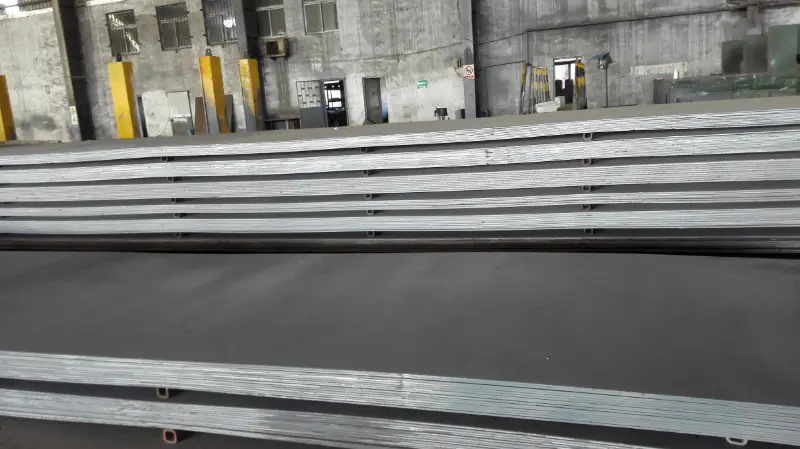
RINA Grade F500 Shipbuilding Steel Plate
RINA Grade F500 Shipbuilding Steel Plate - High Strength Quenched & Tempered Steel for Marine Structures
Comprehensive data for RINA Grade F500 shipbuilding steel plate: chemical composition, mechanical properties, thermal and electrical physical properties, international equivalents, and application guide.
Cutting, welding, cold forming, hot forming, machining
- Phone : +8618037372205
- Email : [email protected]
- WhatsApp: Contact via Whtsapp
- WeChat: +8618037372205
RINA Grade F500 Shipbuilding Steel Plate Introduction
RINA Grade F500 is a high strength quenched and tempered steel plate certified by the Registro Italiano Navale (RINA) for shipbuilding and offshore structural applications. With a minimum yield strength of 500 MPa and excellent low‑temperature toughness down to -60°C (F-grade), it is specifically designed for critical load‑bearing components in harsh marine environments. The fine‑grained microstructure ensures a favorable combination of high strength, good weldability, and ductility. This grade is typically supplied in the normalized or quenched and tempered condition and complies with the requirements of RINA Part D, Chapter 3 – Materials for Hull Structures. It is used for hull frames, deck girders, offshore platform legs, and other heavy‑duty structural members where weight savings and high reliability are essential.
RINA Grade F500 Shipbuilding Steel Plate Chemical Composition - Typical Heat Analysis according to RINA Part D, Ch.3 for Grade F500
The chemical composition is controlled to achieve high strength and excellent low‑temperature toughness. Maximum levels are specified for carbon, phosphorus, and sulfur, while alloying elements such as manganese, chromium, nickel, and molybdenum are added to improve hardenability and tempering resistance. The steel is fully killed and typically fine‑grain treated with aluminum. Microalloying elements such as vanadium, niobium, and titanium may be present individually or in combination.
| Element | Standard Value (max or range) | Remarks |
|---|---|---|
| Carbon (C) | ≤ 0.20 | Ladle analysis |
| Silicon (Si) | ≤ 0.60 | Ladle analysis |
| Manganese (Mn) | ≤ 1.70 | Ladle analysis |
| Phosphorus (P) | ≤ 0.025 | Ladle analysis |
| Sulfur (S) | ≤ 0.015 | Ladle analysis |
| Chromium (Cr) | ≤ 1.50 | Optional; improves hardenability |
| Nickel (Ni) | ≤ 2.0 | Optional; enhances toughness at low temperature |
| Molybdenum (Mo) | ≤ 0.70 | Optional; retards temper softening |
| Vanadium (V) | ≤ 0.12 | Microalloying; grain refiner |
| Niobium (Nb) | ≤ 0.06 | Microalloying; grain refiner |
| Titanium (Ti) | ≤ 0.05 | Microalloying; nitrogen binding |
| Aluminum (Al) total | ≥ 0.015 | Fine grain practice |
| Nitrogen (N) | ≤ 0.015 | Unless sufficient nitride formers present |
| Boron (B) | ≤ 0.005 | If added for hardenability |
RINA Grade F500 Shipbuilding Steel Plate Thermal and Electrical Physical Properties
These physical properties are representative for quenched and tempered low‑alloy steels similar to F500. Actual values may vary slightly with exact chemical composition and heat treatment condition. The data is provided for general design and engineering calculations.
| Property | Typical Value | Unit | Condition / Remarks |
|---|---|---|---|
| Density (ρ) | 7.85 | g/cm³ | 20 °C |
| Elastic Modulus (E) | 210 | GPa | 20 °C, dynamic |
| Shear Modulus (G) | 81 | GPa | 20 °C, calculated from E and ν |
| Poisson's Ratio (ν) | 0.3 | — | 20 °C, elastic range |
| Coefficient of Thermal Expansion (α) | 12.0 × 10⁻⁶ | /K | 20–100 °C |
| Coefficient of Thermal Expansion (α) | 12.8 × 10⁻⁶ | /K | 20–200 °C |
| Coefficient of Thermal Expansion (α) | 13.5 × 10⁻⁶ | /K | 20–400 °C |
| Thermal Conductivity (λ) | 39 | W/(m·K) | 20 °C |
| Specific Heat Capacity (c) | 460 | J/(kg·K) | 20 °C |
| Electrical Resistivity (ρ_e) | 0.24 | μΩ·m | 20 °C |
RINA Grade F500 Shipbuilding Steel Plate Mechanical Properties – Longitudinal Specimens, Q+T Condition, Plate Thickness ≤ 50 mm
Mechanical properties are verified by tensile and impact tests in accordance with RINA rules. The minimum yield strength (ReH) applies to upper yield or 0.2% offset proof strength. Impact energy (KV) is measured on Charpy V-notch specimens at -60 °C for grade F. Bend test is performed with a mandrel diameter of 3 times the specimen thickness (t) for plates ≤ 50 mm. Values depend on product thickness; the table below reflects typical guaranteed minimums for plates up to 50 mm.
| Property | Standard Required Value | Unit | Test Condition |
|---|---|---|---|
| Yield Strength (ReH) | ≥ 500 | MPa | RT, transverse, t ≤ 50 mm |
| Tensile Strength (Rm) | 600 – 770 | MPa | RT, transverse |
| Elongation (A) | ≥ 17 | % | Gauge length 5.65√So, t ≤ 50 mm |
| Elongation (A) | ≥ 16 | % | Gauge length 5.65√So, 50 < t ≤ 100 mm |
| Impact Energy (KV) -60°C | ≥ 50 (long.) / 33 (trans.) | J | Charpy V, average of 3 tests |
| Impact Energy (KV) -60°C min. single | ≥ 70% of average | J | Individual value |
| Bend Test (Mandrel Diameter) | 3t (t = specimen thickness) | — | 180° bend, no cracks |
RINA Grade F500 Shipbuilding Steel Plate Fully Equivalent Material Standards and Replaceable Designations
| Country / Region | Standard | Grade | Remarks |
|---|---|---|---|
| EU | EN 10025-6 | S500Q / S500QL / S500QL1 | Quenched and tempered structural steel with yield strength 500 MPa; QL with specified low temperature toughness (up to -60°C). Similar chemical and mechanical requirements. |
| International | RINA Rules Part D | F500 | Original certification mark. |
| Germany / EU | DNV GL | NV F500 | DNV GL modulus for ship and offshore structures, identical minimum requirements. |
| USA | ABS Rules | EQ51 / EQ47 (adjust for yield) | ABS higher strength quenched and tempered steels; EQ51 has yield 500 MPa ±. Verify toughness class. |
| France | BV Rules | B500 | Bureau Veritas high strength grade with similar properties. |
| UK | LR Rules | FH500 or AH50 | Lloyd's Register designation for 500 MPa yield strength quenched and tempered steel; toughness class F (-60°C). |
| China | CCS Rules | F500 | China Classification Society adopts similar notation for 500 MPa yield, -60°C impact. |
| Japan | NK Rules | KF500 | Nippon Kaiji Kyokai grade for high strength hull steel. |
RINA Grade F500 Shipbuilding Steel Plate Application Introduction
RINA Grade F500 is employed in demanding marine and offshore structural applications where high strength, good fatigue resistance, and reliable low‑temperature toughness are critical. Its quenched and tempered condition ensures a fine‑grained microstructure that balances strength with sufficient ductility for cold forming and welding. The material is typically delivered in plates up to 100 mm thickness, subject to mill qualification and RINA surveyor inspection.
Product Applications: Hull bottom and side shell plates, Deck girders and stiffeners, Heavy‑lift crane pedestals, Offshore module structural frames, Jack‑up rig leg chords and rack teeth, Arctic‑class vessel ice belts
Processed into products: Welded built‑up sections (T‑bars, bulb flats, box girders), Flame‑cut shaped blanks for pad eyes and brackets, Molded shell plates with cold forming, Machined bolted connections and pin holes, Forged flanges and transition pieces (wrought from plate)
Application industries: Shipbuilding (military and commercial vessels), Offshore oil & gas (jackets, decks, platforms), Renewable energy (offshore wind turbine substructures), Heavy machinery (crane booms, excavators), Bridge engineering, Pressure vessels (with additional approval)
RINA Grade F500 Shipbuilding Steel Plate Similar / Closely Matching Alternative Materials
| Country / Region | Standard | Grade | Remarks |
|---|---|---|---|
| EU | EN 10025-6 | S550Q | Slightly higher yield (550 MPa) but often used interchangeably when strength can be higher; toughness class QL may be needed. |
| EU | EN 10025-6 | S460Q | Lower yield strength (460 MPa); may be substituted if design allows for lower strength, with better weldability. |
| EU | EN 10025-4 | S500M | Thermomechanical rolled steel with 500 MPa yield; typically limited to lower thickness and higher temperature toughness. Not a full match for -60°C impact. |
| Germany / EU | SEW 092 | QStE 500 TM | Thermomechanical steel with similar yield; suitable for cold forming but may not cover the required low‑temperature toughness. |
| USA | ASTM A514 / A517 | Grade B/H/S | Quenched and tempered alloy steel plates with yield ~690 MPa; higher strength, requires careful welding procedure. Can be down‑gauge substitute. |
Notes:
- Welding must follow approved procedures with appropriate preheating and low‑hydrogen consumables to avoid cold cracking.
- Post‑weld heat treatment (PWHT) is not normally required for thicknesses below 50 mm, but may be specified when local regulations or service conditions demand stress relief.
- RINA surveyor involvement is mandatory for material certification; mill certificates (3.1 or 3.2 per EN 10204) are issued.
- For plates above 50 mm, mechanical property values (especially elongation and impact energy) may be subject to adjusted requirements per RINA Rules.
- If the steel is to be used in sour service (H₂S environments), additional tests for hydrogen‑induced cracking (HIC) and sulfide stress cracking (SSC) may be required.
- Share



