
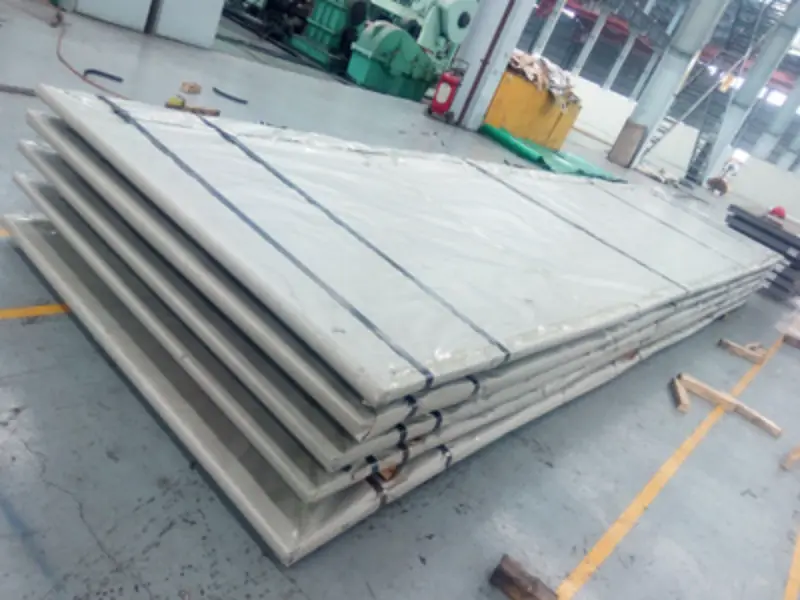
RINA Grade F460 Shipbuilding Steel Plate
RINA Grade F460 Shipbuilding Steel Plate - High Strength Quenched & Tempered Offshore Structural Steel
Comprehensive technical data for RINA Grade F460 steel plate: chemical composition, mechanical properties, thermal & electrical physical properties, equivalent grades, and application guide.
Hot rolling, quenching and tempering, welding, cold forming (limited), cutting
- Phone : +8618037372205
- Email : [email protected]
- WhatsApp: Contact via Whtsapp
- WeChat: +8618037372205
RINA Grade F460 Shipbuilding Steel Plate Introduction
RINA Grade F460 is a high strength quenched and tempered (Q&T) structural steel for shipbuilding and offshore applications, certified by the Italian classification society Registro Italiano Navale (RINA). It is designed to achieve a minimum yield strength of 460 MPa in thicknesses up to 50 mm, with excellent toughness down to -20°C.
This steel grade belongs to the high tensile category defined by the International Association of Classification Societies (IACS) UR W11, which ensures superior weldability, good formability, and high resistance to brittle fracture. It is widely used in critical parts of ship hulls, offshore platforms, and marine equipment where weight reduction without sacrificing structural integrity is crucial.
- Excellent strength-to-weight ratio
- Good low-temperature impact toughness (KV ≥ 31 J at -20°C)
- Strict control of impurities (P, S) for improved cleanliness and weldability
- Available in quenched and tempered condition
RINA Grade F460 Shipbuilding Steel Plate Chemical Composition , Ladle Analysis
The chemical composition of RINA Grade F460 complies with IACS UR W11 for high strength quenched and tempered steels. Values shown are the maximum limits unless a range is given. Microalloying elements such as Nb, V, Ti and controlled nitrogen ensure fine grain size and improved toughness. Total aluminium content is specified as acid-soluble aluminium (Als) to guarantee adequate deoxidation.
| Element | Standard Value (%) | Remarks |
|---|---|---|
| Carbon (C) | ≤ 0.18 | Ladle analysis |
| Silicon (Si) | 0.10 – 0.55 | Ladle analysis |
| Manganese (Mn) | 0.90 – 1.70 | Ladle analysis |
| Phosphorus (P) | ≤ 0.025 | Ladle analysis |
| Sulfur (S) | ≤ 0.025 | Ladle analysis |
| Chromium (Cr) | ≤ 0.80 | Ladle analysis |
| Nickel (Ni) | ≤ 1.00 | Ladle analysis |
| Molybdenum (Mo) | ≤ 0.50 | Ladle analysis |
| Copper (Cu) | ≤ 0.50 | Ladle analysis |
| Niobium (Nb) | ≤ 0.05 | Ladle analysis |
| Vanadium (V) | ≤ 0.10 | Ladle analysis |
| Titanium (Ti) | ≤ 0.05 | Ladle analysis |
| Aluminium (Als) | ≥ 0.015 | Acid-soluble, minimum |
| Nitrogen (N) | ≤ 0.020 | Ladle analysis |
| Boron (B) | ≤ 0.0005 | Optional; if added, must be reported |
RINA Grade F460 Shipbuilding Steel Plate Thermal and Electrical Physical Properties
The physical data given below are typical for low-alloy quenched and tempered steels and can be used for engineering calculations. Thermal expansion is given for the temperature range 20–100°C. Thermal conductivity and specific heat capacity are provided for room temperature. These values are not part of the RINA material certificate but are useful for design.
| Property | Typical Value | Unit | Test Conditions |
|---|---|---|---|
| Density (ρ) | 7850 | kg/m³ | At 20°C |
| Elastic modulus (E) | 205 | GPa | At 20°C; tension |
| Shear modulus (G) | 80 | GPa | Calculated from E and ν |
| Poisson's ratio (ν) | 0.3 | – | In elastic range |
| Thermal expansion coeff. (α) | 12.0 | ×10⁻⁶/K | 20–100°C |
| Thermal conductivity (λ) | 50 | W/(m·K) | At 20°C |
| Specific heat capacity (c) | 460 | J/(kg·K) | At 20°C |
| Electrical resistivity (ρₑ) | 0.25 | μΩ·m | At 20°C |
RINA Grade F460 Shipbuilding Steel Plate Mechanical Properties
The following mechanical properties are required by RINA Rules for Grade F460 plates in the quenched and tempered condition. Tests are performed on transverse specimens unless otherwise stated. Impact testing is carried out at -20°C (longitudinal, KV min. 31 J). Bend test is performed with a former diameter of 3 times the specimen thickness (180° bend) without cracking.
| Property | Required Value | Unit | Test Conditions |
|---|---|---|---|
| Yield strength (ReH) | ≥ 460 | MPa | Thickness t ≤ 50 mm; transverse |
| Tensile strength (Rm) | 570 – 720 | MPa | Thickness t ≤ 50 mm; transverse |
| Elongation (A) | ≥ 17 | % | Gauge length 5.65√S₀; longitudinal |
| Impact energy (KV) | ≥ 31 (average) | J | -20°C; longitudinal; 3 specimens; single min. 22 J |
| Bend test (former diameter) | 3 × t | – | 180° bend; no cracks; t = thickness of test piece |
RINA Grade F460 Shipbuilding Steel Plate Fully Equivalent Grades and Standards
The following classification society grades are technically identical to RINA F460 under IACS UR W11. They can be used as direct substitutes subject to the specific society's certification rules.
| Country/Region | Standard | Grade | Remarks |
|---|---|---|---|
| International | DNV GL | NV F460 | DNV rules; Q&T, -20°C impact |
| International | Lloyd's Register (LR) | FH46 | FH46 is the Q&T high-strength grade with 460 MPa yield |
| International | American Bureau of Shipping (ABS) | FH46 | IACS unified requirements |
| International | Bureau Veritas (BV) | FH460 | FH460 denotes high tensile with 460 MPa yield and H-grade toughness |
| International | ClassNK (NK) | KF460 | NK rules equivalent |
| International | Korean Register (KR) | RF460 | Same minimum toughness at -20°C |
| International | China Classification Society (CCS) | F460 | IACS UR W11 aligned |
RINA Grade F460 Shipbuilding Steel Plate Application Introduction
RINA F460 steel is designed for heavily loaded ship and offshore structures where weight savings and high strength are essential. It is suitable for welded fabrication and can be formed with proper precautions. Typical applications and components include:
Product Applications: Hull plates for container ships, bulk carriers, tankers, Deck and bottom longitudinals, Jack-up rig legs and spudcans, Transition pieces for offshore wind monopiles, Offshore module frames and flare booms, Heavy-duty lifting attachments
Processed into products: Web frames and stiffeners, Bulkhead plates, Brackets and doubler plates, Girder flanges, Crane pedestals and boom sections, Offshore foundation nodes and joints
Application industries: Shipbuilding and ship repair, Offshore oil & gas platforms, Renewable energy (offshore wind turbine foundations), Marine crane and lifting equipment, Heavy engineering and construction, Pressure vessels (subject to additional certification)
RINA Grade F460 Shipbuilding Steel Plate Similar & Comparable Materials
These grades offer comparable strength or chemistry but may differ in certification, delivery condition or supplementary requirements. Use with caution and verify conformance to the relevant classification society's rules.
| Country/Region | Standard | Grade | Remarks |
|---|---|---|---|
| Europe | EN 10025-6 | S460Q / S460QL / S460QL1 | Structural steels with min. 460 MPa yield, Q&T; not ship class certified but often used in offshore structures; check CEV and impact requirements. |
| USA | ASTM A514 / A517 | Grade S / other grades | High yield quenched & tempered steel plates for structural applications; yield strength typically 690 MPa, higher than F460; may require qualification. |
| China | GB/T 16270 | Q460D / Q460E | High strength structural steel, Q&T; impact test temperature varies; suitable for non-marine applications. |
| International | ISO 4950-2 | S460Q | High yield strength flat products; Q&T, similar to EN 10025-6 S460Q. |
Notes:
This data is based on RINA Rules (IACS UR W11) and typical steel supplier experience. For actual project specifications, consult the latest edition of RINA Rules and the material manufacturer's data sheet. Additional tests such as through-thickness properties (Z35), CTOD, or specific corrosion resistance may be required by the end user.
- Share



