
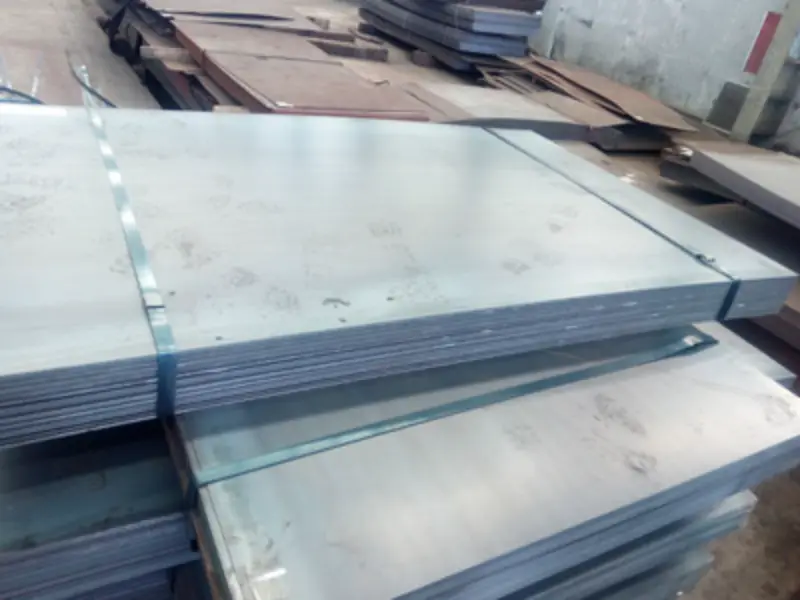
RINA Grade E460 Shipbuilding Steel Plate
RINA Grade E460 Shipbuilding Steel Plate: High Strength Marine Structural Steel
RINA Grade E460 is a high-strength shipbuilding steel plate with a minimum yield strength of 460 MPa, designed for critical marine and offshore structures. It provides excellent weldability, low-temperature toughness, and reliable performance under dynamic loading conditions.
Hot rolling, normalizing, thermo-mechanical controlled processing (TMCP), quenching and tempering (as agreed)
- Phone : +8618037372205
- Email : [email protected]
- WhatsApp: Contact via Whtsapp
- WeChat: +8618037372205
RINA Grade E460 Shipbuilding Steel Plate Introduction
RINA Grade E460 is a high-strength structural steel grade specified by the Registo Italiano Navale (RINA) for use in shipbuilding and offshore engineering. It belongs to the EH460 category under IACS UR W11, indicating a minimum yield strength of 460 MPa and guaranteed impact toughness at -40 °C (E-grade). This steel is produced through controlled rolling, normalizing, or thermo-mechanical controlled processing (TMCP), ensuring fine grain structure and superior mechanical properties. Key features:
- High yield and tensile strength for weight reduction in large structures.
- Excellent toughness at low temperatures, suitable for ice-class vessels and Arctic operations.
- Good weldability with low carbon equivalent values (CEV) to minimize cracking risk.
- Compliance with RINA Part D Chapter 3 and IACS unified requirements.
- Available in plates, wide flats, and sections for hull construction, decks, and stiffeners.
Typical delivery condition is normalized or TMCP, with optional quenched and tempered treatment for thicker sections. The steel is subject to strict impact testing at -40 °C, with minimum absorbed energy of 50 J (longitudinal).
RINA Grade E460 Shipbuilding Steel Plate Chemical Composition
The chemical composition of RINA Grade E460 is designed to achieve high strength while maintaining excellent weldability and toughness. The ladle analysis limits comply with IACS UR W11 for EH460 steels, with additional microalloying elements such as Nb, V, and Ti for grain refinement and precipitation strengthening. Carbon equivalent (CEV) is typically controlled below 0.47% for thickness ≤50 mm to avoid cold cracking during welding.
| Element | Standard Value (wt%) | Remarks |
|---|---|---|
| C | ≤0.20 | Ladle analysis |
| Mn | 0.80–1.70 | Depending on thickness and CEV control |
| Si | ≤0.55 | Deoxidation element |
| P | ≤0.025 | For low temperature toughness |
| S | ≤0.025 | For improved ductility and through-thickness properties |
| Al (total) | ≥0.015 | Fine grain practice |
| Nb | ≤0.05 | Grain refinement element |
| V | ≤0.10 | Precipitation strengthening |
| Ti | ≤0.02 | Grain refinement and inclusion control |
| Cu | ≤0.35 | Residual or added for corrosion resistance |
| Cr | ≤0.25 | Optional addition |
| Ni | ≤0.80 | Optional for toughness improvement |
| Mo | ≤0.08 | Optional addition |
| N | ≤0.012 | Total nitrogen content |
| CEV | ≤0.47 (t ≤50 mm) | CEV = C + Mn/6 + (Cr+Mo+V)/5 + (Ni+Cu)/15 |
RINA Grade E460 Shipbuilding Steel Plate Thermal and Electrical Physical Properties
The physical properties provided are typical values for a C-Mn high-strength structural steel at room temperature unless otherwise noted. These values are useful for engineering calculations, including weight estimation, thermal expansion analysis, and heat transfer simulations. Slight variations may occur depending on exact chemical composition and heat treatment condition.
| Property | Standard Value | Unit | Test Conditions |
|---|---|---|---|
| Density (ρ) | 7.85 | g/cm³ | At 20 °C |
| Modulus of elasticity (E) | 210 | GPa | Room temperature |
| Shear modulus (G) | approx. 80 | GPa | Room temperature |
| Poisson's ratio (ν) | 0.3 | – | Room temperature |
| Thermal expansion coefficient (α) | 11.5 x10⁻⁶ | K⁻¹ | 20–100 °C |
| Thermal conductivity (λ) | approx. 50 | W/(m·K) | At 20 °C |
| Specific heat capacity | approx. 460 | J/(kg·K) | At 20 °C |
| Electrical resistivity (ρ_e) | approx. 0.20 | µΩ·m | At 20 °C |
RINA Grade E460 Shipbuilding Steel Plate Mechanical Properties
The mechanical properties of RINA Grade E460 steel plates are determined according to tensile and impact testing requirements in RINA rules. Yield strength and tensile strength are specified for different thickness ranges. Charpy V-notch impact tests are performed at -40 °C, with minimum absorbed energy values for longitudinal and transverse specimens. Bending tests require a 180° bend over a specified former diameter without cracking.
| Property | Standard Value | Unit | Test Conditions |
|---|---|---|---|
| Yield strength (ReH) | ≥460 | MPa | Thickness ≤50 mm, transverse |
| Yield strength (ReH) | ≥450 | MPa | 50 mm < thickness ≤70 mm |
| Yield strength (ReH) | ≥440 | MPa | 70 mm < thickness ≤100 mm |
| Tensile strength (Rm) | 570–720 | MPa | Thickness ≤100 mm, transverse |
| Elongation (A5) | ≥17 | % | Gauge length 5.65√S₀, thickness ≤50 mm |
| Elongation (A5) | ≥17–15 | % | Thickness 50–100 mm (depending on specification) |
| Charpy impact energy (KV2) | ≥50 | J | Longitudinal, -40 °C, 10x10 mm specimen |
| Charpy impact energy (KV2) | ≥34 | J | Transverse, -40 °C, 10x10 mm specimen |
| Bend test (180°) | No cracks | – | Bend former diameter = 3a (a = plate thickness) |
RINA Grade E460 Shipbuilding Steel Plate Completely Equivalent Material Standards and Replaceable Grades
| Country/Region | Standard | Grade | Note |
|---|---|---|---|
| International | IACS UR W11 | EH460 | Unified requirement for high strength hull structural steel |
| USA | ABS | EH460 | American Bureau of Shipping equivalent |
| France | BV | EH460 | Bureau Veritas equivalent |
| Norway/Germany | DNV GL | VL E460 | DNV GL rules for ships |
| UK | LR | EH460 | Lloyd's Register equivalent |
| South Korea | KR | EH460 | Korean Register equivalent |
| Japan | NK | KE460 | Nippon Kaiji Kyokai equivalent |
| China | CCS | EH460 | China Classification Society equivalent |
RINA Grade E460 Shipbuilding Steel Plate Application Introduction
RINA Grade E460 steel is primarily used in the construction of seagoing vessels and offshore structures where high strength and excellent low-temperature toughness are required. It is suitable for critical structural components subjected to heavy loads and harsh environments.
Product Applications: Hull plates and shells, Deck plates and bulkheads, Longitudinal and transverse stiffeners, Offshore platform legs and nodes, Deckhouses and superstructures, Hatch coamings and crane pedestals
Processed into products: Main deck plating, Bottom and side shell plates, Inner bottom plates, Web frames and girders, Stringers and stiffening bars, Bulkhead plates, Reinforcement pads and brackets
Application industries: Shipbuilding (cargo ships, tankers, bulk carriers, container vessels), Offshore engineering (platforms, FPSOs, subsea structures), Marine and port equipment, Ice-class vessels and Arctic structures
RINA Grade E460 Shipbuilding Steel Plate Similar or Alternative Material Recommendations
| Country/Region | Standard | Grade | Note |
|---|---|---|---|
| International | IACS UR W11 | EH420 | Lower yield strength (420 MPa) but same toughness level |
| International | IACS UR W11 | EH500 | Higher yield strength (500 MPa) for heavier loading |
| EU | EN 10025-4 | S460M/ML | Thermomechanical rolled structural steel; not ship-class certified but comparable mechanical properties |
| EU | EN 10025-6 | S460Q/QL | Quenched and tempered grade with similar strength; requires evaluation for marine use |
Notes:
Special requirements:
- Through-thickness properties (Z-quality) can be supplied according to RINA rules or EN 10164 to prevent lamellar tearing under high restraint.
- Ultrasonic testing in accordance with EN 10160 or equivalent can be specified for critical applications.
- Delivery condition may include normalizing rolling or TMCP with specific heat treatment agreed upon order.
- Steel shall be manufactured from fully killed fine grain steel.
- Impact test temperature for E460 is -40 °C, unless otherwise specified for special applications.
- Share



