
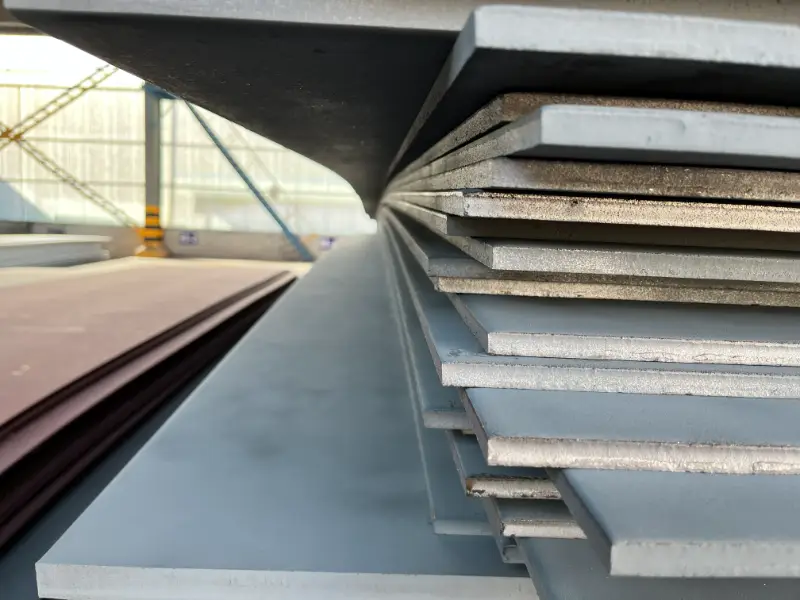
RINA Grade D460 Shipbuilding Steel Plate
RINA Grade D460 Shipbuilding Steel Plate: High-Strength Marine Structural Steel with -20°C Toughness
Comprehensive material data for RINA Grade D460 shipbuilding steel plate, including chemical composition, mechanical properties, and thermal-physical properties. Ideal for hull structures, offshore platforms, and heavy welded components.
Thermo-mechanical controlled process (TMCP), normalised rolling, cutting, cold forming, welding
- Phone : +8618037372205
- Email : [email protected]
- WhatsApp: Contact via Whtsapp
- WeChat: +8618037372205
RINA Grade D460 Shipbuilding Steel Plate Introduction
RINA Grade D460 is a high-strength, weldable structural steel plate specified by the Italian Classification Society RINA for shipbuilding and marine applications. It belongs to the 460 MPa minimum yield strength category with guaranteed impact toughness at -20°C (at least 31 J longitudinal). This normalized or thermo-mechanically rolled steel offers an excellent balance of strength, toughness, and weldability, making it suitable for critical hull members, decks, and bottom structures of large vessels.
Key features include:
- Minimum yield strength of 460 MPa for plates up to 50 mm thickness
- Good low-temperature toughness down to -20°C
- Controlled chemistry with microalloying (Nb, V, Ti) to refine grain size and enhance properties
- Compliance with RINA Part D requirements
- Weldable by all common methods without excessive preheat
This grade is equivalent to IACS DH460 and EN 10025-4 S460M, ensuring global acceptance in marine construction.
RINA Grade D460 Shipbuilding Steel Plate Chemical Composition
The chemical composition conforms to RINA Rules Part D. Microalloying elements such as niobium, vanadium and titanium are added for grain refinement and precipitation strengthening. Phosphorus and sulphur are strictly controlled to ensure good toughness and weldability. Carbon equivalent (CEV) is limited to guarantee weldability. Typical limits based on thickness ≤ 50 mm.
| Element | Specified Value (%) | Remarks |
|---|---|---|
| C | ≤ 0.20 | Maximum |
| Si | 0.10 – 0.55 | Typical range |
| Mn | 0.90 – 1.70 | Required |
| P | ≤ 0.025 | Maximum |
| S | ≤ 0.025 | Maximum |
| Al (total) | ≥ 0.015 | Minimum, for grain refinement |
| N | ≤ 0.020 | Maximum |
| Nb | 0.02 – 0.05 | Optional, fine grain |
| V | 0.05 – 0.10 | Optional, precipitation hardening |
| Ti | ≤ 0.02 | Optional, weldability improvement |
| Cu | ≤ 0.35 | Maximum |
| Cr | ≤ 0.25 | Maximum |
| Ni | ≤ 0.40 | Maximum |
| Mo | ≤ 0.08 | Maximum |
| CEV | ≤ 0.42 (typical) | C + Mn/6 + (Cr+Mo+V)/5 + (Ni+Cu)/15 |
RINA Grade D460 Shipbuilding Steel Plate Thermal and Electrical Physical Properties
These values are representative of similar low-carbon microalloyed steels and are provided for design calculations. They are not mandatory specification requirements and may vary slightly depending on exact chemical composition and heat treatment.
Density: 7.85 g/cm³ · Elastic modulus: 205 GPa · Poisson ratio: 0.3.
| Property | Typical Value | Unit | Reference Condition |
|---|---|---|---|
| Density (ρ) | ~7850 | kg/m³ | Room temperature |
| Modulus of elasticity (E) | ~205 | GPa | Room temperature |
| Shear modulus (G) | ~79.3 | GPa | Room temperature |
| Poisson ratio (ν) | ~0.3 | – | Room temperature |
| Thermal expansion coefficient (α) | ~11.5 × 10⁻⁶ | K⁻¹ | 20 – 100 °C |
| Thermal conductivity (λ) | ~50 | W/(m·K) | Room temperature |
| Specific heat capacity | ~460 | J/(kg·K) | Room temperature |
| Electrical resistivity (ρ_e) | ~0.17 | μΩ·m | Room temperature |
RINA Grade D460 Shipbuilding Steel Plate Mechanical Properties
Mechanical properties are tested on transverse or longitudinal specimens as per RINA requirements. Yield strength, tensile strength, and elongation depend on plate thickness. Charpy V-notch impact tests are performed at -20 °C. Bending test ensures formability without cracking. Values represent minimum requirements unless a range is given.
| Property | Specified Value | Unit | Test Conditions |
|---|---|---|---|
| Yield strength (ReH) | ≥ 460 | MPa | t ≤ 50 mm |
| Yield strength (ReH) | ≥ 440 | MPa | 50 < t ≤ 70 mm |
| Yield strength (ReH) | ≥ 420 | MPa | 70 < t ≤ 100 mm |
| Tensile strength (Rm) | 570 – 720 | MPa | t ≤ 100 mm |
| Elongation (A) | ≥ 17 | % | t ≤ 50 mm, gauge length 5.65√So |
| Elongation (A) | ≥ 16 | % | 50 < t ≤ 70 mm |
| Elongation (A) | ≥ 15 | % | 70 < t ≤ 100 mm |
| Bend test (bend angle 180°) | d = 3a | – | t ≤ 50 mm, a = specimen thickness |
| Bend test (bend angle 180°) | d = 4a | – | 50 < t ≤ 100 mm |
| Charpy V-notch impact (KV) longitudinal | ≥ 31 | J | -20 °C |
| Charpy V-notch impact (KV) transverse | ≥ 24 | J | -20 °C |
RINA Grade D460 Shipbuilding Steel Plate Exact Equivalent Material Standards & Substitute Grades
| Country / Region | Standard | Grade | Remarks |
|---|---|---|---|
| International | IACS UR W31 | DH460 | Identical toughness (-20 °C) and strength requirements |
| China | GB/T 712-2011 | DH460 | Grade D460 high-strength hull structural steel |
| European Union | EN 10025-4 | S460M (thermo-mechanical rolled) | Optionally with -20 °C impact (quality M2), equivalent strength |
| USA | ASTM A131/A131M | DH460 | Grade DH460 shipbuilding steel |
| Japan | JIS G 3106 | SM570 | Weldable high-strength steel, min. yield 460 MPa; note different classification |
| Other Classification Societies | ABS / BV / DNV / LR Rules | DH460 | Equivalent -20 °C high-strength ship plate |
RINA Grade D460 Shipbuilding Steel Plate Application Introduction
RINA D460 steel plates are designed for heavy-duty welded structures in marine environments. Their high strength allows weight reduction without sacrificing safety. Typical fabrication involves gas cutting, cold forming, and multi-pass welding with low-hydrogen procedures. Preheating is generally not required for moderate thickness, thanks to the low carbon equivalent.
Components are often used in critical areas where high fatigue resistance and brittle fracture prevention are essential.
Product Applications: Hull shell plates (side and bottom), Strength deck plates and deck longitudinals, Transverse bulkheads and web frames, Bottom floors and girder plates, Structural nodes and transition pieces in offshore jackets
Processed into products: Ship hull stiffeners (T-beams, angles), Bracket plates and knees, Keel plates and bilge strakes, Reinforcement pads for portholes and hatches, Cut-outs for welded penetrations in pressure bulkheads
Application industries: Shipbuilding (bulk carriers, container ships, tankers), Offshore engineering (jack-up rigs, platforms), Marine structures (bridges, lock gates), Military and naval vessels (hull and structural parts), Heavy machinery (crane booms, welded pressure parts)
RINA Grade D460 Shipbuilding Steel Plate Similar / Near-Equivalent Materials for Comparison
| Country / Region | Standard | Grade | Remarks |
|---|---|---|---|
| International | IACS UR W31 | EH460 | Higher toughness at -40 °C, otherwise similar chemistry and strength |
| International | IACS UR W31 | FH460 | Ultra-low-carbon bainitic, -60 °C impact, similar yield |
| European Union | EN 10025-6 | S460QL (quenched and tempered) | Min. yield 460 MPa, different processing route, good weldability |
| European Union | EN 10025-3 | S460N (normalised) | Normalised fine-grain steel, yield 460 MPa, suitable for lower thickness |
| China | GB/T 1591-2018 | Q460D | Low-alloy high-strength structural steel, -20 °C impact, similar strength |
| USA | ASTM A572/A572M | Grade 65 | Yield 450 MPa (similar), but not specifically marine certified |
Notes:
Additional Requirements: Plates typically undergo ultrasonic testing as per RINA rules. Surface quality and flatness tolerances comply with RINA standards. For thinnest gauges (< 10 mm), some property values may be adjusted; consult the material certificate.
Welding consumables should match the strength level and toughness requirements. Post-weld heat treatment is not normally applied but may be specified for certain thicknesses.
- Share



