
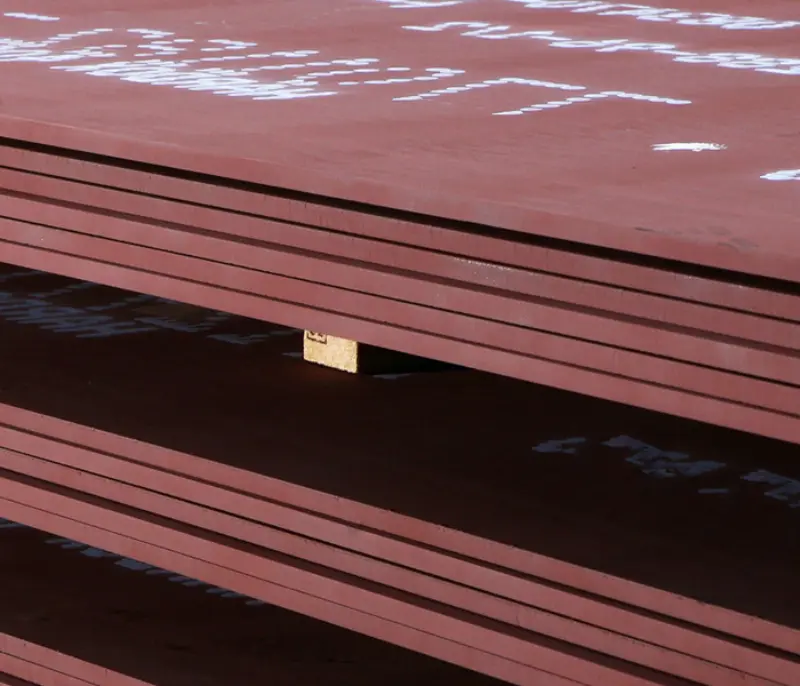
RINA Grade A460 Shipbuilding Steel Plate
RINA Grade A460 Shipbuilding Steel Plate: High-Strength Marine Grade for Extreme Loads
Comprehensive technical data for RINA Grade A460 shipbuilding steel plate, including chemical composition, mechanical properties, thermal and electrical physical properties, international equivalents, and application guidance.
Thermomechanical rolling (TMCP), normalizing, quenching and tempering (optional), cutting, welding, forming
- Phone : +8618037372205
- Email : [email protected]
- WhatsApp: Contact via Whtsapp
- WeChat: +8618037372205
RINA Grade A460 Shipbuilding Steel Plate Introduction
RINA Grade A460 is a high-strength structural steel plate certified by the Italian Classification Society (RINA) for shipbuilding and offshore applications. It belongs to the high-strength fine-grain steel group with a specified minimum yield strength of 460 MPa.
- Excellent weldability and toughness at 0°C (Grade A).
- Supplied in normalized or thermomechanically rolled (TMCP) condition.
- Suitable for critical hull members, decks, and offshore structures subject to high static and dynamic loads.
RINA Grade A460 Shipbuilding Steel Plate Chemical Composition
Typical ladle analysis according to RINA Rules. All values are maximum unless range or minimum specified. Microalloying elements (Nb, V, Ti) may be added singly or in combination to achieve fine-grain strengthening.
| Chemical Element | Nominal Value | Remarks |
|---|---|---|
| Carbon (C) | ≤ 0.18 | Max |
| Silicon (Si) | ≤ 0.50 | Max |
| Manganese (Mn) | 0.90 - 1.60 | Range |
| Phosphorus (P) | ≤ 0.035 | Max |
| Sulfur (S) | ≤ 0.035 | Max |
| Aluminum (Al) total | ≥ 0.015 | Min, if used as grain refiner |
| Niobium (Nb) | ≤ 0.05 | Max |
| Vanadium (V) | ≤ 0.10 | Max |
| Titanium (Ti) | ≤ 0.02 | Max |
| Copper (Cu) | ≤ 0.35 | Max |
| Chromium (Cr) | ≤ 0.20 | Max |
| Nickel (Ni) | ≤ 0.40 | Max |
| Molybdenum (Mo) | ≤ 0.08 | Max |
| Nitrogen (N) | ≤ 0.012 | Max |
RINA Grade A460 Shipbuilding Steel Plate Thermal and Electrical Physical Properties
Representative values for structural steel at room temperature. Variations may occur with specific heat treatment and exact composition. Thermal expansion measured between 20°C and 100°C.
| Property | Typical Value | Unit | Test Condition |
|---|---|---|---|
| Density (ρ) | 7850 | kg/m³ | Room temperature |
| Modulus of Elasticity (E) | 205 | GPa | Room temperature |
| Shear Modulus (G) | 80 | GPa | Room temperature |
| Poisson's Ratio (ν) | 0.30 | - | Room temperature |
| Thermal Expansion Coefficient (α) | 12.0 × 10⁻⁶ | K⁻¹ | 20-100°C |
| Thermal Conductivity (λ) | 45.0 | W/(m·K) | Room temperature |
| Specific Heat Capacity | 460 | J/(kg·K) | Room temperature |
| Electrical Resistivity (ρ_e) | 0.25 × 10⁻⁶ | Ω·m | Room temperature |
RINA Grade A460 Shipbuilding Steel Plate Mechanical Properties
Tensile and impact testing at 0°C for Grade A460. Properties apply to plate thicknesses up to 50 mm unless otherwise stated. Transverse test pieces may show slightly lower elongation and impact energy; typical longitudinal values given.
| Property | Standard Requirement | Unit | Test Condition |
|---|---|---|---|
| Yield Strength (ReH) | ≥ 460 | MPa | Room temperature, thickness ≤ 50 mm |
| Tensile Strength (Rm) | 570 - 720 | MPa | Room temperature |
| Elongation (A5) | ≥ 17 | % | Gauge length 5.65√So |
| Impact Energy (KV) longitudinal | ≥ 34 | J | At 0°C, Charpy V-notch |
| Impact Energy (KV) transverse | ≥ 24 | J | At 0°C, Charpy V-notch |
| Bend Test | No cracks | - | Bend angle 180°, mandrel diameter = 3a (a = thickness) |
RINA Grade A460 Shipbuilding Steel Plate Exact Equivalent Standards and Replaceable Grades
| Country/Region | Standard | Grade | Remarks |
|---|---|---|---|
| International (IACS) | Common IACS UR W11 | AH460 | Min 460 MPa yield, 0°C impact |
| USA | ABS | AH460 | Same chemical and mechanical requirements |
| Norway/Germany | DNV | NV A460 | Equivalent to RINA A460 |
| UK | Lloyd's Register (LR) | AH460 | Identical strength and impact class |
| France | Bureau Veritas (BV) | AH460 | Direct equivalent |
| China | CCS | AH460 | Grade AH460, 0°C impact |
| South Korea | KR | AH460 | AH460 in Korean Register |
| Japan | NK (ClassNK) | KA460 | KA460 corresponds to A460 |
RINA Grade A460 Shipbuilding Steel Plate Application Introduction
RINA Grade A460 is designed for highly stressed hull and offshore structural members where weight reduction and high strength are essential. It can be used in ambient temperatures down to 0°C without risk of brittle fracture. Typical processing includes cutting, cold or hot forming, and welding (with appropriate preheating and consumables for high-strength steel).
Product Applications: Container ships, bulk carriers, tankers (deck, hull, bottom plates), Jack-up rig legs and offshore platform topside structures, Pressure hulls for subsea structures, Reinforced structural members in large bridges, Crane booms and heavy lifting equipment
Processed into products: Web frames, stringers, floor plates, Bilge keels and rudder horns, Hatch coaming and corner castings, Transition joints between mild and high-strength steel, Stiffened panels and box girders
Application industries: Shipbuilding, Offshore oil and gas, Renewable offshore energy (wind turbine foundations), Heavy civil engineering, Port and harbor construction
RINA Grade A460 Shipbuilding Steel Plate Similar/Comparative Alternative Grades
| Country/Region | Standard | Grade | Remarks |
|---|---|---|---|
| International | RINA | DH460 | Same strength, improved toughness at -20°C |
| International | RINA | EH460 | Same strength, excellent toughness at -40°C |
| International | RINA | FH460 | Same strength, superior toughness at -60°C |
| EU | EN 10025-4 | S460MLO / S460Q | Offshore structural steel, similar strength, different toughness categories |
| USA | ASTM A514 | Grade B, H, Q (quenched & tempered) | Higher yield (690 MPa), but comparable in some structural heavy-plate applications; requires welding procedure qualification |
Notes:
- Plates can be supplied with through-thickness properties (Z-quality) according to RINA additional requirements for improved lamellar tearing resistance.
- Ultrasonic testing in accordance with EN 10160 or ASTM A578 is often performed for critical applications.
- For thicknesses above 50 mm, yield strength may be slightly reduced (consult mill specific data).
- Welding consumables should match the required strength and toughness level; preheat may be necessary based on plate thickness and carbon equivalent (CEV typically below 0.43 for TMCP condition).
- Share



