
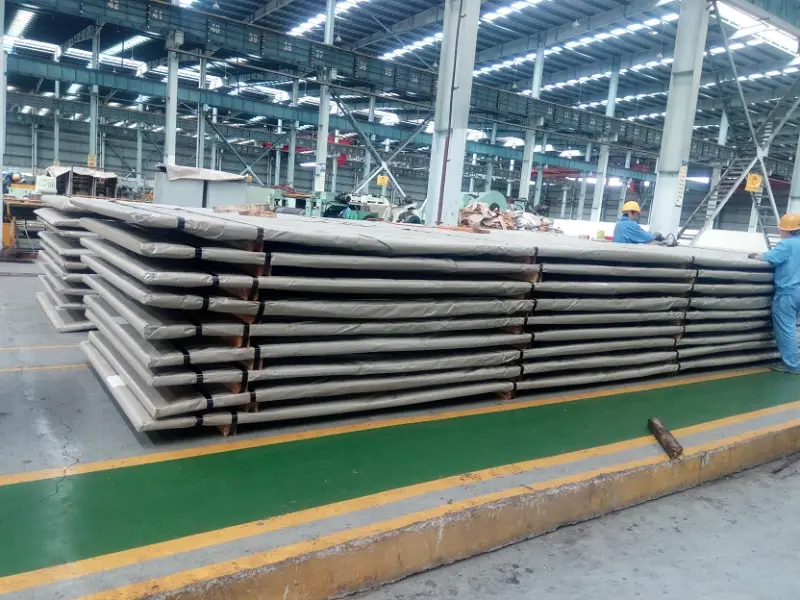
RINA Grade F420 Shipbuilding Steel Plate
RINA Grade F420 Shipbuilding Steel Plate - High Strength TMCP Marine Steel
Detailed material data for RINA Grade F420 shipbuilding steel plate: chemical composition, mechanical properties, thermal and electrical physical properties, international equivalents, and application guide.
Hot rolling, Thermo-Mechanical Control Process (TMCP), Normalizing, Quenching & Tempering (optional)
- Phone : +8618037372205
- Email : [email protected]
- WhatsApp: Contact via Whtsapp
- WeChat: +8618037372205
RINA Grade F420 Shipbuilding Steel Plate Introduction
RINA Grade F420 is a high strength hull structural steel plate certified by the Registro Italiano Navale (RINA). This steel is designed for shipbuilding and marine engineering applications requiring minimum yield strength of 420 MPa and excellent low-temperature toughness down to -40°C. Typically produced through Thermo-Mechanical Control Process (TMCP) or normalizing, it offers an optimal combination of high strength, good weldability and reliable notch toughness. Its chemistry is carefully controlled with microalloying elements to achieve fine grain structure, making it suitable for critical structural components in severe environments.
- Yield strength ≥420 MPa for thickness ≤50 mm
- Superior toughness at -40°C (transverse 27J / longitudinal 41J min)
- Excellent weldability with controlled carbon equivalent
- Compliant with RINA Rules Part D, Chapter 2 and IACS UR W11
RINA Grade F420 Shipbuilding Steel Plate Chemical Composition
The chemical composition complies with RINA Part D, Chapter 2, Section 1 and IACS UR W11. Maximum limits are given unless a range is indicated. Microalloying with Nb, V, Ti ensures grain refinement and precipitation strengthening. The carbon equivalent (CEV) is controlled to guarantee crack-free welding without excessive preheating.
- Fine grain practice: Al ≥0.015% or sufficient other grain refiners.
- Optional additions of Cu, Cr, Ni, Mo may be specified for thickness >50 mm or improved weathering resistance.
- The steel is fully killed and made to fine grain practice.
| Element | Standard Value (max % unless range) | Remarks |
|---|---|---|
| C | 0.20 | Max. Lower for TMCP, typical ≤0.16 |
| Si | 0.10 – 0.55 | Range |
| Mn | 0.90 – 1.60 | Range, higher Mn for strength |
| P | 0.025 | Max, for product analysis ≤0.030 |
| S | 0.025 | Max, for product analysis ≤0.030 |
| Al (total) | ≥0.015 | Fine grain practice, acid-soluble |
| Nb | 0.02 – 0.05 | Typical range (optional), max 0.05 |
| V | 0.05 – 0.10 | Typical range (optional), max 0.10 |
| Ti | ≤0.02 | Optional for grain refinement, max 0.02 |
| Cu | ≤0.35 | Optional, for atmospheric corrosion resistance |
| Cr | ≤0.20 | Optional, max 0.25 for higher thickness |
| Ni | ≤0.40 | Optional |
| Mo | ≤0.08 | Optional, max 0.08 |
| N | ≤0.012 | If not sufficient Al or Ti, total N max 0.009 |
| CEV (IIW) | 0.40 – 0.43 (typical) | Dependent on thickness and TMCP; max agreed |
RINA Grade F420 Shipbuilding Steel Plate Thermal and Electrical Physical Properties
Typical physical properties for low-carbon microalloyed steel at room temperature, unless otherwise noted. These values are indicative and may vary slightly with exact composition and heat treatment condition. They are suitable for engineering design calculations.
- Density is practically constant for all steel grades.
- Thermal conductivity decreases with increasing temperature; value given at 20°C.
- Electrical resistivity also increases with temperature.
| Property | Typical Value | Unit | Test Condition / Remarks |
|---|---|---|---|
| Density (ρ) | 7.85 | g/cm³ | at 20°C |
| Elastic modulus (E) | 210 | GPa | at 20°C, dynamic or static |
| Shear modulus (G) | 81 | GPa | Calculated from E and Poisson's ratio |
| Poisson's ratio (ν) | 0.30 | – | within elastic range |
| Thermal expansion coefficient (α) | 12 | 10⁻⁶/K | between 20°C and 100°C |
| Thermal conductivity (λ) | 52 | W/(m·K) | at 20°C |
| Specific heat capacity | 460 | J/(kg·K) | at 20°C |
| Electrical resistivity (ρ_e) | 0.20 | 10⁻⁶ Ω·m | at 20°C |
RINA Grade F420 Shipbuilding Steel Plate Mechanical Properties
Mechanical properties according to RINA Rules Part D, Chapter 2, Section 4 and IACS UR W11. Transverse test specimens are standard unless longitudinal is agreed. Notch toughness at -40°C is a key requirement for grade F. Yield strength decreases with increasing thickness, as shown in the multiple rows.
- All tensile values are minimum unless a range is given for tensile strength.
- Impact test: average of three specimens, single value ≥70% of specified minimum.
- Bend test: no cracks or ruptures after 180° bending to specified former diameter.
| Property | Standard Requirement | Unit | Test Condition / Remarks |
|---|---|---|---|
| Yield strength (ReH) | ≥420 | MPa | Thickness ≤50 mm, transverse |
| Yield strength (ReH) | ≥400 | MPa | Thickness >50 mm ≤70 mm, transverse |
| Yield strength (ReH) | ≥380 | MPa | Thickness >70 mm ≤100 mm, transverse |
| Tensile strength (Rm) | 530 – 680 | MPa | Thickness ≤100 mm, transverse |
| Elongation (A5) | ≥19 | % | Thickness ≤50 mm, longitudinal (5.65√So) |
| Elongation (A5) | ≥19 | % | Thickness >50 mm ≤70 mm, longitudinal |
| Elongation (A5) | ≥19 | % | Thickness >70 mm ≤100 mm, longitudinal |
| Elongation (A50) | ≥16 | % | When using 50 mm gauge length, transverse |
| Charpy impact (KV) longitudinal | ≥41 | J | At -40°C, thickness ≤100 mm, average |
| Charpy impact (KV) transverse | ≥27 | J | At -40°C, thickness ≤100 mm, average |
| Bend test (180°) – t ≤50 mm | No cracks | – | Former diameter = 3t (t = thickness) |
| Bend test (180°) – 50 < t ≤100 mm | No cracks | – | Former diameter = 4t |
RINA Grade F420 Shipbuilding Steel Plate Equivalent Material Standards and Substitutable Grades
| Country / Region | Standard | Grade | Remarks |
|---|---|---|---|
| International (IACS) | IACS UR W11 | FH420 | Unified requirement for all member societies |
| Norway / Germany (DNV GL) | DNV GL Rules Pt.2 Ch.2 | VL FH420 | Identical technical requirements as RINA F420 |
| USA (ABS) | ABS Rules Part 2, Chapter 1 | FH420 | Grade FH420, strength and toughness matched |
| UK (LR) | LR Rules for Ships, Chapter 3 | FH420 | Same testing and chemistry limits |
| France (BV) | BV Rules Part B, Ch 6 | FH420 | Full equivalence |
| China (CCS) | CCS Rules Part 1, Chapter 3 | FH420 | Same as IACS UR W11 |
| Japan (NK) | NK Rules Part K | FH420 | Grade KFH420, identical properties |
| Korea (KR) | KR Rules Pt.2 Ch.1 | FH420 | Completely interchangeable |
RINA Grade F420 Shipbuilding Steel Plate Application Introduction
RINA F420 steel is used primarily in the marine and offshore sectors. Its high strength allows designers to reduce plate thickness, thereby lowering structural weight without compromising safety. The guaranteed toughness at -40°C makes it ideal for Arctic and cold-water vessels. Typical processing includes flame cutting, cold forming, and welding using standard methods (SAW, SMAW, FCAW) with suitable consumables.
- Preheating is usually unnecessary for moderate thickness TMCP plates; follow manufacturer guidelines.
- Post-weld heat treatment (PWHT) is rarely required but must respect tempering temperature limits.
- Cut surfaces are not prone to hardening thanks to low carbon content.
Product Applications: Large container ships (hatch coamings, sheer strakes), Bulk carriers and tankers (strengthened deck plates, bottom plating), Arctic supply vessels (ice belts, stem plates), Offshore topside modules and helideck structures, Subsea structural components
Processed into products: Longitudinal stiffeners and frames, Transverse web frames and stringers, Shell plates (side and bottom) in high-stress areas, Hatch corners and coamings (high fatigue resistance), Bracket plates and beam knees, Offshore mooring structural parts, Heavy-duty crane booms and pedestal rings
Application industries: Shipbuilding and ship repair (commercial vessels, naval ships), Offshore oil & gas (platforms, FPSO, jackets, modules), Marine engineering (docks, locks, port structures), Ice-going vessels and icebreakers, Heavy lifting and transport equipment (crane pedestals, heavy load structures)
RINA Grade F420 Shipbuilding Steel Plate Similar / Comparable Alternative Materials
| Country / Region | Standard | Grade | Remarks |
|---|---|---|---|
| Europe | EN 10025-4 | S420ML / S420MLO | Thermomechanical rolled steel for offshore structures; min ReH 420 MPa, toughness down to -50°C; slightly different chemistry, suitable for marine applications with agreement |
| USA | ASTM A131 / A131M | FH40 (modified) | FH40 has min 390 MPa yield, but with microalloy adjustment can reach 420 MPa; need technical assessment |
| International | API 2W / 2Y | Grade 50 (420 MPa) | Steel for offshore platforms; similar strength, CTOD tested, often accepted as alternative for non-ship hull components |
| Japan | JIS G 3106 | SM520C / SM570 | SM570 offers min 420 MPa yield for thicker sections, but different noth toughness design; requires verification for marine use |
| China | GB/T 712 | FH420 | Chinese shipbuilding steel, identical to CCS FH420, directly comparable to RINA F420 |
Notes:
- Carbon Equivalent (CEV): For thickness up to 50 mm, CEV ≤0.38% is often specified (TMCP). The general formula is CEV = C + Mn/6 + (Cr+Mo+V)/5 + (Ni+Cu)/15. Consult mill certificate for exact value.
- Weldability: F420 has excellent weldability. Consumables should match the strength and toughness level (e.g., AWS A5.18 ER70S-6 for GMAW, E71T-1 for FCAW, or equivalent with 420 MPa yield). Preheating typically not required for plate thickness <40 mm at ambient temperature.
- Z-direction properties: For improved through-thickness ductility (lamellar tearing resistance), F420 can be ordered with Z-quality (e.g., Z25, Z35) per EN 10164 or IACS recommendation.
- Ultrasonic testing: Plates are normally supplied with UT according to EN 10160 class S1/E1 or equivalent class, ensuring internal soundness.
- Always refer to the original RINA Rules for the exact requirements of the specific project and plate thickness.
- Share



