
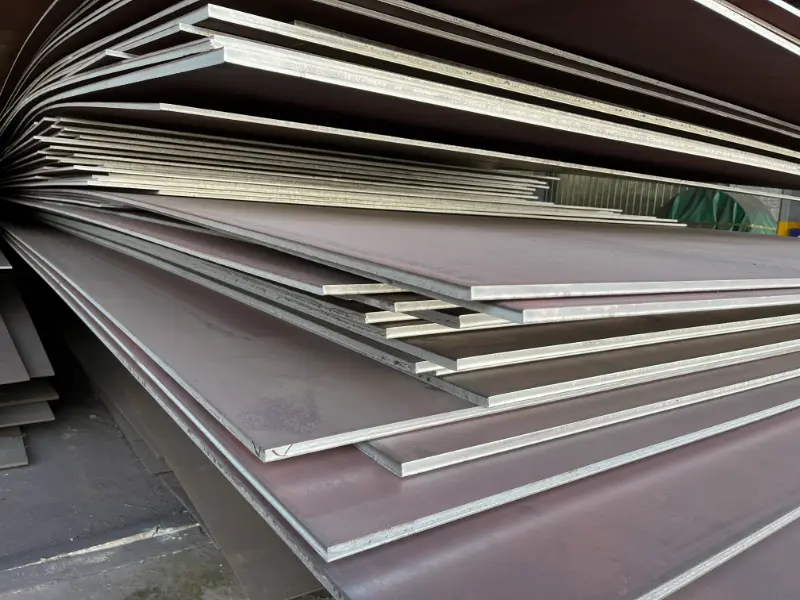
RINA Grade E420 Shipbuilding Steel Plate
RINA Grade E420 Shipbuilding Steel Plate - Comprehensive Material Data & Equivalents
Complete material properties, chemical composition, mechanical values, and thermal characteristics of RINA Grade E420 high-strength hull structural steel plate per RINA Rules 2020. Includes equivalent grades across major classification societies and application guidance for ship and offshore engineering.
Hot rolling, controlled rolling, normalizing (N), thermo-mechanical controlled processing (TMCP), quenching & tempering (when agreed)
- Phone : +8618037372205
- Email : [email protected]
- WhatsApp: Contact via Whtsapp
- WeChat: +8618037372205
RINA Grade E420 Shipbuilding Steel Plate Introduction
RINA Grade E420 is a high-strength, fine-grain structural steel plate primarily used in shipbuilding and offshore construction. It belongs to the EH420 category under IACS UR W11/W13 and is certified by Registro Italiano Navale (RINA). The plate offers a minimum yield strength of 420 MPa and excellent notch toughness down to -40°C, making it suitable for critical hull members and Arctic-grade marine structures. Delivery condition is typically normalized (N) or thermo-mechanically rolled (TM). Key features:
- High strength-to-weight ratio
- Good weldability with controlled carbon equivalent (Ceq ≤ 0.40% for t≤50 mm)
- Fine-grain structure achieved through microalloying (Nb, V, Ti)
- Low-temperature impact resistance (E-grade: ≥27 J at -40°C)
RINA Grade E420 Shipbuilding Steel Plate Chemical Composition
The chemical requirements comply with IACS UR W11 for EH420 grade and RINA additional specifications. The steel is fully killed and fine-grain treated.
- Nb, V, Ti are added singly or in combination to refine grain.
- Carbon equivalent (Ceq) is limited to ensure weldability: Ceq = C + Mn/6 + (Cr+Mo+V)/5 + (Ni+Cu)/15 ≤ 0.40% for thickness ≤ 50 mm; for greater thickness special agreements apply.
- Residual elements (Cu, Cr, Ni, Mo) are controlled to avoid hardenability issues.
| Element | Specified Value (wt.%) | Notes |
|---|---|---|
| Carbon (C) | ≤ 0.21 | Ladle analysis |
| Manganese (Mn) | 0.80 – 1.70 | Depending on thickness and C content |
| Silicon (Si) | 0.10 – 0.55 | Killed steel |
| Phosphorus (P) | ≤ 0.030 | Maximum |
| Sulfur (S) | ≤ 0.030 | Maximum |
| Aluminum (Al) acid soluble | ≥ 0.015 | For fine-grain |
| Niobium (Nb) | 0.02 – 0.05 | Microalloy (single or combined) |
| Vanadium (V) | 0.05 – 0.10 | Microalloy |
| Titanium (Ti) | ≤ 0.02 | Microalloy |
| Copper (Cu) | ≤ 0.35 | Residual |
| Chromium (Cr) | ≤ 0.25 | Residual |
| Nickel (Ni) | ≤ 0.40 | Residual |
| Molybdenum (Mo) | ≤ 0.08 | Residual |
| Nitrogen (N) | ≤ 0.012 | All elements in fine-grain steel |
RINA Grade E420 Shipbuilding Steel Plate Thermal and Electrical Properties
These physical properties are typical for low-alloy structural steel and serve as engineering references. They do not substitute for specific testing.
- Density slightly varies with alloy content; standard value used.
- Thermal expansion is linear up to 400°C; values at 20-100°C are most common.
- Thermal conductivity decreases with increasing temperature.
| Property | Typical Value | Unit | Test Conditions / Remarks |
|---|---|---|---|
| Density (ρ) | 7.85 | g/cm³ | Ambient temperature |
| Elastic modulus (E) | 210 | GPa | Tension, ambient |
| Shear modulus (G) | 80 | GPa | Calculated from E, ν=0.3 |
| Poisson's ratio (ν) | 0.30 | — | Within elastic range |
| Thermal expansion coefficient (α) | 11.5 × 10⁻⁶ | K⁻¹ | 20-100°C |
| Thermal conductivity (λ) | 50 | W/(m·K) | At 20°C |
| Specific heat capacity (cp) | 460 | J/(kg·K) | At 20°C |
| Electrical resistivity (ρ_e) | approx. 0.25 × 10⁻⁶ | Ω·m | At 20°C, carbon steel |
RINA Grade E420 Shipbuilding Steel Plate Mechanical Properties
Test results apply to transverse specimens for plates (unless specified) and are valid for normalized or TMCP condition.
- Tensile test at ambient temperature.
- Charpy V-notch impact test at -40°C for E-grade steel.
- Bending test (180°): no cracks on mandrel diameter 3t.
- For thicknesses > 50 mm, slightly revised values may apply per standard.
| Property | Requirement | Unit | Test Conditions / Remarks |
|---|---|---|---|
| Yield strength (ReH) | ≥ 420 | MPa | Thickness ≤ 50 mm, transverse |
| Tensile strength (Rm) | 530 – 680 | MPa | Transverse |
| Elongation after fracture (A5) | ≥ 19 | % | Gauge length 5.65√S0, transverse, t≤50 mm |
| Charpy impact energy (KV) | ≥ 27 (longitudinal) | J | Temperature: -40°C, V-notch, average of 3 specimens |
| Charpy impact energy (KV) | ≥ 20 (transverse) | J | Temperature: -40°C, V-notch, average of 3 specimens |
| Bend test (mandrel diameter) | 3t (180°) | — | t = specimen thickness, no cracks |
RINA Grade E420 Shipbuilding Steel Plate Exact Equivalent Grades – Global Classification Societies
The following grades are recognized as equivalent to RINA E420 under the respective classification society rules, all following IACS UR W11/W13 for high-strength hull structural steel with minimum 420 MPa yield and -40°C impact toughness.
| Country / Society | Standard | Grade | Remarks |
|---|---|---|---|
| International (ABS) | ABS Rules | EQ47 / EH420 | Same strength & toughness |
| France (BV) | BV Rules | E420 | Identical to RINA E420 |
| China (CCS) | CCS Rules | E420 | Equivalent EH420 |
| Norway (DNV) | DNV Rules | E420 | Also DNV EH420, NVE420 |
| Germany (GL) | GL Rules | E420 | Similar to GL-E420 |
| South Korea (KR) | KR Rules | E420 / RE420 | Equivalency confirmed |
| UK (LR) | LR Rules | E420 | LR EH420 |
| Japan (NK) | NK Rules | KE420 | NK EH420 equivalent |
| Russia (RS) | RS Rules | E420 | RS EH420 |
RINA Grade E420 Shipbuilding Steel Plate Application Introduction
RINA E420 steel plate is ideally suited for heavily loaded ship and offshore structures where high strength allows weight and cost reduction. It is widely used in harsh environments requiring guaranteed low-temperature toughness.
- Shipbuilding: hull plates, deck stringers, sheer strakes, ice-strengthened belts.
- Offshore engineering: jacket legs, platform decks, flare booms.
- Heavy equipment: crane booms, heavy lift vessel structures.
Product Applications: Container ships, bulk carriers, oil tankers, Offshore platforms (jack-up rigs, semi-submersibles), Icebreakers and Arctic supply vessels, Floating production storage and offloading (FPSO) units, Ship unloaders and heavy-duty cranes
Processed into products: Hull bottom and side shell plates, Deck plates and main deck girders, Transverse bulkheads and watertight doors, Stiffeners (frames, longitudinals, girders), Offshore platform braces and node cans, Mooring equipment foundations, Launch and recovery system frames
Application industries: Commercial and naval shipbuilding, Offshore oil & gas exploration and production, Renewable energy (offshore wind turbine foundations), Heavy lifting and transportation equipment, Polar-class vessel construction
RINA Grade E420 Shipbuilding Steel Plate Closely Related / Substitute Steel Grades
These materials are not exact matches but offer similar strength level and toughness, often used where RINA E420 is unavailable or design permits alternatives. Differences in specified minimum impact temperature (e.g., -20°C vs -40°C) and delivery condition must be assessed by the designer.
| Country / Standard | Grade | Typical Use | Remarks |
|---|---|---|---|
| IACS / Common | DH420 / EH460 | Offshore / ship | Higher strength EH460, or DH420 with -20°C impact |
| EN 10025-4 | S420M/ML | Structural steel | Thermo-mechanical, fine grain, Charpy at -20°C (ML) or -50°C (S420ML) |
| EN 10025-3 | S420N/NL | Normalized structural steel | Normalized fine-grain steel, N=-20°C, NL=-50°C |
| API RP 2A | API 2H Grade 50 | Offshore structures | 457 MPa min yield, impact properties vary |
| ASTM A131 | EH36 / EH40 | Shipbuilding | Lower yield (355/390 MPa), comparable toughness at -40°C |
| BS 7191 | 450EM/450EMZ | Marine structural | Yield ~450 MPa, but thicker section properties differ |
| JIS G 3106 | SM490B/C/YS | General structural | 490 MPa tensile class; need impact check |
Notes:
Welding: E420 steel possesses good weldability, but preheat and interpass temperature control are recommended depending on thickness and heat input. Consumables matching yield strength and toughness (e.g., AWS E7018-1 or E81T1-Ni) should be selected. Post-weld heat treatment (PWHT) is generally not required.
Certification: All plates are accompanied by RINA 3.2 inspection certificate in accordance with EN 10204. Ultrasonic testing to class EN 10160 S3/E3 or RINA specification is normally performed.
Storage & handling: Keep material dry, protected from mechanical damage, and properly marked to maintain traceability.
- Share



