
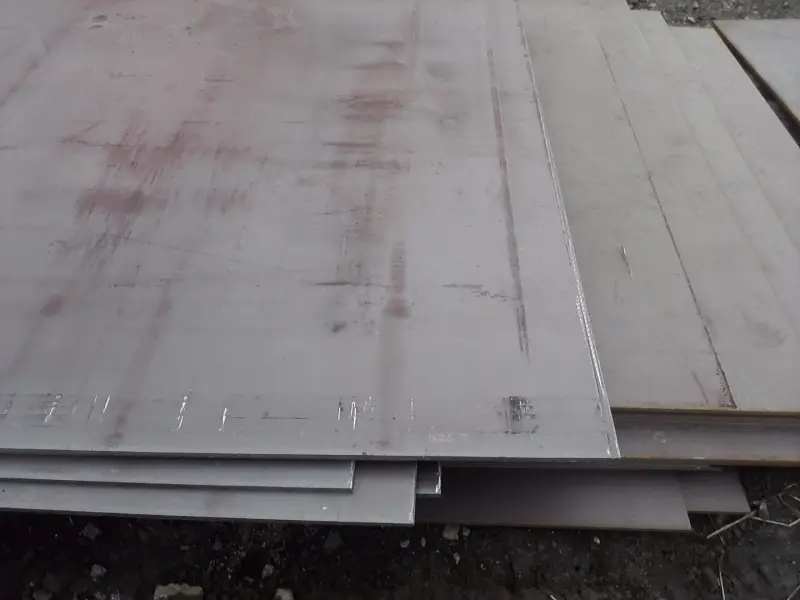
RINA Grade D420 High-Strength Shipbuilding Steel
RINA Grade D420 High-Strength Shipbuilding Steel: Full Data & Cross-References
Complete material properties for RINA Grade D420 shipbuilding steel plate as per RINA Rules for Materials, including chemical composition, mechanical properties, thermal and electrical data, international equivalents, and application guidance.
Hot rolling, controlled rolling, normalising, thermo-mechanical controlled processing (TMCP)
- Phone : +8618037372205
- Email : [email protected]
- WhatsApp: Contact via Whtsapp
- WeChat: +8618037372205
RINA Grade D420 High-Strength Shipbuilding Steel Introduction
RINA Grade D420 is a high-strength, low-alloy shipbuilding steel plate governed by the Registro Italiano Navale (RINA) Rules for Materials. It delivers a minimum yield strength of 420 MPa and excellent low-temperature toughness, designated by the "D" grade which requires an average impact energy of 27 J at -20°C. The steel is intended for critical structural components in seagoing vessels, offshore platforms, and other marine applications where high strength, weldability, and notch toughness are essential. It is typically supplied in normalized or thermo-mechanically controlled processed (TMCP) condition, allowing reduced carbon equivalent and enhanced fabrication characteristics. The grade is fully recognized by major classification societies, facilitating international projects and material interoperability.
RINA Grade D420 High-Strength Shipbuilding Steel Chemical Composition
Chemical limits are in accordance with IACS UR W11 for high-strength shipbuilding steel plates, Grade D, yield strength 420 MPa. Values are maximum unless a range is given.
- Carbon Equivalent (CEV): Typically limited to ≤0.43% for thickness ≤ 50 mm and ≤0.45% for greater thickness, depending on delivery condition.
- Fine grain practice: Aluminium is mandatory; niobium, vanadium, and titanium may be added individually or in combination to achieve strength and toughness.
- Residual elements: Cu, Ni, Cr, Mo are generally residual but can be added as alloying elements under agreement.
| Element | Standard Value (wt%) | Remarks |
|---|---|---|
| Carbon (C) | ≤ 0.21 | Ladle analysis; product analysis permitted slight increase |
| Manganese (Mn) | 0.80 – 1.70 | For thickness > 30 mm, minimum Mn may be 1.00 |
| Silicon (Si) | 0.10 – 0.55 | Higher Si may be used with agreement |
| Phosphorus (P) | ≤ 0.035 | Low phosphorus required for ductility |
| Sulfur (S) | ≤ 0.035 | Low sulfur for toughness and weldability |
| Aluminium (Al) | ≥ 0.015 (acid soluble) | Fine grain requirement; typically 0.020–0.055 |
| Niobium (Nb) | ≤ 0.05 | Micro-alloying element for grain refinement |
| Vanadium (V) | ≤ 0.10 | Can be used for precipitation strengthening |
| Titanium (Ti) | ≤ 0.02 | Grain refinement and N fixation |
| Copper (Cu) | ≤ 0.35 | Residual or alloying; may increase if specified |
| Nickel (Ni) | ≤ 0.40 | Improves toughness; higher allowed under agreement |
| Chromium (Cr) | ≤ 0.20 | Usually residual; higher permissible via negotiation |
| Molybdenum (Mo) | ≤ 0.08 | Residual; higher allowable if agreed |
| Nitrogen (N) | ≤ 0.009 | If not killed with Ti, V, or Al sufficient |
RINA Grade D420 High-Strength Shipbuilding Steel Thermal and Electrical Physical Properties
These physical constants are typical for shipbuilding-grade low-alloy structural steel and can be used for engineering calculations. Actual values may vary slightly with composition and heat treatment condition.
- Thermal expansion coefficient is given for the range 20–100°C; it increases moderately with temperature.
- Thermal conductivity and specific heat capacity are ambient reference values.
| Property | Typical Value | Unit | Test Condition / Remarks |
|---|---|---|---|
| Density (ρ) | 7.85 | g/cm³ | At 20°C |
| Modulus of elasticity (E) | 205 | GPa | Tensile, at 20°C |
| Shear modulus (G) | 79 | GPa | Derived from E and Poisson's ratio |
| Poisson's ratio (ν) | 0.30 | – | Elastic range, at 20°C |
| Thermal expansion coefficient (α) | 11.7 | 10⁻⁶/K | Between 20°C and 100°C |
| Thermal conductivity (λ) | ~ 50 | W/(m·K) | At 20°C |
| Specific heat capacity (cp) | ~ 460 | J/(kg·K) | At 20°C |
| Electrical resistivity (ρ_e) | ~ 0.22 | Ω·mm²/m | At 20°C |
RINA Grade D420 High-Strength Shipbuilding Steel Mechanical Properties
Minimum requirements per RINA Rules at ambient temperature, valid for plate thickness up to 100 mm.
- Tensile properties are determined on longitudinal test pieces; transverse values may be slightly lower but must meet individual specification.
- Impact test temperatures for Grade D: -20°C; average of three specimens ≥ 27 J, single value ≥ 20 J.
- Bend test: 180° bending without cracks; throat diameter varies with thickness.
- Thicker plates (t >50 mm) show reduced yield strength due to size effect, as indicated.
| Property | Standard Requirement | Unit | Test Condition / Remarks |
|---|---|---|---|
| Upper yield strength (ReH) | ≥ 420 | MPa | Thickness t ≤ 50 mm |
| Upper yield strength (ReH) | ≥ 400 | MPa | 50 mm < t ≤ 70 mm |
| Upper yield strength (ReH) | ≥ 380 | MPa | 70 mm < t ≤ 100 mm |
| Tensile strength (Rm) | 530 – 680 | MPa | All thicknesses |
| Elongation after fracture (A5) | ≥ 18 | % | Longitudinal, gauge length 5.65√So, |
| Elongation after fracture (A5) | ≥ 22 | % | For thickness t ≤ 40 mm, typical |
| Impact energy (KV2) | ≥ 27 (average) | J | At -20°C, longitudinal, 10×10 mm specimen |
| Impact energy (KV2) | ≥ 20 (single) | J | Individual specimen minimum at -20°C |
| Bend test (180°) | d = 3a | – | t ≤ 25 mm, a = specimen thickness, no fracture |
| Bend test (180°) | d = 4a | – | 25 mm < t ≤ 50 mm |
RINA Grade D420 High-Strength Shipbuilding Steel Fully Equivalent Material Standards and Substitute Grades
| Country/Region | Standard | Grade/Designation | Remarks |
|---|---|---|---|
| Norway/Germany | DNV GL Rules for Classification: Ships / Offshore Standard DNVGL-OS-B101 | DNV D420 | Identical mechanical and chemical requirements, same toughness class |
| United Kingdom | Lloyd's Register Rules for Materials | LR D420 | Same yield (420 MPa), D-grade impact (-20°C), fully interchangeable |
| France | Bureau Veritas Rules on Materials and Welding | BV D420 | Matches RINA D420 in all technical aspects |
| China | China Classification Society Rules for Materials and Welding | CCS D420 | Harmonised with IACS UR W11; direct substitute |
| Korea | Korean Register Rules for Materials | KR D420 | Equivalent high-strength ship plate with identical spec |
| USA | American Bureau of Shipping (ABS) Rules | ABS EQ47 (yield 460) | Close but not exact; EQ47 offers higher strength. D420 can be replaced by EQ47 with revised design; reverse substitution needs assessment. |
RINA Grade D420 High-Strength Shipbuilding Steel Application Introduction
RINA Grade D420 steel plates are designed for welded structures in the marine environment where high static and dynamic loads are present. The combination of strength, toughness, and good weldability makes it a versatile choice for critical hull members and offshore components. Typical fabrication processes include cutting, cold forming, welding (with suitable low-hydrogen consumables), and occasional hot forming under controlled conditions. Applications span:
Product Applications: Container ships, bulk carriers, tankers, and passenger vessels, Jack-up rigs, semi-submersibles, and fixed platforms, Wind turbine monopiles, jackets, and topside structures, Lock gates, breakwaters, and hulls of floating production storage and offloading (FPSO) units
Processed into products: Main deck, bottom, and side shell plating, Longitudinal and transverse frames, girders, and stringers, Bulkheads and deep tank walls, Offshore module support stools and equipment pads, Reinforcement plates at corners, hatch coamings, and crane pedestals
Application industries: Shipbuilding and ship repair, Offshore oil and gas exploration and production, Renewable energy (offshore wind turbine foundations, transition pieces), Marine and coastal engineering (ports, floating docks), Heavy lift and transportation vessels (barges, crane structures)
RINA Grade D420 High-Strength Shipbuilding Steel Similar or Alternative Materials
| Country/Region | Standard | Grade/Designation | Remarks |
|---|---|---|---|
| European Union | EN 10025-4 | S420ML / S420MLO | Hot-rolled TMCP fine-grain structural steel, yield 420 MPa, impact to -50°C (ML). Suitable for offshore and shipbuilding with additional testing. |
| USA | ASTM A572 | Grade 65 (Type 1 and 2) | Yield strength 450 MPa, tensile 550 MPa min; not specifically for shipbuilding but can be used with classification society approval, especially if impact requirements are met. |
| Japan | JIS G 3106 | SM570 | Yield 460 MPa, weldable structural steel for bridges and ships; higher strength, but toughness and chemistry must be verified per class rules. |
| Russia | GOST 5521 | PС D40 | Marine steel with yield 390–440 MPa depending on grade; can serve as alternative if 420 MPa level is achieved and class society certifies. |
Notes:
Welding and fabrication notes: Despite its high strength, D420 possesses a low carbon equivalent (CEV ≤ 0.43 typical) when supplied in TMCP condition, which facilitates welding without preheat in moderate thicknesses. However, preheat and interpass temperature control may be required for thicker sections and highly restrained joints to avoid hydrogen cracking. Corrosion: As with all structural steels, adequate coating and cathodic protection are necessary for long-term seawater exposure. Certification: Plates are issued with RINA 3.2 inspection certificates; other classification society endorsements can be arranged upon request.
- Share



