
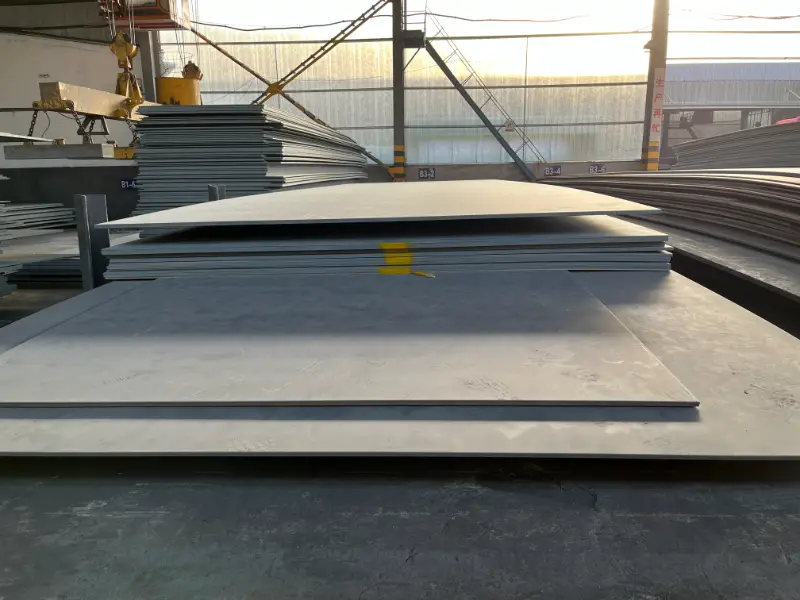
RINA Grade A420 Shipbuilding Steel Plate
RINA Grade A420 Shipbuilding Steel Plate - Composition, Properties & Equivalents
Complete material data sheet for RINA Grade A420 high-strength shipbuilding steel plate according to RINA Rules and IACS UR W11, including chemical composition, mechanical and physical properties, equivalent grades, and application guide.
Hot rolling, normalising, TMCP, QT; suitable for welding, cutting, forming, and machining
- Phone : +8618037372205
- Email : [email protected]
- WhatsApp: Contact via Whtsapp
- WeChat: +8618037372205
RINA Grade A420 Shipbuilding Steel Plate Introduction
RINA Grade A420 is a high-strength shipbuilding steel plate regulated by the Italian classification society Registro Italiano Navale (RINA). It belongs to the group of normalised or thermo-mechanically rolled weldable fine-grain structural steels with a minimum yield strength of 420 MPa.
- Designed for primary structural components in ships and offshore installations
- Supplied in grades determined by impact test temperature: A (0°C), D (-20°C), E (-40°C), F (-60°C); Grade A420 corresponds to the ‘A’ quality level
- Conforms to IACS UR W11 unified requirements for higher-strength hull structural steels
- Combinable good weldability with high toughness and excellent strength-to-weight ratio
- Typical delivery condition: normalised rolling, TMCP or quenching and tempering, depending on thickness and manufacturer capabilities
RINA Grade A420 Shipbuilding Steel Plate Chemical Composition
The chemical composition complies with the limits specified in IACS UR W11 for grade AH420 (AL, NB, V, TI may be added singly or in combination as grain-refining elements).
- Carbon equivalent (Ceq) is controlled depending on thickness: typically Ceq ≤ 0.41% (t≤50mm), ≤0.43% (50<t≤100mm)
- Tramp elements (Cr, Ni, Mo, Cu) are limited to ensure weldability
- Nitrogen is limited unless nitrogen-binding elements are present
| Element | Specified Value (max unless range) | Remarks |
|---|---|---|
| C | ≤ 0.21 | Carbon |
| Si | ≤ 0.55 | Silicon |
| Mn | 0.60 - 1.70 | Manganese (min 0.55 if grain-refining elements used) |
| P | ≤ 0.035 | Phosphorus |
| S | ≤ 0.035 | Sulphur |
| Cr | ≤ 0.20 | Chromium (residual element) |
| Ni | ≤ 0.40 | Nickel (residual element) |
| Mo | ≤ 0.08 | Molybdenum (residual element) |
| Cu | ≤ 0.35 | Copper (residual element) |
| Nb | 0.02 - 0.05 | Niobium (if added for grain refinement) |
| V | 0.05 - 0.10 | Vanadium (if added for grain refinement) |
| Ti | ≤ 0.02 | Titanium (if added for grain refinement) |
| Al (total) | ≥ 0.015 | Total aluminium, if used as the main grain refiner |
| N | ≤ 0.009* | Nitrogen; limit applies unless Al, Nb, V, or Ti are present in sufficient amounts |
RINA Grade A420 Shipbuilding Steel Plate Thermal and Electrical Physical Properties
Physical property values are typical for low-alloy carbon-manganese structural steel and are not classification society requirements. They are provided for design calculations.
- Properties vary slightly with heat treatment condition and temperature; data given for quenched and tempered / TMCP condition.
- Thermal conductivity and specific heat capacity decrease/increase with temperature; the table includes values at 20 °C and at elevated temperatures for reference.
| Property | Typical Value | Unit | Test Condition / Temperature |
|---|---|---|---|
| Density (ρ) | 7.85 | g/cm³ | 20 °C |
| Modulus of elasticity (E) | 210 | GPa | 20 °C |
| Shear modulus (G) | 80 | GPa | Calculated from E and ν |
| Poisson's ratio (ν) | 0.3 | — | Elastic range |
| Coefficient of thermal expansion (α) | 11.5 × 10−⁶ 12.5 × 10−⁶ 13.5 × 10−⁶ | K−¹ | 20–100 °C 20–200 °C 20–400 °C |
| Thermal conductivity (λ) | 45 (at RT) 42 (at 100 °C) 38 (at 200 °C) | W/(m·K) | Approximate values for TMCP/QT steel |
| Specific heat capacity (c) | 460 500 540 | J/(kg·K) | at 20 °C at 100 °C at 200 °C |
| Electrical resistivity (ρe) | 0.22 × 10−⁶ | Ω·m | 20 °C |
RINA Grade A420 Shipbuilding Steel Plate Mechanical Properties
Properties are determined in accordance with IACS UR W11 for normalised-rolling or TMCP delivery condition.
- Tensile test specimens are taken in the transverse direction for plate widths ≥ 600 mm; impact specimens in longitudinal direction.
- Minimum values apply to thicknesses ≤ 50 mm; for thicker plates, some reduction in elongation and increase in yield/tensile ratio may occur as per standard.
- Bending test is also required (no cracking) with mandrel diameter depending on thickness and grade.
| Property | Specified Value | Unit | Test Condition / Note |
|---|---|---|---|
| ReH (Upper yield strength / proof strength Rp0.2) | ≥ 420 | MPa | Thickness ≤ 50 mm, room temperature |
| Rm (Tensile strength) | 530 - 680 | MPa | Thickness ≤ 50 mm |
| A (Elongation after fracture) | ≥ 18 | % | Gauge length L0 = 5.65√S0, thickness ≤ 50 mm; transverse specimens |
| KV (Charpy V-notch impact energy) | ≥ 34 (avg.) ≥ 24 (single) | J | Longitudinal, at 0 °C (Grade A420) |
| Bend test (mandrel diameter for 180° bend) | 3t (t≤25mm) 4t (t>25mm) | — | No cracks; t = plate thickness. Specimen width 38 mm. |
| Thickness reduction on elongation | For t > 50 mm: A ≥ 17% | % | Plates over 50 mm thick; check also specific RINA rules |
RINA Grade A420 Shipbuilding Steel Plate International Equivalent Grades – Full Equivalents to RINA A420 / AH420
| Country / Society | Standard / Rule | Grade | Remarks |
|---|---|---|---|
| Italy / RINA | RINA Rules | A420 | The present grade, quality A (0 °C impact) |
| IACS unified | UR W11 | AH420 | Unified extra-high strength steel, 0 °C impact |
| American Bureau of Shipping | ABS Rules Part 2 | AH420 | Equivalent high-strength hull steel |
| Bureau Veritas | BV Rules | AH420 | Quality A, yield 420 MPa |
| China Classification Society | CCS Rules Part 1 | AH420 | Identical to IACS AH420 |
| DNV GL | DNVGL Rules Pt.2 Ch.2 | NV A420 / VL A420 | Grade A420; often marked NV A420 |
| Korean Register | KR Rules | RA420 | Equivalent to AH420 |
| Lloyd's Register | LR Rules | AH420 | High strength grade AH420 |
| Nippon Kaiji Kyokai (ClassNK) | NK Rules Part K | KA420 | Equivalent to AH420 |
| Russian Maritime Register | RS Rules | A420 | Mirrors IACS grade |
| Indian Register of Shipping | IRS Rules | IH420 | Equates to AH420 |
RINA Grade A420 Shipbuilding Steel Plate Application Introduction
RINA Grade A420 plate is intended for welded structures in shipbuilding and marine environments where a combination of high strength (420 MPa yield) and reliable toughness at 0 °C is required. It is commonly used in areas subject to moderate dynamic loads and low-temperature service. The steel can be cut, cold formed, and welded using conventional shipyard procedures. Preheating and post-weld heat treatment are generally not required for thin and medium sections. Typical service temperature environments range from -5 °C to 0 °C.
Product Applications: Hull plates and stiffeners for container ships, bulk carriers, tankers, Deck plating and strength members in ro-ro and passenger ships, Legs and rack/chord of jack-up drilling rigs, Offshore platform topside primary structures, Monopile and transition piece cans for offshore wind turbines
Processed into products: Ship hull envelope – bottom, side and deck plates, Longitudinal and transverse frames, girders, stringers, Bulkhead plates and watertight doors, Crane pedestals and A-frames on offshore vessels, Weld-in pad eyes, lifting lugs and tow brackets, Structural nodes and gusset plates in tubular joints
Application industries: Shipbuilding (merchant and naval vessels), Offshore oil & gas (jack-up rigs, semi-submersibles), Port and harbour engineering (steel sheet piling, quay walls), Renewable energy (offshore wind turbine foundations, transition pieces), Heavy steel construction (cranes, bridges in marine environment)
RINA Grade A420 Shipbuilding Steel Plate Similar / Closely Related Steel Grades
| Country / Society | Standard / Rule | Grade | Remarks |
|---|---|---|---|
| IACS | UR W11 | DH420 | Same strength, impact temperature -20 °C; improved notch toughness |
| IACS | UR W11 | EH420 | Same strength, impact temperature -40 °C; used for critical structures |
| IACS | UR W11 | FH420 | Same strength, impact temperature -60 °C; highest toughness requirement |
| IACS | UR W11 | A460 / AH460 | Next higher strength level (yield 460 MPa); similar chemistry with higher Mn and microalloying; same impact temperature |
| EN | EN 10025-4 | S420ML / S420MLO | Offshore structural steel with comparable yield strength, -50 °C impact; not directly interchangeable but close in performance |
| API | API 2H / 2W | Grade 50 | Offshore platform steel with min yield 345–414 MPa; lower strength but used in similar applications |
Notes:
- Welding: A420 steel exhibits good weldability with a carbon equivalent typically ≤0.41%. Common consumables: low-hydrogen basic electrodes (AWS E7018, E8018) or submerged arc welding with matching strength filler metals. Preheat and interpass temperature control is recommended for thicknesses > 30 mm.
- Cold Forming: Minimum recommended bending radius is 3t up to 25 mm thickness; for thicker plates 4t. The material can be flanged, rolled, and pressed at ambient temperature respecting strain-ageing limits.
- Surface Condition: Plates are delivered with mill scale unless shot-blasted and shop-primed to protect against corrosion during construction. Primer must be compatible with the final painting scheme.
- Certification: RINA 3.1 or 3.2 certificates are issued for each plate lot, verifying chemical composition, tensile and impact properties, and original heat number traceability.
- For applications requiring lower transition temperatures, upgrade to DH420, EH420 or FH420 should be considered.
- Share



