
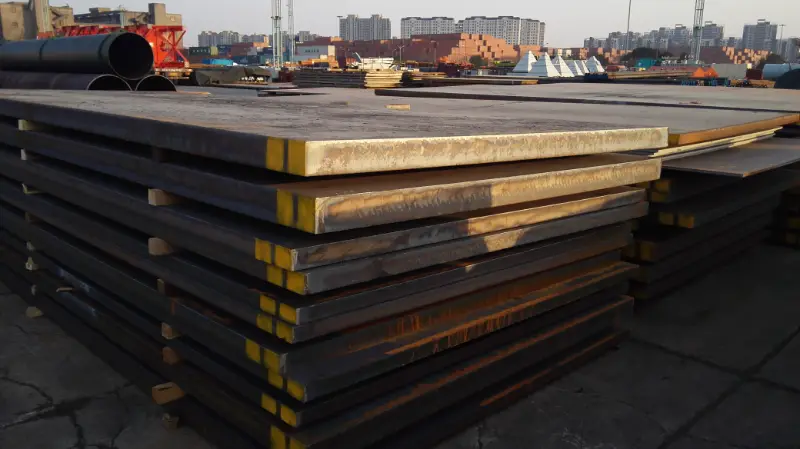
RINA Grade F40 Shipbuilding Steel Plate
RINA Grade F40 Shipbuilding Steel Plate: High-Strength Arctic Marine Grade
Comprehensive material data for RINA Grade F40 shipbuilding steel plate including chemical composition, mechanical properties, thermal and electrical physical properties, international equivalents, and application guide.
Normalizing, TMCP, hot rolling
- Phone : +8618037372205
- Email : [email protected]
- WhatsApp: Contact via Whtsapp
- WeChat: +8618037372205
RINA Grade F40 Shipbuilding Steel Plate Introduction
RINA Grade F40 is a high-strength hull structural steel certified by the Registro Italiano Navale (RINA) for use in shipbuilding and offshore engineering. It belongs to the FH40 category under IACS UR W11, with a minimum yield strength of 390 MPa and guaranteed Charpy impact properties at -60°C. The steel is characterized by excellent weldability, low-temperature toughness, and good formability, making it suitable for critical structures in arctic environments. It is typically supplied in normalized or thermomechanically controlled rolled condition.
RINA Grade F40 Shipbuilding Steel Plate Chemical Composition
Chemical requirements according to RINA Rules and IACS UR W11. Elements are given as maximum values except where a range is indicated. All values are in weight percent.
| Chemical Element | Specified Value (wt%) | Remarks |
|---|---|---|
| Carbon (C) | ≤0.16 | max |
| Silicon (Si) | ≤0.50 | max |
| Manganese (Mn) | 0.90 - 1.60 | range |
| Phosphorus (P) | ≤0.025 | max |
| Sulfur (S) | ≤0.025 | max |
| Aluminium (Al) | ≥0.020 (total) | min |
| Niobium (Nb) | ≤0.05 | max |
| Vanadium (V) | ≤0.10 | max |
| Titanium (Ti) | ≤0.02 | max |
| Chromium (Cr) | ≤0.20 | max (residual) |
| Nickel (Ni) | ≤0.40 | max (residual) |
| Molybdenum (Mo) | ≤0.08 | max (residual) |
| Copper (Cu) | ≤0.35 | max (residual) |
| Nitrogen (N) | ≤0.009 | max |
| Ceq (Carbon Equivalent) | ≤0.40 | for thickness ≤50mm, typical |
RINA Grade F40 Shipbuilding Steel Plate Thermal and Electrical Physical Properties
Approximate physical properties for low-alloy carbon‑manganese structural steel at room temperature, unless otherwise noted. These values are not part of the mandatory specification but are commonly used for design calculations.
| Property | Typical Value | Unit | Test Condition |
|---|---|---|---|
| Density (ρ) | 7.85 | g/cm³ | 20 °C |
| Modulus of Elasticity (E) | 205 | GPa | ambient |
| Shear Modulus (G) | 80 | GPa | ambient (calculated) |
| Poisson's Ratio (ν) | 0.3 | - | ambient |
| Thermal Expansion Coefficient (α) | 12.0 | ×10⁻⁶ /K | 20 – 100 °C |
| Thermal Expansion Coefficient (α) | 12.8 | ×10⁻⁶ /K | 20 – 200 °C |
| Thermal Conductivity (λ) | 45 | W/(m·K) | 20 °C |
| Specific Heat Capacity (c) | 460 | J/(kg·K) | 20 °C |
| Electrical Resistivity (ρe) | 0.18 | ×10⁻⁶ Ω·m | 20 °C |
RINA Grade F40 Shipbuilding Steel Plate Mechanical Properties
Tensile and impact properties per RINA Rules and IACS UR W11. Values depend on product thickness. The Charpy impact test is conducted at -60°C on longitudinal specimens (10x10 mm). Bend test requires no cracks or defects.
| Property | Specified Value | Unit | Test Condition / Thickness Range |
|---|---|---|---|
| Yield Strength (ReH) | ≥390 | MPa | t ≤ 100 mm |
| Tensile Strength (Rm) | 510 - 650 | MPa | t ≤ 100 mm |
| Elongation after fracture (A5) | ≥20 | % | t ≤ 50 mm |
| Elongation after fracture (A5) | ≥19 | % | 50 < t ≤ 70 mm |
| Elongation after fracture (A5) | ≥19 | % | 70 < t ≤ 100 mm |
| Bend Test (180°) | d = 3a | - | t ≤ 25 mm |
| Bend Test (180°) | d = 4a | - | 25 < t ≤ 50 mm |
| Bend Test (180°) | d = 5a | - | 50 < t ≤ 100 mm |
| Charpy V‑notch Impact (KV₂) | ≥41 (longitudinal) | J | at -60 °C, 10×10 mm specimen |
| Charpy V‑notch Impact (KV₂) | ≥27 (transverse) | J | at -60 °C, optional / agreed |
RINA Grade F40 Shipbuilding Steel Plate Fully Equivalent Material Standards and Substitute Grades
| Country / Region | Standard / Society | Grade | Remarks |
|---|---|---|---|
| International (IACS) | UR W11 | FH40 | Fully equivalent, -60°C impact |
| USA | ABS | FH40 | Identical strength and toughness |
| Norway / Germany | DNV GL | FH40 | Same specification |
| France | BV | FH40 | Same specification |
| UK | LR | FH40 | Same specification |
| Japan | NK | KF40 | NK notation KF40, equivalent properties |
| China | CCS | FH40 | Identical |
| South Korea | KR | FH40 | Identical |
| Russia | RS | FH40 | Identical |
RINA Grade F40 Shipbuilding Steel Plate Application Introduction
RINA Grade F40 is designed for demanding marine and offshore structures operating at low temperatures. Its high strength-to-weight ratio allows weight reduction while maintaining structural integrity. The -60°C impact toughness makes it suitable for ice-class vessels and arctic environments. Typical processing includes cutting, bending, and welding, and the steel is well suited for both conventional and high‑heat‑input welding processes.
Product Applications: Hull plates and stiffeners, Decks and bulkheads, Ice belt and stringer plates, Jack‑up rig legs and spudcans, Offshore module structural members, Heavy‑lift crane pedestals
Processed into products: Longitudinal and transverse frames, Web frames and girders, Bulkhead plates and stiffeners, Hatch coamings and corners, Bracket plates and tripping brackets, Main deck and strength deck panels
Application industries: Shipbuilding (merchant ships, naval vessels, icebreakers), Offshore engineering (platforms, jack‑ups, FPSOs), Marine construction (docks, port equipment, lock gates), Renewable energy (offshore wind turbine foundations)
RINA Grade F40 Shipbuilding Steel Plate Closely Related Alternative Materials
| Country / Region | Standard / Society | Grade | Remarks |
|---|---|---|---|
| Italy (RINA) | RINA Rules | E40 | Same strength but impact test at -40°C instead of -60°C; suitable for less severe cold temperatures. |
| USA | ABS | EH40 | Equivalent to RINA E40, -40°C impact. |
| China | CCS | EH40 | Similar strength, -40°C toughness. |
| International | EN 10025-3 | S420N/NL | Structural steel with min ReH 420 MPa, but different toughness and delivery condition; not for ship classification. |
Notes:
- Carbon equivalent (Ceq) should be carefully controlled to ensure good weldability; preheat and interpass temperatures may be required based on thickness and heat input.
- Supplementary requirements such as Z‑direction (through‑thickness) properties, ultrasonic testing, and stricter dimensional tolerances can be agreed upon at the time of ordering.
- For plates thinner than 10 mm, the impact test specimen size and minimum energy values are adjusted according to the classification society rules.
- Share



