
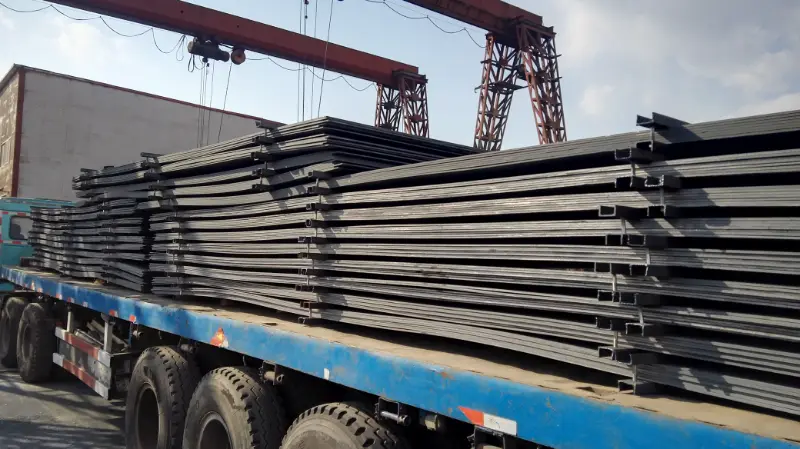
RINA Grade E40 Shipbuilding Steel Plate
RINA Grade E40 Shipbuilding Steel Plate: Composition, Mechanical & Thermal Properties, Equivalents & Application Data
Complete material data for RINA Grade E40 high-strength shipbuilding steel plate according to RINA Rules for the Classification of Ships, including chemical composition, mechanical properties, thermal-physical properties, international equivalents, and typical application guidance.
Hot rolling, normalizing, thermomechanical rolling (TMCP), quenching and tempering (Q+T), cold forming (limited), welding
- Phone : +8618037372205
- Email : [email protected]
- WhatsApp: Contact via Whtsapp
- WeChat: +8618037372205
RINA Grade E40 Shipbuilding Steel Plate Introduction
RINA Grade E40 is a high-strength hull structural steel plate certified by the Italian Classification Society (RINA) in accordance with the RINA Rules for the Classification of Ships, Part D, Chapter 2. It belongs to the E40 strength level under the IACS Unified Requirement W11. The "E" indicates impact testing at -40°C, and "40" denotes a minimum yield strength of 390 MPa. This steel is designed for critical shipbuilding components that require a combination of high strength, excellent weldability, and guaranteed low-temperature toughness.
- Minimum yield strength: 390 MPa
- Tensile strength: 510–650 MPa
- Excellent Charpy impact energy at -40°C (longitudinal ≥ 41 J for thin plates)
- Good cold bending performance
- Available in normalized (N), thermomechanical control processed (TMCP), or quenched and tempered (Q+T) delivery conditions
Typical applications include decks, shells, bottom plates, bulkheads, and structural members of ships and offshore platforms.
RINA Grade E40 Shipbuilding Steel Plate Chemical Composition
The chemical composition of RINA Grade E40 is defined in the RINA Rules, Table 43 (High-strength structural steels). For grain refinement, the acid-soluble aluminium (Als) content must be at least 0.015% when aluminium is used. The micro-alloying elements niobium, vanadium and titanium may be added singly or in combination; their total content is controlled to ensure weldability and toughness. Residual elements like Cu, Cr, Ni, Mo are limited to avoid adverse effects on mechanical properties.
| Element | Content (%) | Remarks |
|---|---|---|
| C | ≤ 0.18 | Maximum |
| Mn | 0.90 – 1.60 | Normal range |
| Si | ≤ 0.50 | Maximum |
| P | ≤ 0.035 | Maximum |
| S | ≤ 0.035 | Maximum |
| Als (acid soluble) | ≥ 0.015 | Minimum when Al is used for grain refinement |
| Nb | 0.02 – 0.05 | If used individually |
| V | 0.05 – 0.10 | If used individually |
| Ti | 0.01 – 0.05 | If used individually; Ti/Nb/V sum ≤ 0.12% if combined |
| Cu | ≤ 0.35 | Residual element |
| Cr | ≤ 0.20 | Residual element; may be increased to 0.25% by agreement |
| Ni | ≤ 0.40 | Residual element |
| Mo | ≤ 0.08 | Residual element |
RINA Grade E40 Shipbuilding Steel Plate Thermal and Electrical Physical Properties
The following properties are typical for carbon-manganese structural steels similar to RINA Grade E40. They are not mandatory in the material standard but serve as a general guideline for engineering calculations and simulation. Actual values may vary slightly depending on the exact composition and heat treatment condition.
| Property | Typical Value | Unit | Remarks |
|---|---|---|---|
| Density (ρ) | 7.85 | g/cm³ | Ambient temperature |
| Elastic modulus (E) | 210 | GPa | Ambient temperature |
| Shear modulus (G) | approx. 80 | GPa | Ambient temperature |
| Poisson's ratio (ν) | 0.3 | — | Ambient temperature, elastic range |
| Thermal expansion coefficient (α) | 11.5 – 12.5 × 10⁻⁶ | /K | Range from 20°C to 200°C |
| Thermal conductivity (λ) | approx. 48 | W/(m·K) | At 100°C |
| Specific heat capacity (cp) | approx. 460 | J/(kg·K) | From 20°C to 100°C |
| Electrical resistivity (ρe) | approx. 0.16 × 10⁻⁶ | Ω·m | At 20°C |
RINA Grade E40 Shipbuilding Steel Plate Mechanical Properties
The following mechanical properties apply to RINA Grade E40 plates in delivery condition. Tensile test specimens are transverse to the rolling direction; impact specimens are taken longitudinal and transverse. Charpy V-notch impact energy requirements depend on plate thickness and specimen orientation. Bend test mandrel diameters are specified for different thicknesses to verify formability without cracking.
Values are in accordance with the RINA Rules for the Classification of Ships, Part D, Chapter 2.
| Property | Required Value | Unit | Test Condition / Remarks |
|---|---|---|---|
| Yield strength (ReH) | ≥ 390 | MPa | All thicknesses |
| Tensile strength (Rm) | 510 – 650 | MPa | All thicknesses |
| Elongation (A) | ≥ 20 | % | Gauge length L0 = 5.65√S0, thickness t ≤ 50 mm |
| Elongation (A) | ≥ 19 | % | Gauge length L0 = 5.65√S0, 50 mm < t ≤ 70 mm |
| Elongation (A) | ≥ 18 | % | Gauge length L0 = 5.65√S0, 70 mm < t ≤ 100 mm |
| Impact energy (KV, Long.) | ≥ 41 (avg.) / 28 (single) | J | -40°C, thickness t ≤ 50 mm |
| Impact energy (KV, Long.) | ≥ 37 (avg.) / 26 (single) | J | -40°C, 50 mm < t ≤ 70 mm |
| Impact energy (KV, Long.) | ≥ 34 (avg.) / 24 (single) | J | -40°C, 70 mm < t ≤ 100 mm |
| Impact energy (KV, Trans.) | ≥ 27 (avg.) / 19 (single) | J | -40°C, thickness t ≤ 50 mm |
| Impact energy (KV, Trans.) | ≥ 25 (avg.) / 18 (single) | J | -40°C, 50 mm < t ≤ 70 mm |
| Impact energy (KV, Trans.) | ≥ 23 (avg.) / 16 (single) | J | -40°C, 70 mm < t ≤ 100 mm |
| Bend test (180°) | d = 3a | — | Plate thickness a ≤ 25 mm; no cracks |
| Bend test (180°) | d = 4a | — | Plate thickness a > 25 mm; no cracks |
RINA Grade E40 Shipbuilding Steel Plate Complete Equivalent Standards and Replaceable Grades
| Country / Region | Standard | Grade | Remarks |
|---|---|---|---|
| IACS | UR W11 | E40 | International Association of Classification Societies, unified requirement |
| Italy (RINA) | RINA Rules Pt.D Ch.2 | E40 | Original grade discussed |
| USA (ABS) | ABS Rules | EH40 | Fully equivalent strength and toughness class |
| Norway (DNV) | DNV Rules | E40 | Fully equivalent |
| France (BV) | BV Rules | E40 | Fully equivalent |
| UK (LR) | Lloyd's Register Rules | EH40 | Fully equivalent |
| China (CCS) | CCS Rules | E40 | Fully equivalent |
| Japan (NK/ClassNK) | ClassNK Rules | KE40 | Fully equivalent |
| Korea (KR) | Korean Register Rules | RE40 | Fully equivalent |
| International (ASTM) | ASTM A131/A131M | EH40 | Equivalent high-strength shipbuilding steel |
RINA Grade E40 Shipbuilding Steel Plate Application Introduction
RINA Grade E40 is a premium shipbuilding plate steel designed for low-temperature environments and high mechanical load conditions. It is commonly employed in the construction of hull envelopes, decks, bottom structures, and major stiffening elements for vessels operating in cold or ice-class waters as well as for large merchant, military, and offshore units. The good weldability and formability allow the production of complex shapes using conventional shipyard processes.
Typical applications include:
Product Applications: Hull shell plates (deck, side, bottom), Transverse and longitudinal bulkheads, Deck stringers and sheer strakes, Box keels and bilge keels, Web frames and beam constructions, Offshore platform topside and jacket nodes
Processed into products: Large-size cut plates for stiffeners (flat bars, angle profiles), Rolled and welded T-beam flanges, Structural brackets and gussets, Hatch coaming plates, Pontoon plating for floating docks, High-stress regions near propulsion and rudder integration
Application industries: Marine shipbuilding (tankers, bulk carriers, container ships, LNG carriers, cruise ships), Naval architecture (warships, auxiliaries), Offshore engineering (jack-up rigs, semisubmersibles, floating production units), Heavy steel construction (port cranes, bridge components in marine environment)
RINA Grade E40 Shipbuilding Steel Plate Similar or Nearby Substitute Materials
| Country / Region | Standard | Grade | Remarks |
|---|---|---|---|
| IACS / Multi | UR W11 | E36 | Yield strength 355 MPa, similar toughness class (-40°C); slightly lower strength |
| European Union (CEN) | EN 10025-4 | S420G2+M or S420G2+Q | 420 MPa min yield steel for offshore structures; equivalent toughness class, slightly higher strength |
| China (GB/T) | GB 712-2011 | EH40 | Chinese shipbuilding steel; practically identical properties |
| Russia (GOST) | GOST 5521-93 | D40 (Д40) | Similar strength level, but different test temperature and classification system |
Notes:
Welding considerations: RINA E40 is readily weldable with standard procedures (SAW, FCAW, SMAW). For thicker sections, preheating (100–150°C) may be required to avoid hydrogen cracking. The carbon equivalent (CEV) is typically ≤ 0.40% (by TMCP route) to ensure excellent weldability.
Certification: Each plate is stamped or marked with the RINA mark, grade, heat number, and delivery condition; a full inspection certificate type 3.1 or 3.2 (according to EN 10204) is issued by the mill.
Thickness tolerance: Plates are normally supplied with Class A or B thickness tolerances per EN 10029 or equivalent; dimensional and flatness tolerances are as agreed in the order.
- Share



