
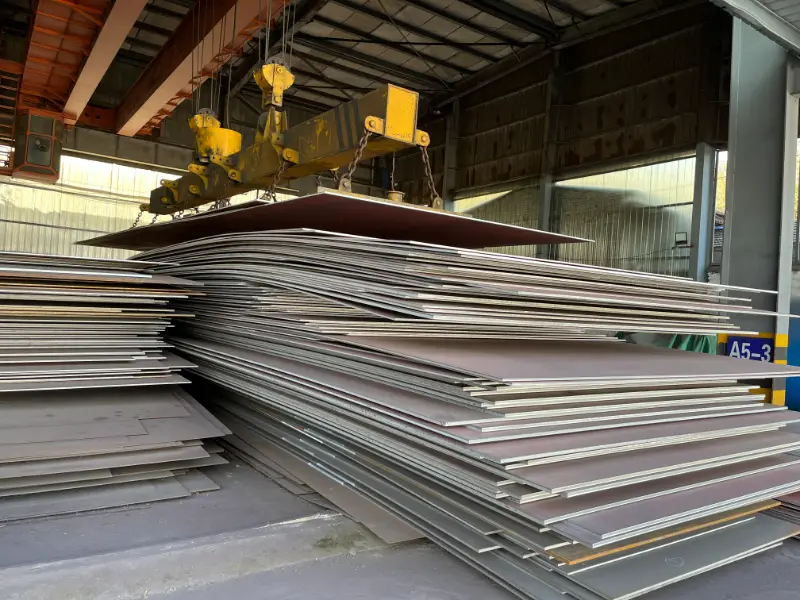
RINA Grade A500 Shipbuilding Steel Plate
RINA Grade A500 Shipbuilding Steel Plate: 500 MPa Yield for Modern Vessel Design
Comprehensive data sheet for RINA Grade A500 shipbuilding steel plate including chemical composition, mechanical properties, physical characteristics, international equivalents, and application guidance.
Thermo-Mechanical Controlled Processing (TMCP), Normalizing rolling, Quenching & Tempering (optional); welding by all conventional methods
- Phone : +8618037372205
- Email : [email protected]
- WhatsApp: Contact via Whtsapp
- WeChat: +8618037372205
RINA Grade A500 Shipbuilding Steel Plate Introduction
RINA Grade A500 is a high-strength structural shipbuilding steel plate certified by the Registro Italiano Navale (RINA) under their Rules for Classification of Ships. This grade belongs to the A-toughness category (impact test at 0°C) and guarantees a minimum yield strength of 500 MPa in the as-delivered condition, typically produced via thermo-mechanical controlled processing (TMCP) or normalizing rolling. Its microstructure is fine-grained ferrite with precipitation hardening, enabling
- Excellent weldability with low carbon equivalent (CEV ≤ 0.47%)
- High resistance to brittle fracture, satisfying stringent notch toughness requirements
- Good formability and cold bending capacity for complex ship hull geometries
- Uniform mechanical properties across thicknesses up to approx. 100 mm
This grade is widely used in critical structures of container ships, bulk carriers, offshore platforms, and naval vessels where weight reduction and high strength are paramount.
RINA Grade A500 Shipbuilding Steel Plate Chemical Composition
Typical chemical composition based on RINA Material Rules for Grade A500 with fine-grain practice and microalloying. Values are maximum unless a range is indicated. Note:
- Carbon Equivalent (CEV) = C + Mn/6 + (Cr+Mo+V)/5 + (Ni+Cu)/15, typically ≤ 0.47%.
- Microalloying elements such as Nb, V, and Ti are added singly or in combination to achieve the required strength while maintaining weldability.
| Element | Value (max) | Remarks |
|---|---|---|
| Carbon (C) | 0.12 % | Lowering C improves toughness and weldability |
| Silicon (Si) | 0.55 % | Deoxidizer, contributes to solid solution strengthening |
| Manganese (Mn) | 1.70 % | Major solid solution strengthener; actual range typically 1.00-1.70% |
| Phosphorus (P) | 0.025 % | Strictly controlled for low-temperature toughness |
| Sulfur (S) | 0.020 % | Low S required for high ductility and through-thickness properties |
| Aluminum (Al) | ≥ 0.015 % (total) | Fine grain practice; acid soluble Al is specified |
| Niobium (Nb) | 0.05 % | Microalloy – grain refinement and precipitation hardening |
| Vanadium (V) | 0.10 % | Optional microalloy – contributes to precipitation strengthening |
| Titanium (Ti) | 0.02 % | For sulfide shape control and grain refinement; also fixes nitrogen |
| Chromium (Cr) | 0.25 % | Residual element, may be present up to this level |
| Nickel (Ni) | 0.40 % | Residual, improves toughness when intentionally added above 0.30% |
| Copper (Cu) | 0.30 % | Residual, may be present; higher Cu requires agreement |
| Molybdenum (Mo) | 0.10 % | Residual; enhances hardenability if added intentionally |
| Nitrogen (N) | 0.012 % | Typically bound by Al and Ti |
RINA Grade A500 Shipbuilding Steel Plate Physical Properties
Representative physical properties for a low-alloyed TMCP steel of this type. Actual values may vary slightly with exact composition and processing.
- Thermal conductivity and specific heat capacity decrease with increasing temperature.
- Electrical resistivity increases with temperature (approx. +0.15 nΩ·m/K).
- These values are not mandatory in RINA rules but serve as guidance for design and welding simulations.
| Property | Typical Value | Unit | Test Condition / Remarks |
|---|---|---|---|
| Density (ρ) | 7850 | kg/m³ | At 20°C |
| Modulus of Elasticity (E) | 210 | GPa | At 20°C |
| Shear Modulus (G) | 81 | GPa | Calculated from E and Poisson's ratio |
| Poisson's Ratio (ν) | 0.3 | - | Within elastic range at room temperature |
| Thermal Expansion Coefficient (α) | 11.5 × 10⁻6 | /K | Average between 20°C and 100°C |
| Thermal Expansion Coefficient (α) | 12.3 × 10⁻6 | /K | Average between 20°C and 200°C |
| Thermal Conductivity (λ) | 45 | W/(m·K) | At 20°C |
| Thermal Conductivity (λ) | 41 | W/(m·K) | At 200°C |
| Specific Heat Capacity (cp) | 470 | J/(kg·K) | At 20°C |
| Specific Heat Capacity (cp) | 520 | J/(kg·K) | At 200°C |
| Electrical Resistivity (ρe) | 0.22 | μΩ·m | At 20°C |
RINA Grade A500 Shipbuilding Steel Plate Mechanical Properties
Minimum mechanical properties as required by RINA Rules for Grade A500. Test sampling is transverse to the rolling direction, except where noted. Note:
- Yield strength and tensile strength are for as-delivered condition (TMCP or N).
- Elongation values apply to proportional test pieces with gauge length L₀ = 5.65√S₀ for thin products; for full thickness tests L₀ = 50 mm, values are derived from L₀ = 5.65√S₀.
- Charpy V-notch impact energy is an average of three specimens, with individual minimum not less than 70% of the average.
| Property | Required Value | Unit | Test Condition |
|---|---|---|---|
| Yield Strength (ReH) | ≥ 500 | MPa | Ambient; plate thickness ≤ 50 mm |
| Yield Strength (ReH) | ≥ 480 | MPa | Ambient; plate thickness 50 < t ≤ 100 mm |
| Tensile Strength (Rm) | 610 – 770 | MPa | Ambient; all thicknesses |
| Elongation (A) | ≥ 17 | % | L₀ = 5.65√S₀; thickness ≤ 40 mm, transverse |
| Elongation (A) | ≥ 16 | % | L₀ = 5.65√S₀; thickness 40 < t ≤ 100 mm, transverse |
| Charpy V-notch Impact (KV₂) | ≥ 34 | J | At 0°C; transverse; thickness ≤ 100 mm (full-size specimen 10×10 mm) |
| Charpy V-notch Impact (KV₂) | ≥ 27 | J | At 0°C; transverse; sub-size specimen (e.g., 7.5×10 mm) – pro rata values might be agreed |
| Bend Test (Former Diameter) | No cracks or defects | - | 180° bend over former diameter = 3× specimen thickness (t), at ambient temperature |
RINA Grade A500 Shipbuilding Steel Plate Fully Equivalent Material Standards and Replaceable Grades
| Country/Region | Standard | Grade | Remarks |
|---|---|---|---|
| Europe (EN) | EN 10225 | S500G2+M/Q | Weldable structural steel for offshore structures; yield 500 MPa, grade 2 toughness |
| Bureau Veritas (BV) | BV Rules Pt.2 Mat. & Welding | A500 | Equivalent A-toughness grade, 500 MPa yield |
| Lloyd's Register (LR) | LR Rules for Ships | A500 | Grade A500 certified by LR |
| American Bureau of Shipping (ABS) | ABS Rules for Materials | A500 | ABS high strength grade A500, identical requirements |
| DNV (Det Norske Veritas) | DNV Rules for Ships | NV A500 | Direct equivalent; A-toughness at 0°C |
| ClassNK (Nippon Kaiji Kyokai) | ClassNK Rules | KA500 | Corresponds to RINA A500; K toughness class |
RINA Grade A500 Shipbuilding Steel Plate Application Introduction
RINA A500 is specifically tailored for weight-critical structures where the combination of 500 MPa yield strength and reliable notch toughness at 0°C is sufficient. It is a cost-effective choice for many general shipbuilding applications, though for Arctic service, grades with lower transformation temperature (D, E, F) may be preferred.
Product Applications: Hull bottom and side shell plates, Strength deck plating (e.g., forward and aft peak regions), Longitudinal stiffeners (flat bars, bulb profiles), Transverse webs and frames, Hatch coamings and coaming stays, Foundation plates for heavy machinery and cranes, Offshore platform decks and module support beams
Processed into products: Shell plate sub-assemblies for high-stress areas, Built-up girders and stiffened panels, Corrugated bulkhead sections (if cold formable), Reinforcements around openings and crane pedestals, Fatigue-resistant brackets and doublers, Welded box beams for crane booms, Nodes in tubular truss structures
Application industries: Commercial shipbuilding (bulk carriers, container vessels, tankers), Naval architecture (patrol boats, corvettes), Offshore oil & gas (topsides modules, flare booms, helideck supports), Port and harbour construction (heavy-lift crane girders), Renewable energy (offshore wind turbine transition pieces, anchor flanges)
RINA Grade A500 Shipbuilding Steel Plate Similar / Alternative Materials with Close Performance
| Country/Region | Standard | Grade | Remarks |
|---|---|---|---|
| Europe (EN) | EN 10225 | S460G2+M | Yield strength 460 MPa instead of 500 MPa; otherwise similar toughness and weldability |
| RINA | RINA Rules | AH40 / DH40 / EH40 | Minimum yield 390 MPa; lower strength but widely used for hulls – A, D, E toughness levels |
| RINA | RINA Rules | AH460 / EH460 | Yield 460 MPa class – next lower step within RINA system |
| ASTM International | ASTM A131 / A131M | Grade EH40 / FH48 | ASTM shipbuilding steels; EH40 yields 390 MPa; FH48 yields 470 MPa – not directly a match but used where 500 MPa is not required |
| API | API 2W | Grade 50 (345 MPa yield) or Grade 60 (415 MPa yield) | Used in fixed offshore platforms; requires grinding of surface for fatigue-prone joints; lower strength alternatives |
Notes:
Important remarks:
- This grade is typically delivered with a certificate (3.1 or 3.2 per EN 10204) including chemical analysis and mechanical test results.
- Weldability: preheating and interpass temperature control should follow recommended practice based on CEV and thickness; typically preheat is not mandatory for thin plates (<30 mm) with low hydrogen processes.
- Post-weld heat treatment (stress relief) is generally not required, but if applied, possible loss of strength due to tempering of microalloy precipitates must be considered.
- For plates with improved through-thickness properties (Z-quality), supplementary testing per EN 10160 or ASTM A770 may be specified.
- Contact RINA-certified mills for the exact guaranteed properties of their specific production route.
- Share



