
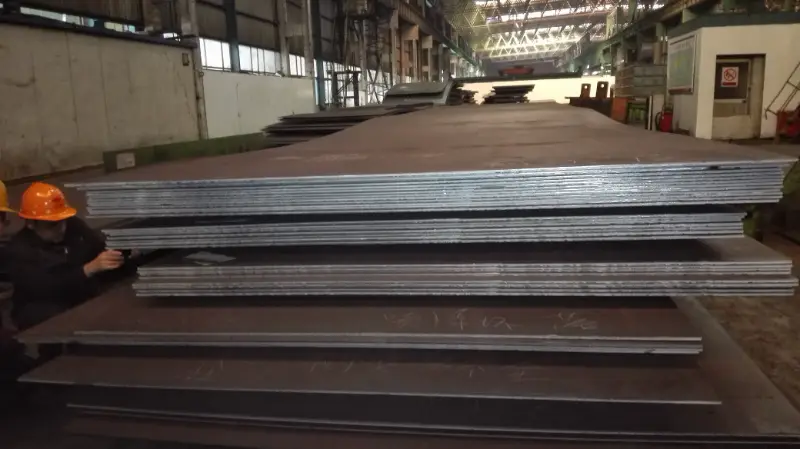
RINA Grade D500 Shipbuilding Steel Plate
RINA Grade D500 High-Strength Shipbuilding Steel Plate – Properties & Equivalents
In-depth datasheet for RINA Grade D500 shipbuilding steel plate, including chemical composition, mechanical and thermal properties, international equivalents, and application guidance.
Thermo-Mechanical Controlled Processing (TMCP), Quenching and Tempering (Q+T), Normalizing, Welding (all common methods), Hot and Cold Forming, Machining
- Phone : +8618037372205
- Email : [email protected]
- WhatsApp: Contact via Whtsapp
- WeChat: +8618037372205
RINA Grade D500 Shipbuilding Steel Plate Introduction
RINA Grade D500 is a normalized or thermo-mechanically controlled processed (TMCP) high-strength structural steel plate certified by the Registro Italiano Navale (RINA). Classified under the RINA Rules for the Classification of Ships, it is designed for critical load-bearing components in shipbuilding and offshore structures. The designation 'D' indicates impact toughness guaranteed at -20°C, while '500' denotes a minimum yield strength of 500 MPa. This grade offers an optimized balance of high strength, excellent weldability, and enhanced resistance to brittle fracture, making it suitable for heavy-section members subjected to dynamic loads and low-temperature service. It is typically supplied in the TMCP or quenched and tempered condition, ensuring uniform mechanical properties throughout the plate thickness. RINA D500 finds application in hull girders, deck stringers, longitudinal stiffeners, and regions of high stress concentration. Its compliance with rigorous international ship classification standards ensures reliability in harsh marine environments.
RINA Grade D500 Shipbuilding Steel Plate Chemical Composition – RINA Grade D500
Typical chemical composition limits according to RINA Rules for high-strength shipbuilding steel with minimum yield 500 MPa. The steel is fully killed and fine grain treated. Microalloying elements such as Nb, V, Ti may be added singly or in combination to achieve strength and toughness goals. The carbon equivalent (CEV) is controlled to guarantee good weldability.
| Element | Standard Requirement (max, unless range specified) | Remarks |
|---|---|---|
| C | ≤ 0.18 | Main hardening element; higher content may impair weldability |
| Si | ≤ 0.50 | Deoxidizer; improves strength |
| Mn | 0.90 – 1.60 | Refines grain, increases strength and toughness |
| P | ≤ 0.025 | Phosphorus as harmful impurity; kept low for toughness |
| S | ≤ 0.020 | Sulfur as impurity; restricted to avoid hot shortness |
| Al (acid-soluble) | ≥ 0.020 | Grain refining and deoxidation |
| Nb | ≤ 0.05 | Grain refining and precipitation strengthening |
| V | ≤ 0.10 | Precipitation strengthening |
| Ti | ≤ 0.05 | Grain refining, nitrogen fixation |
| Cu | ≤ 0.50 | May contribute to atmospheric corrosion resistance |
| Cr | ≤ 0.50 | Optional for enhanced hardenability |
| Ni | ≤ 0.80 | Improves low-temperature toughness |
| Mo | ≤ 0.50 | Optional for thick sections to maintain strength |
| CEV (typical) | ≤ 0.42 – 0.48 (depending on thickness) | Carbon equivalent = C + Mn/6 + (Cr+Mo+V)/5 + (Ni+Cu)/15 |
RINA Grade D500 Shipbuilding Steel Plate Thermal and Electrical Physical Properties
Typical physical properties for low-carbon low-alloy structural steel applicable to RINA D500 at ambient temperature. These values are not normally specified by RINA but are provided as guidance for design calculations. They are representative of rolled plate products.
| Property | Standard Value | Unit | Test Condition / Notes |
|---|---|---|---|
| Density (ρ) | 7.85 | g/cm³ | At 20°C |
| Elastic Modulus (E) | 205 – 210 | GPa | At room temperature; decreases with rising temperature |
| Shear Modulus (G) | 80 – 81 | GPa | Calculated from E and Poisson's ratio |
| Poisson's Ratio (ν) | 0.30 | – | Elastic range |
| Thermal Expansion Coefficient (α) | 11.5 – 12.5 (20–200°C) | 10⁻⁶/K | Average; up to 400°C value around 13.5 ×10⁻⁶/K |
| Thermal Conductivity (λ) | 48 – 54 | W/(m·K) | At 20°C; decreases with elevated temperature |
| Specific Heat Capacity (c) | 460 – 480 | J/(kg·K) | At 20°C; 550–600 J/(kg·K) at elevated temperatures |
| Electrical Resistivity (ρ_e) | 0.22 – 0.28 | µΩ·m | At ambient temperature; varies with alloy content |
RINA Grade D500 Shipbuilding Steel Plate Mechanical Properties – RINA D500 Plates
Mechanical properties as required by RINA Rules. Values vary with plate thickness; a higher thickness may result in slightly lower strength or elongation. Minimum impact energy tested on Charpy V-notch specimens taken transverse to the rolling direction at -20°C (D-grade). Transverse tensile properties are indicated. Actual mill test results may exceed these minima.
| Property | Standard Requirement | Unit | Test Condition / Notes |
|---|---|---|---|
| Yield Strength (ReH) | ≥ 500 | MPa | Thickness ≤ 50 mm (typical range 500–620 MPa depending on mill) |
| Yield Strength (ReH) | ≥ 480 | MPa | Thickness > 50 mm up to 100 mm |
| Yield Strength (ReH) | ≥ 460 | MPa | Thickness > 100 mm up to 150 mm |
| Tensile Strength (Rm) | 610 – 770 (thk ≤ 100 mm) | MPa | Transverse; range may narrow based on thickness |
| Tensile Strength (Rm) | 590 – 740 (thk > 100 mm) | MPa | Per some supplementary rules |
| Elongation (A5) | ≥ 16 | % | Gauge length 5.65√S₀; transverse specimen, thickness ≤ 50 mm |
| Elongation (A5) | ≥ 14 | % | Thickness > 50 mm |
| Charpy Impact (KV, -20°C) | ≥ 27 (individual) / ≥ 34 (average) | J | Transverse specimen; size 10×10 mm |
| Bend Test (180°) | d = 3a (for thk ≤ 50 mm) | – | No cracks; mandrel diameter d, specimen thickness a |
| Bend Test (180°) | d = 4a (for thk > 50 mm) | – |
RINA Grade D500 Shipbuilding Steel Plate Fully Equivalent Material Standards and Substitutable Grades
| Country/Region | Standard | Grade | Remarks |
|---|---|---|---|
| UK (Lloyd's Register) | LR Rules | AH40/DH40/EH40 (500 min yield) | Direct equivalent when impact test temperature matches. DH40 ensures -20°C toughness. |
| USA (ABS) | ABS Rules | DH40 / EH40 (>500 MPa) | ABS grades DH40 and EH40 are chemically and mechanically equivalent. Verify toughness temperature. |
| Norway/Germany (DNV) | DNV Rules | NVE40 | NVE40 with minimum 500 MPa yield and -20°C impact (E grade) corresponds to D500. |
| France (BV) | BV Rules | AH40/DH40/EH40 | Strength level 40 corresponds to 500 MPa yield; DH40 provides -20°C impact. |
| China (CCS) | CCS Rules | DH40 / EH40 | CCS high-strength hull steel Grade DH40. |
| Korea (KR) | KR Rules | DH40 / EH40 | Korean Register with same yield and impact requirements. |
| Japan (NK) | NK Rules | KD40/KE40 | ClassNK high-strength grades with 500 MPa yield. |
| International (IACS) | IACS UR W11 | DH40/EH40 | IACS unified requirement for high-strength hull structural steel; D500 aligns with DH40 with minimum 500 MPa yield. |
RINA Grade D500 Shipbuilding Steel Plate Application Introduction
RINA Grade D500 is engineered for critical structural applications in shipbuilding where high strength and low-temperature toughness are essential. It is supplied as TMCP or Q+T plates and can be fabricated using standard procedures. The following list details typical industries, products, and components:
Product Applications: Hull structural members: main deck plating, side shell, bottom longitudinal, Longitudinal stiffeners and web frames, Hatch coaming, crane pedestals, and anchor handling equipment, Offshore platform components: deck plates, column spool pieces, thrust beams, Padeyes, lifting lugs, and heavy-duty brackets
Processed into products: Deck inserts and stringer plates subjected to high global bending moments, Bilge keel connections and skeg plates, Strengthened openings for thrusters and rudder horns, Vertical and horizontal stiffeners in watertight and deep-tank bulkheads, Foundation plates for deck machinery (capstans, winches, towing pins), Scalloped flanged brackets in highly stressed intersections
Application industries: Shipbuilding and ship repair (merchant vessels, naval ships, LNG carriers), Offshore oil & gas platforms (jacket legs, topside modules, flare booms), Marine renewable energy (wind turbine substructures, floating solar foundations), Heavy civil and marine construction (bridge decks, lock gates)
RINA Grade D500 Shipbuilding Steel Plate Near/Similar Substitute Materials and Comparison
| Country/Region | Standard | Grade | Remarks |
|---|---|---|---|
| Italy (RINA) | RINA Rules | Grade D460 (EH36 type) | Yield strength 460 MPa instead of 500 MPa; slightly lower strength but similar toughness at -20°C. |
| Europe | EN 10025-4 | S460ML / S500ML | Thermo-mechanical rolled fine grain structural steels; S500ML gives 500 MPa yield and guaranteed transverse impact at -50°C. Not ship-classed but widely used. |
| USA | ASTM A131/A131M | DH36/EH36 | Lower min yield (355 MPa). Not a direct match in strength but used for less demanding locations. For equivalent strength see EH40. |
| Germany | StE 500 (DIN 17102) | Ste 500 TM | Weldable fine grain steel with min 500 MPa yield; now replaced by S500ML but can be considered for non-classed structures. |
| Japan | JIS G 3106 | SM570 TMC | Rolled steel for welded structures with min 460–570 MPa tensile; SM570 provides similar UTS range but yield is ~420–450 MPa min, lower than D500. Requires additional checks for marine use. |
| China | GB/T 712 | DH40 / EH40 | Chinese hull structural steel at 500 MPa level, directly comparable. DH40 ensures -20°C impact. |
Notes:
Important considerations:
- Welding must follow approved welding consumables and procedures; preheating may be required for thick sections (>30 mm) to avoid hydrogen cracking.
- Maximum thickness for TMCP delivery is generally up to 100 mm; above that quenching and tempering is used to meet property requirements.
- Stamping: each plate carries the RINA stamp, grade, heat number, and marks of surveyor.
- Impact testing temperature of -20°C (D-grade) must be specified separately; for lower service temperatures, request E-grade (-40°C) or F-grade (-60°C) equivalent with 500 MPa yield.
- For exact substitution with other class societies, the responsible surveyor must agree; minor adjustments in chemistry may be necessary to meet all class rules.
- Share



