
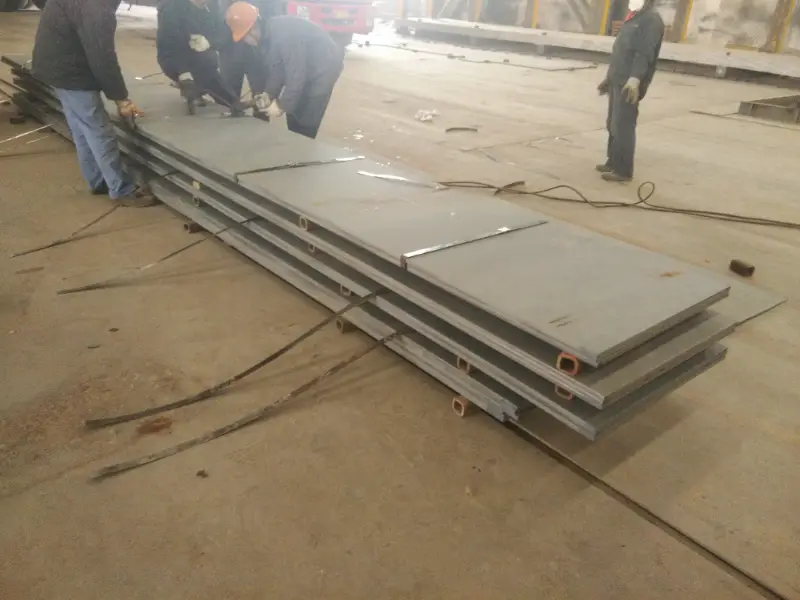
RINA Grade E690 Shipbuilding Steel Plate
RINA Grade E690 Shipbuilding Steel Plate – High Strength Quenched & Tempered Steel for Marine Structures
Comprehensive datasheet for RINA Grade E690 shipbuilding steel plate: chemical composition, mechanical properties, thermal & electrical data, international equivalents, and application guidance for marine and offshore engineering.
Hot rolling followed by quenching and tempering; can be cut, cold formed, and welded with appropriate heat input control.
- Phone : +8618037372205
- Email : [email protected]
- WhatsApp: Contact via Whtsapp
- WeChat: +8618037372205
RINA Grade E690 Shipbuilding Steel Plate Introduction
RINA Grade E690 is a high-strength, quenched and tempered structural steel plate certified by the Registro Italiano Navale (RINA), specifically designed for shipbuilding and offshore constructions. With a minimum yield strength of 690 MPa, it belongs to the group of extra-high-strength steels, enabling weight reduction and enhanced load-bearing capacity. The steel exhibits excellent weldability when proper procedures are followed, good low-temperature toughness (typically tested at -40 °C), and resistance to brittle fracture. It is supplied in the quenched and tempered condition and finds primary use in critical components such as hulls, decks, and offshore platform structures subjected to severe dynamic loads.
RINA Grade E690 Shipbuilding Steel Plate Chemical Composition
The chemical composition of RINA E690 is carefully controlled to achieve the required strength and toughness. Carbon content is limited to enhance weldability, while microalloying elements such as niobium, vanadium, and titanium contribute to grain refinement. Maximum limits are accordant with RINA Rules; however, lower carbon values are often supplied to ensure carbon equivalent (CEV) conducive to excellent weldability. Typical values are also provided for reference.
| Element | Standard Requirement (max % unless range given) | Remarks |
|---|---|---|
| Carbon (C) | ≤ 0.20 | Typical 0.10–0.18 |
| Silicon (Si) | ≤ 0.55 | Typically 0.10–0.50 |
| Manganese (Mn) | ≤ 1.70 | Typical 1.00–1.60 |
| Phosphorus (P) | ≤ 0.025 | Stringently limited |
| Sulfur (S) | ≤ 0.020 | Stringently limited |
| Chromium (Cr) | ≤ 1.50 | Optional, often 0.50–1.00 |
| Nickel (Ni) | ≤ 2.0 | Optional for toughness, typically ≤ 1.0 |
| Molybdenum (Mo) | ≤ 0.70 | Typical 0.10–0.50 |
| Copper (Cu) | ≤ 0.50 | Added for atmospheric corrosion resistance if required |
| Niobium (Nb) | ≤ 0.06 | Microalloying grain refiner |
| Vanadium (V) | ≤ 0.10 | Optional precipitation strengthening |
| Titanium (Ti) | ≤ 0.05 | Used for nitrogen fixation and grain refinement |
| Aluminum (Al total) | 0.020 – 0.060 | For deoxidation |
| Nitrogen (N) | ≤ 0.015 | Controlled to avoid strain aging |
| Boron (B) | ≤ 0.005 | Optional for hardenability improvement |
RINA Grade E690 Shipbuilding Steel Plate Thermal and Electrical Physical Properties
Physical properties are typical for quenched and tempered high-strength low-alloy steels with a density near 7.85 kg/dm³. These values are not mandatory per RINA Rules but are representative for design purposes. Data vary slightly with chemical composition and heat treatment.
| Property | Typical Value | Unit | Test Condition / Remarks |
|---|---|---|---|
| Density (ρ) | 7.85 | g/cm³ | Room temperature |
| Modulus of elasticity (E) | 210 | GPa | Tensile, 20 °C |
| Shear modulus (G) | 81 | GPa | Calculated from E and ν |
| Poisson's ratio (ν) | 0.3 | – | Elastic range |
| Coefficient of thermal expansion (α) | 11.1 × 10⁻⁶ | K⁻¹ | 20 °C to 100 °C |
| Coefficient of thermal expansion (α) | 12.5 × 10⁻⁶ | K⁻¹ | 20 °C to 400 °C |
| Thermal conductivity (λ) | 40 | W/(m·K) | At 20 °C |
| Specific heat capacity (cₚ) | 460 | J/(kg·K) | At 20 °C |
| Electrical resistivity (ρₑ) | 0.25 – 0.30 | Ω·mm²/m | At 20 °C |
| Melting range | ≈ 1420 – 1460 | °C | Approximate solidus/liquidus |
RINA Grade E690 Shipbuilding Steel Plate Mechanical Properties
Mechanical testing is performed according to RINA Rules. Specimens are taken transverse to the rolling direction. The following minimum values represent the room-temperature tensile and impact properties. For thicknesses up to 50 mm, typical values are shown; for heavier plates, slight reduction in strength may apply. Impact energy is measured on Charpy V-notch specimens at -40 °C (E grade).
| Property | Required Value | Unit | Test Condition |
|---|---|---|---|
| Yield strength (ReH) | ≥ 690 | MPa | Ambient temperature, thickness ≤ 50 mm |
| Tensile strength (Rm) | 770 – 940 | MPa | Ambient temperature, thickness ≤ 50 mm |
| Elongation after fracture (A) | ≥ 14 | % | Gauge length 5.65√So |
| Reduction of area (Z) | Typically ≥ 50 | % | Comparable grades |
| Impact energy (KV) at -40 °C, longitudinal | ≥ 69 (min. 69 average on 3 specimens, single min. 52) | J | Charpy V-notch, test temperature -40 °C |
| Impact energy (KV) at -60 °C | May be agreed upon (e.g., ≥ 27 J) | J | Optional supplementary requirement |
| Bend test (180°) | No cracks, d = 3a (t < 12 mm) or d = 4a (t ≥ 12 mm) | – | Mandrel diameter d, specimen thickness a |
RINA Grade E690 Shipbuilding Steel Plate Completely Equivalent Material Standards and Substitutable Grades
| Country/Region | Standard | Grade | Remarks |
|---|---|---|---|
| International | EN 10025-6 | S690QL / S690QL1 | Technical delivery conditions for flat products, Q&T; completely equivalent mechanical and chemical concept. |
| USA | ASTM A514 / A517 | Grade Q | A514 plate, A517 for pressure vessel; similar 690 MPa min. yield. |
| American Bureau of Shipping (ABS) | ABS Rules | EQ70 | Equivalent shipbuilding grade with 690 MPa min. yield. |
| DNV (Det Norske Veritas) | DNV Rules | E690 | Direct counterpart in DNV classification; same mechanical requirements. |
| Bureau Veritas (BV) | BV Rules | E690 | Equivalent high-strength shipbuilding plate. |
| Lloyd's Register (LR) | LR Rules | E690 | Same yield/tensile class as RINA E690. |
| China Classification Society (CCS) | CCS Rules | E690 | E690 grade for marine structures. |
| ClassNK (Nippon Kaiji Kyokai) | NK Rules | E690 | Equivalent shipbuilding plate. |
RINA Grade E690 Shipbuilding Steel Plate Application Introduction
RINA E690 steel is engineered for demanding marine and offshore environments where high strength-to-weight ratio and excellent low-temperature toughness are essential. Its quenched and tempered microstructure provides a balance of strength, ductility, and weldability, enabling fabrication of lighter, yet durable, structures. It is primarily used in thick sections requiring resistance to fatigue and impact loads.
Product Applications: Plates for hulls and decks of icebreakers and arctic vessels, Structural frames of large container ships, Leg components of self-elevating offshore platforms (jack-ups), Crane booms and lattice structures on heavy-lift vessels, Offshore module support beams and nodes, Reinforced plating for impact and collision zones
Processed into products: Ship hull shell plating and longitudinal stiffeners, Bottom and side shell frames in high-stress areas, Jack-up leg chords, rack plates, and spudcans, Deck crane pedestals and slew rings, Turret structures for FPSO mooring, Brackets, haunches, and heavy gusset plates in node connections, Wind tower transition pieces and foundation grouting connectors
Application industries: Commercial and naval shipbuilding (hulls, decks, superstructures), Offshore oil and gas (jack-up rig legs, semi-submersible platforms, FPSO modules), Marine renewable energy (offshore wind turbine substructures, wave energy structures), Heavy-lift and dredging vessels, Port and harbor equipment (ship unloaders, container crane booms), Mobile bridges and military bridging equipment
RINA Grade E690 Shipbuilding Steel Plate Similar / Near-Equivalent Material Recommendations
| Country/Region | Standard | Grade | Remarks |
|---|---|---|---|
| European Union | EN 10025-6 | S890QL | Higher strength (890 MPa) but similar processing route; for higher load applications. |
| USA | ASTM A710 | Grade A, Class 3 | 690 MPa yield precipitation-hardened steel; different metallurgical approach. |
| Germany | DIN EN 10083-3 | 42CrMo4+QT | Quenched and tempered steel with ~700–850 MPa tensile, lower toughness, sometimes used in machinery. |
| Japan | JIS G 3106 | SM570 | High tensile strength structural steel (570 MPa class); noticeably lower strength but more readily available. |
| International | ISO 4951 | S690QL | Similar to EN S690QL; widely accepted as near-equivalent. |
Notes:
Welding: Preheating and controlled interpass temperature are recommended, typically 100–175 °C depending on thickness. Use low-hydrogen electrodes (AWS E11018-M or equivalent). Post-weld heat treatment is not normally required for thicknesses under 50 mm but may be specified for heavy sections to reduce residual stresses.
Carbon Equivalent (CEV): Typical CEV is 0.45–0.55% (IIW formula), ensuring good weldability.
Ultrasonic testing: Often supplied with through-thickness (Z-quality) according to EN 10164 Z25 or Z35.
Thickness range: Commonly available from 6 mm to 150 mm (special up to 250 mm). For thicknesses above 50 mm, mechanical values may require re-negotiation.
Corrosion protection: As a low alloy steel, E690 requires protective coating or cathodic protection in seawater immersion.
- Share



