
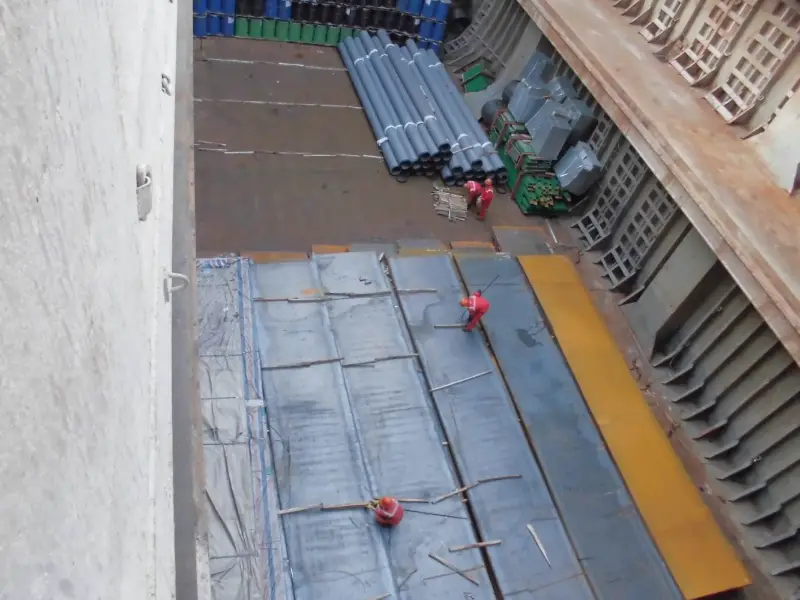
RINA Grade F690 Shipbuilding Steel Plate
RINA Grade F690 Shipbuilding Steel Plate - Properties, Equivalents & Applications
Complete technical data for RINA Grade F690 shipbuilding steel plate: chemical composition, mechanical and thermal properties, international equivalents, and typical applications in shipbuilding and offshore engineering.
Welding, thermal cutting, cold forming (limited), machining
- Phone : +8618037372205
- Email : [email protected]
- WhatsApp: Contact via Whtsapp
- WeChat: +8618037372205
RINA Grade F690 Shipbuilding Steel Plate Introduction
RINA Grade F690 is a high-strength, quenched and tempered shipbuilding steel plate defined under the Registro Italiano Navale (RINA) Rules. It belongs to the category of extra-high-strength structural steels for marine applications, offering a minimum yield strength of 690 MPa and excellent toughness at low temperatures down to -60 °C (F-grade). The steel is designed for critical structural components in ships, offshore platforms, and marine equipment where weight savings and high load-bearing capacity are essential. Typical delivery condition is quenched and tempered (Q+T), and it meets the IACS UR W11 requirements for EH690 grade.
RINA Grade F690 Shipbuilding Steel Plate Chemical Composition
The chemical composition of RINA F690 is controlled to achieve high strength and excellent low‑temperature toughness. Limits are per IACS Unified Requirement W11 for EH690 grade. Additional microalloying elements (Nb, V, Ti) are used for grain refinement. The carbon equivalent (CEV) is restricted, typically below 0.55% for good weldability.
| Element | Typical max. value (wt. %) | Remarks |
|---|---|---|
| Carbon (C) | ≤ 0.20 | Ladle analysis |
| Silicon (Si) | 0.10 – 0.55 | Killed steel practice |
| Manganese (Mn) | 0.90 – 1.70 | For strength and toughness |
| Phosphorus (P) | ≤ 0.025 | Low P for cleanliness |
| Sulfur (S) | ≤ 0.015 | Low S for toughness (IACS typically ≤0.025) |
| Chromium (Cr) | ≤ 0.70 | Optional hardenability addition |
| Nickel (Ni) | ≤ 1.00 | Improves low‑temperature toughness |
| Molybdenum (Mo) | ≤ 0.70 | Increases hardenability and temper resistance |
| Copper (Cu) | ≤ 0.50 | Weathering resistance, if specified |
| Aluminium (Al) | ≥ 0.015 (acid soluble) | Grain refinement by fine AlN |
| Niobium (Nb) | ≤ 0.06 | Microalloying, grain refinement |
| Vanadium (V) | ≤ 0.10 | Precipitation strengthening |
| Titanium (Ti) | ≤ 0.05 | Grain refinement and sulphide shape control |
| Nitrogen (N) | ≤ 0.020 | Supplied as grain‑refined steel |
| Carbon Equivalent (CEV) | ≤ 0.55 | CEV = C + Mn/6 + (Cr+Mo+V)/5 + (Ni+Cu)/15 |
RINA Grade F690 Shipbuilding Steel Plate Thermal and Electrical Physical Properties
The following physical properties are typical for quenched and tempered high‑strength structural steels in the 690 MPa yield class. Actual values may vary slightly depending on exact chemical composition and heat treatment. The data are provided for design calculations (heat transfer, thermal stress, electrical resistance).
| Property | Typical value | Unit | Test condition / Remarks |
|---|---|---|---|
| Density (ρ) | 7850 | kg/m³ | At 20 °C |
| Modulus of elasticity (E) | 210 | GPa | At 20 °C, tension |
| Shear modulus (G) | 81 | GPa | At 20 °C, calculated from E and ν |
| Poisson's ratio (ν) | 0.3 | — | Elastic range |
| Thermal expansion coefficient (α) | 11.0 | 10⁻⁶/K | Ambient to 100 °C |
| Thermal expansion coefficient (α) | 12.0 | 10⁻⁶/K | Ambient to 200 °C |
| Thermal conductivity (λ) | 35 | W/(m·K) | At 20 °C |
| Thermal conductivity (λ) | 33 | W/(m·K) | At 200 °C |
| Specific heat capacity (cp) | 460 | J/(kg·K) | At 20 °C |
| Electrical resistivity (ρe) | 0.25 – 0.35 | µΩ·m | At 20 °C, typical for low‑alloy steel |
RINA Grade F690 Shipbuilding Steel Plate Mechanical Properties
Mechanical properties of RINA F690 are verified by tensile and impact tests on specimens taken from the delivered condition (Quenched and Tempered). Requirements vary with plate thickness. Values below are minimums unless ranges are indicated. The steel exhibits excellent notch toughness at -60 °C, characteristic of the 'F' grade.
| Property | Requirement | Unit | Test condition / Thickness range |
|---|---|---|---|
| Yield strength (ReH) | ≥ 690 | MPa | t ≤ 50 mm |
| Yield strength (ReH) | ≥ 670 | MPa | 50 < t ≤ 100 mm |
| Tensile strength (Rm) | 770 – 940 | MPa | t ≤ 50 mm |
| Tensile strength (Rm) | 770 – 940 | MPa | 50 < t ≤ 100 mm |
| Elongation (A5) | ≥ 14 | % | t ≤ 50 mm (gage length 5.65√So) |
| Elongation (A5) | ≥ 14 | % | 50 < t ≤ 100 mm |
| Charpy V‑notch impact energy (KV) | ≥ 69 (longitudinal) | J | -60 °C, t ≤ 50 mm |
| Charpy V‑notch impact energy (KV) | ≥ 69 (longitudinal) | J | -60 °C, 50 < t ≤ 100 mm |
| Bend test (mandrel diameter) | 3t | — | t ≤ 25 mm, 180° bend |
| Bend test (mandrel diameter) | 4t | — | 25 < t ≤ 50 mm, 180° bend |
| Bend test (mandrel diameter) | 5t | — | 50 < t ≤ 100 mm, 180° bend |
RINA Grade F690 Shipbuilding Steel Plate Grades with Fully Equivalent Standards and Designations
| Country/Region | Standard | Grade | Remarks |
|---|---|---|---|
| International (IACS) | IACS UR W11 | EH690 | Identical mechanical and toughness requirements |
| Italy (RINA) | RINA Rules Pt.D | F690 | The current grade |
| France (BV) | BV Rules Pt.D | EH690 | Fully equivalent, F grade optional |
| Norway (DNV) | DNV Rules Pt.2 | E690 | Same yield class, -40 °C option for E; -60 °C requires special agreement |
| UK (LR) | LR Rules Pt.4 | EH690 | Equivalent; F690 not directly listed but EH690 covers same properties |
| USA (ABS) | ABS Rules Pt.2 | EQ70 | EQ70 corresponds to EH690, impact at -60 °C for 'F' grade |
| Japan (NK) | NK Rules Pt.K | KE690 | K equivalents to EH; special agreement for F grade |
| Korea (KR) | KR Rules Pt.2 | RE690 | RE690 similar, F variant possible |
| China (CCS) | CCS Rules Pt.3 | E690 | E690 for -40 °C; F690 not standard but can be supplied |
RINA Grade F690 Shipbuilding Steel Plate Application Introduction
RINA F690 steel plates are used where high strength and low temperature toughness are essential to reduce structural weight or withstand extreme service conditions. They are commonly processed by welding, flame/plasma/laser cutting, and cold forming (limited to large radii). Pre-heating and post‑weld heat treatment may be required depending on thickness and welding procedure. Typical applications span the marine and offshore industries.
Product Applications: Ship hulls and deckhouses, Jack‑up rig legs, spudcans, and fixation structures, Offshore crane pedestals and booms, Mooring equipment and bollards, Subsea lifting frames and spreader beams, Wind turbine transition pieces and monopiles (where class‑approved)
Processed into products: Welded structural sections (T‑beams, stiffeners, girders), Cut and machined heavy plates for leg racks and chords, Formed shells for pressure vessels, Flame‑cut lifting lugs and padeyes, Machined pins and shear keys for leg fixation systems, Fabricated winch bases and fairlead supports
Application industries: Shipbuilding (naval vessels, heavy‑lift vessels, icebreakers), Offshore oil & gas (jack‑up rigs, semisubmersibles, FPSO topsides), Marine heavy lifting and crane construction, Renewable offshore energy (wind turbine foundations, substations), Pressure vessel fabrication for low‑temperature service
RINA Grade F690 Shipbuilding Steel Plate Closely Related or Similar Steel Grades
| Country/Region | Standard | Grade | Remarks |
|---|---|---|---|
| EU | EN 10025-6 | S690Q | Quenched and tempered structural steel, impact at -20 °C (J0) or -40 °C (J2); not for marine class but similar strength |
| EU | EN 10025-6 | S690QL | QL has improved low‑temperature toughness (-40 °C); can be alternative for less demanding marine applications |
| USA | ASTM A514 / A517 | Grade S | Yield strength ≥690 MPa, but impact requirements differ (usually -18 °C); requires qualification for marine use |
| USA | ASTM A709 | Grade HPS 100W | Higher strength (690 MPa tensile), requires individual approval for shipbuilding |
| Japan | JIS G 3128 | SHY685 | High‑yield‑strength steel for welded structures, similar strength class, impact at -20 °C |
| Worldwide | ISO 4950-3 / ISO 630-6 | S690Q | Standard for structural steel with minimum yield 690 MPa; not class‑approved without additional testing |
Notes:
Welding considerations: RINA F690 requires low‑hydrogen welding processes (e.g., SAW, GMAW, FCAW) with consumables matching the strength and toughness level. Pre‑heating (typically 100–150 °C) and interpass temperature control may be mandatory depending on plate thickness and CEV. Post‑weld heat treatment (PWHT) is usually avoided to maintain the quenched and tempered properties; if required, a full procedure qualification is essential. Certification: Plates are supplied with RINA inspection certificate 3.1 or 3.2 according to EN 10204. Additional testing (e.g., ultrasonic testing per EN 10160 class S2/E2) is common.
- Share



