
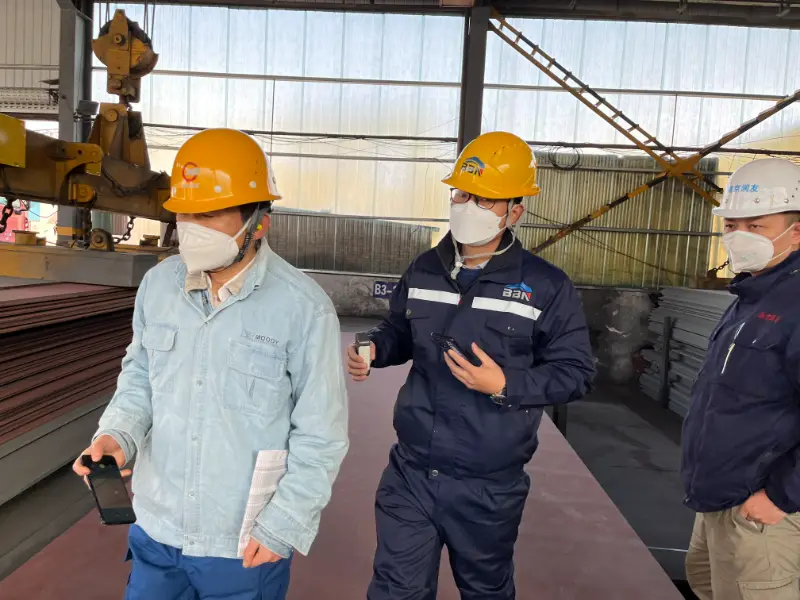
KR Grade A Shipbuilding Steel Plate
KR Grade A Shipbuilding Steel Plate: Chemical Composition, Mechanical & Physical Properties
Detailed datasheet of KR Grade A shipbuilding steel plate including chemical composition, mechanical properties, thermal and electrical properties, international equivalents, and application guide.
Hot rolling, controlled rolling, normalizing, thermomechanical controlled processing (TMCP) as agreed
- Phone : +8618037372205
- Email : [email protected]
- WhatsApp: Contact via Whtsapp
- WeChat: +8618037372205
KR Grade A Shipbuilding Steel Plate Introduction
KR Grade A is a normal strength hull structural steel grade certified by the Korean Register (KR) for shipbuilding and marine construction. It conforms to the IACS UR W11 unified requirements for ordinary strength steels. The steel offers reliable weldability and notch toughness at ambient temperatures, with a minimum yield strength of 235 MPa and tensile strength ranging from 400 to 520 MPa. It is supplied in various forms such as plates, sections, and bars. Typical delivery conditions are hot-rolled, controlled-rolled, or normalized, with optional thermomechanical controlled processing (TMCP) for enhanced properties. The steel is widely used in hull structures of commercial ships, offshore platforms, and marine equipment where moderate strength and good impact resistance at temperatures down to 20°C are required.
KR Grade A Shipbuilding Steel Plate Chemical Composition
The chemical composition of KR Grade A complies with IACS UR W11. Maximum limits are specified for elements such as carbon, sulfur, and phosphorus to ensure weldability and toughness. Manganese content is adjusted to achieve the required mechanical properties, with the minimum manganese set as 2.5 times the carbon content. Residual elements (Cr, Ni, Cu, Mo) are controlled to avoid detrimental effects on steel properties. Grain-refining elements may be added, and the total aluminum content is typically present as a deoxidizer.
| Chemical Element | Standard Value (max or range) | Remarks |
|---|---|---|
| Carbon (C) | ≤ 0.21% | Heat analysis |
| Manganese (Mn) | ≥ 2.5 × C (minimum); typically 0.80 – 1.20% | Minimum requirement depends on actual C content |
| Silicon (Si) | ≤ 0.50% | |
| Phosphorus (P) | ≤ 0.035% | |
| Sulfur (S) | ≤ 0.035% | |
| Aluminum (Al, total) | ≥ 0.015% (when fine-grain practice is used) | Optional: for fully killed fine-grain steel |
| Chromium (Cr) | ≤ 0.20% | Residual element; higher for composition to be agreed |
| Nickel (Ni) | ≤ 0.40% | Residual |
| Copper (Cu) | ≤ 0.35% | Residual |
| Molybdenum (Mo) | ≤ 0.08% | Residual |
| Nitrogen (N) | ≤ 0.009% (if aluminum treated) | For fine-grain steel |
| Vanadium (V) | ≤ 0.05% | (optional addition) |
| Niobium (Nb) | ≤ 0.03% | (optional addition) |
| Titanium (Ti) | ≤ 0.02% | (optional addition) |
KR Grade A Shipbuilding Steel Plate Thermal and Electrical Physical Properties
The physical properties are typical for carbon-manganese structural steels and are provided for design calculations. They may vary slightly depending on the exact chemical composition and heat treatment condition. Data are based on published technical literature for similar steel grades.
| Property | Typical Value | Unit | Test Condition / Remarks |
|---|---|---|---|
| Density (ρ) | 7.85 | g/cm³ | at 20°C |
| Elastic Modulus (E) | 210 | GPa | at 20°C |
| Shear Modulus (G) | approx. 81 | GPa | calculated from E and ν |
| Poisson's Ratio (ν) | 0.3 | — | at 20°C |
| Thermal Expansion Coefficient (α) | 12.5 × 10⁻⁶ | /K | between 20°C and 200°C |
| Thermal Expansion Coefficient (α) | 13.6 × 10⁻⁶ | /K | between 20°C and 400°C |
| Thermal Conductivity (λ) | 51 | W/(m·K) | at 20°C |
| Specific Heat Capacity (cp) | 486 | J/(kg·K) | at 20°C |
| Electrical Resistivity (ρₑ) | 0.16 | Ω·mm²/m | at 20°C |
KR Grade A Shipbuilding Steel Plate Mechanical Properties
Mechanical testing is performed on representative specimens in accordance with KR requirements. The yield strength, tensile strength, and elongation are determined at room temperature. Charpy V-notch impact tests are required at 20°C for Grade A (longitudinal specimens). Bend tests are carried out with a mandrel diameter of 2t (t = specimen thickness) through 180° without cracking. Values are applicable for thicknesses up to 50 mm; for thicker products, slightly reduced minimum elongation may apply.
| Property | Standard Requirement (min or range) | Unit | Test Condition / Remarks |
|---|---|---|---|
| Yield Strength (ReH) | ≥ 235 | MPa | Upper yield, room temperature; for t ≤ 50 mm |
| Tensile Strength (Rm) | 400 – 520 | MPa | Room temperature; for all thicknesses |
| Elongation (A) | ≥ 22 | % | Gauge length 5.65√S₀; for t ≤ 50 mm |
| Bend Test | 180° bend without cracks | — | Mandrel diameter = 2t (t = specimen thickness) |
| Charpy V-notch Impact Energy (KV) | ≥ 27 (longitudinal) | J | At +20°C; average of 3 specimens; one individual min 20 J |
| Charpy V-notch Impact Energy (KV) | ≥ 20 (transverse, if required) | J | At +20°C; average of 3 specimens; one individual min 14 J |
KR Grade A Shipbuilding Steel Plate Exactly Equivalent Material Standards and Substitutable Grades
| Country / Region | Standard / Classification Society | Grade Designation | Remarks |
|---|---|---|---|
| Korea | Korean Register (KR) | KR Grade A | Base specification |
| USA | American Bureau of Shipping (ABS) | ABS Grade A | Fully interchangeable |
| Norway / Germany | DNV | DNV Grade A | Fully interchangeable |
| UK | Lloyd's Register (LR) | LR Grade A | Fully interchangeable |
| France | Bureau Veritas (BV) | BV Grade A | Fully interchangeable |
| China | China Classification Society (CCS) | CCS A | Fully interchangeable |
| Japan | Nippon Kaiji Kyokai (NK) | NK Grade A | Fully interchangeable |
| Italy | Registro Italiano Navale (RINA) | RINA Grade A | Fully interchangeable |
| India | Indian Register of Shipping (IRS) | IRS Grade A | Fully interchangeable |
| Russia | Russian Maritime Register of Shipping (RMRS) | RS Grade A | Fully interchangeable |
KR Grade A Shipbuilding Steel Plate Application Introduction
KR Grade A is principally used in shipbuilding and marine construction where moderate strength and good weldability are required. It is suitable for primary and secondary hull structural elements, as well as non-critical components operating at ambient temperatures. The steel exhibits excellent formability and can be processed by common cold and hot working practices. Its typical applications span a wide range of vessels and offshore structures.
Product Applications: Ship hulls (shell plating, decks, bottom plates), Bulkheads and watertight doors, Superstructures and deckhouses, Offshore platform topsides and jackets, Bridges and structural modules
Processed into products: Longitudinal and transverse stiffeners, Frames, beams, and girders, Brackets and knees, Hull side and bottom plates, Web plates and stringers, Non-critical stiffened panels
Application industries: Commercial shipbuilding (tankers, bulk carriers, container ships), Naval architecture and marine engineering, Offshore oil & gas platform construction, Barge and pontoon fabrication, Port and harbor equipment
KR Grade A Shipbuilding Steel Plate Similar or Near-Substitute Steel Grades
| Country / Region | Standard | Grade Designation | Remarks |
|---|---|---|---|
| International (IACS) | IACS UR W11 | Grade B | Slightly higher Mn; impact test at 0°C instead of +20°C; for applications requiring better low-temperature toughness |
| International (IACS) | IACS UR W11 | Grade D | Higher manganese and fine-grain practice; impact test at -20°C; for colder service conditions |
| Europe | EN 10025-2 | S235J0 / S235J2 | Structural steel with similar strength but different impact requirements; not identical in weldability certification |
| Japan | JIS G 3106 | SM400A / SM400B | Weldable structural steel with yield 235 MPa; SM400B offers guaranteed impact at 0°C |
| China | GB/T 712 | A | Chinese shipbuilding steel A grade; identical chemical and mechanical requirements |
Notes:
- All values are for thickness ≤ 50 mm unless otherwise specified; for thicker products, consult classification society rules for possible property reductions.
- Optional supplementary impact testing at lower temperatures can be agreed upon; standard Grade A is tested at +20°C.
- Steel can be supplied with through-thickness property requirements (Z-grade) per IACS UR Z25 if specified.
- Weldability: Preheating is generally not required for thicknesses below 30 mm under normal conditions; for higher thicknesses or high restraint conditions, preheat to 100–150°C may be recommended.
- CEV (Carbon Equivalent Value) typically ≤ 0.38% based on heat analysis, suitable for low-hydrogen welding processes.
- Share



