
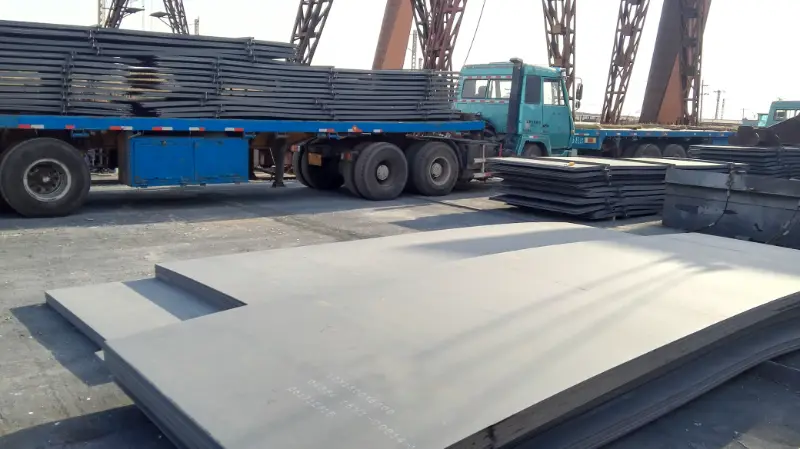
KR Grade B Shipbuilding Steel Plate
KR Grade B Shipbuilding Steel Plate: Specification, Properties & Equivalents
Comprehensive technical data for KR Grade B shipbuilding steel plate, including chemical composition, mechanical properties, thermal and electrical physical properties, international equivalents, and application guidance.
Hot rolling; Normalizing (optional, for thicknesses above certain limits); Quenching and tempering (not typical for Grade B)
- Phone : +8618037372205
- Email : [email protected]
- WhatsApp: Contact via Whtsapp
- WeChat: +8618037372205
KR Grade B Shipbuilding Steel Plate Introduction
KR Grade B is an ordinary-strength hull structural steel plate certified by the Korean Register of Shipping (KR). It is designed for use in ship and offshore structure construction where moderate toughness is required. The grade offers a minimum yield strength of 235 MPa and a tensile strength range of 400–520 MPa. It is supplied in normalized or as-rolled condition, with impact testing at 0°C to ensure reliable performance in marine environments. Typical applications include hull plates, stiffeners, bulkheads, and deck structures. The steel is produced to strict specifications ensuring weldability, formability, and resistance to brittle fracture. International classification societies recognize equivalent grades under the IACS common structural rules.
- Minimum yield strength 235 MPa
- Charpy impact test at 0°C
- Thickness up to 100 mm available
KR Grade B Shipbuilding Steel Plate Chemical Composition
The chemical composition of KR Grade B is governed by IACS UR W11 (Ordinary Strength Hull Structural Steel). All values are maximum unless a range or minimum is given. Grain refining elements shall be present in sufficient amount to obtain fine austenitic grain size. For thicknesses > 40 mm, a reduced minimum manganese content applies.
- Deoxidation practice: fully killed with additions of grain refining elements such as Al, Nb, V, or Ti.
- Residual elements (Cr, Ni, Cu, Mo) are typically limited each to 0.30% and total to 0.70%.
| Chemical Element | Standard Value | Remarks |
|---|---|---|
| Carbon (C) | ≤ 0.21% | Ladle analysis |
| Manganese (Mn) | ≥ 0.80% (for t ≤ 40 mm) | ≥ 0.70% for t > 40 mm |
| Silicon (Si) | 0.10 – 0.35% | |
| Phosphorus (P) | ≤ 0.035% | |
| Sulfur (S) | ≤ 0.035% | |
| Aluminium (Al, acid soluble) | ≥ 0.015% | Required if grain refining is achieved by Al additions |
| Chromium (Cr) | ≤ 0.30% | Residual |
| Nickel (Ni) | ≤ 0.30% | Residual |
| Copper (Cu) | ≤ 0.30% | Residual |
| Molybdenum (Mo) | ≤ 0.30% | Residual |
| Total Cr+Ni+Cu+Mo | ≤ 0.70% | Residual sum |
KR Grade B Shipbuilding Steel Plate Thermal and Electrical Physical Properties
These physical properties are typical for carbon-manganese structural steels at room temperature unless otherwise noted. Actual values may vary slightly depending on exact composition and heat treatment.
- All values should be considered approximate and are not guaranteed.
| Property | Typical Value | Unit | Temperature / Condition |
|---|---|---|---|
| Density (ρ) | 7.85 | g/cm³ | 20°C |
| Modulus of Elasticity (E) | 205 | GPa | 20°C |
| Shear Modulus (G) | 80 | GPa | 20°C |
| Poisson's Ratio (ν) | 0.30 | – | 20°C |
| Coefficient of Thermal Expansion (α) | 11.5 × 10⁻⁶ | K⁻¹ | 20 – 100°C |
| Coefficient of Thermal Expansion (α) | 12.5 × 10⁻⁶ | K⁻¹ | 20 – 300°C |
| Thermal Conductivity (λ) | 52 | W/(m·K) | 20 – 100°C |
| Specific Heat Capacity (c) | 460 | J/(kg·K) | 20°C |
| Electrical Resistivity (ρₑ) | 0.22 × 10⁻⁶ | Ω·m | 20°C |
KR Grade B Shipbuilding Steel Plate Mechanical Properties
The mechanical properties of KR Grade B plates are verified by tensile, impact, and cold bend tests in accordance with KR Rules. The values below are minimum or range requirements as per IACS UR W11. Yield strength and tensile strength apply to transverse test specimens; elongation depends on gauge length.
- Transverse specimens are standard; longitudinal specimens may be used for plates of limited width.
- Impact test temperature: 0°C for Grade B.
| Property | Standard Requirement | Unit | Test Conditions |
|---|---|---|---|
| Yield Strength (ReH) | ≥ 235 | MPa | All thicknesses, transverse |
| Tensile Strength (Rm) | 400 – 520 | MPa | Transverse |
| Elongation (A5) | ≥ 22 | % | Thickness ≤ 50 mm, longitudinal; ≥ 20% transverse |
| Elongation (A5) | ≥ 21 | % | Thickness > 50 mm, transverse (longitudinal ≥ 22%) |
| Charpy V-notch Impact Energy (KV) | ≥ 27 (average), ≥ 20 (single) | J | Longitudinal, 0°C, standard 10×10 mm specimen |
| Charpy V-notch Impact Energy (KV) | ≥ 20 (average), ≥ 14 (single) | J | Transverse, 0°C, standard 10×10 mm specimen |
| Cold Bend Test (180°) | No cracks or defects | – | Bend diameter: 3a for t ≤ 30 mm; 4a for t > 30 mm (a = specimen thickness) |
KR Grade B Shipbuilding Steel Plate Completely Equivalent Material Standards and Replaceable Grade Recommendations
| Country/Region | Standard | Grade | Remarks |
|---|---|---|---|
| International | IACS UR W11 | Ordinary Strength Grade B | All IACS members |
| USA | ABS Rules | Grade B | American Bureau of Shipping |
| UK | LR Rules | Grade B | Lloyd's Register |
| Norway/Germany | DNV Rules | Grade B (NV B) | DNV GL (now DNV) |
| France | BV Rules | Grade B | Bureau Veritas |
| Japan | NK Rules | Grade B | Nippon Kaiji Kyokai |
| China | CCS Rules | Grade B | China Classification Society |
| Italy | RINA Rules | Grade B | Registro Italiano Navale |
KR Grade B Shipbuilding Steel Plate Application Introduction
KR Grade B steel is extensively used in marine and offshore engineering due to its reliable toughness at 0°C and good weldability. It is suitable for fabrication by cutting, forming, welding, and machining processes common in shipyards. Key industries and applications include:
- Shipbuilding: hull plates, deck plates, bulkheads, stiffeners, web frames.
- Offshore structures: decks, jackets, modules where 0°C impact performance suffices.
- Barge and pontoon construction.
- Coastal and inland waterway vessels.
Typical components include main hull plating, longitudinal and transverse framing, superstructure elements, and foundations.
Product Applications: Bulk carriers, container ships, tankers, and general cargo vessels, Offshore supply vessels and tugs, Floating docks and pontoons, River–sea combination vessels
Processed into products: Hull plates and bottom plates, Deck plates and deckhouse structures, Longitudinal girders and stiffeners, Transverse bulkheads and watertight doors, Web frames and brackets, Machinery seatings and foundations
Application industries: Shipbuilding and ship repair, Offshore oil and gas platform fabrication, Marine engineering and port equipment, Barge and floating terminal construction
KR Grade B Shipbuilding Steel Plate Similar/Approximate Alternative Material Recommendations
| Country/Region | Standard | Grade | Remarks |
|---|---|---|---|
| Europe | EN 10025-2 | S235JR / S235J0 / S235J2 | Structural steel; S235J0 offers impact at 0°C but not subject to full shipbuilding certification; check thickness and toughness requirements |
| USA | ASTM A36 / ASTM A131 | A36 / Grade B | ASTM A131 Grade B is the exact shipbuilding equivalent; A36 is a general structural grade with comparable yield strength |
| Japan | JIS G3101 | SS400 | General structural steel; not impact tested; use only for non-critical applications |
| China | GB/T 712 | B | Chinese shipbuilding steel, equivalent to CCS Grade B |
Notes:
For thicknesses above 50 mm, special agreement may be required for mechanical property values. Plates are usually supplied with classification society stamp and certificates. Surface condition and tolerances comply with KR Rules or EN 10029. Dimensional and flatness tolerances may be agreed upon at the time of order. Supplementary requirements such as Z‑direction through‑thickness testing (Z35) can be specified for components under high tensile stress in the through‑thickness direction.
- Share



