
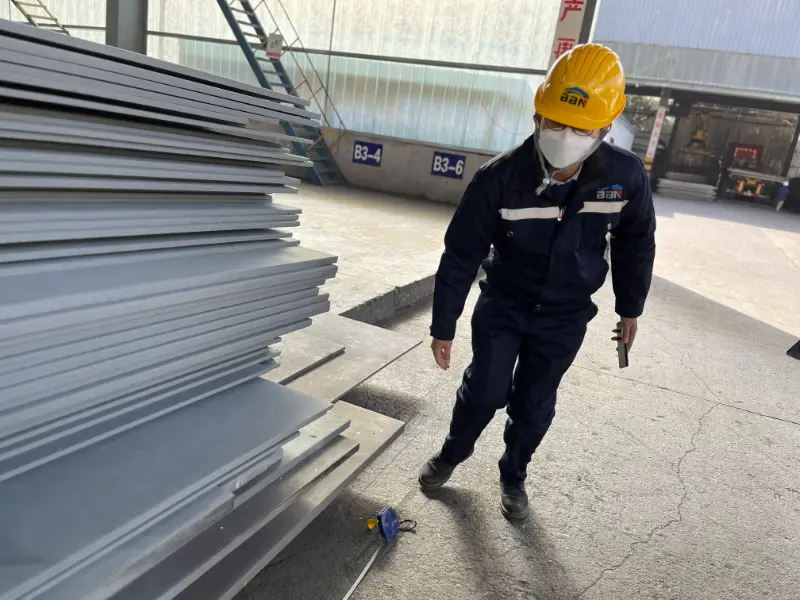
KR Grade D Shipbuilding Steel Plate
KR Grade D Shipbuilding Steel Plate: Comprehensive Properties, Equivalents & Application
Complete datasheet for KR Grade D shipbuilding steel plate covering chemical composition, mechanical and physical properties, equivalent grades, and applications in marine construction. Expert technical reference for engineers and procurement.
Hot rolling, normalizing, welding, flame/plasma/laser cutting, cold bending, forming, machining
- Phone : +8618037372205
- Email : [email protected]
- WhatsApp: Contact via Whtsapp
- WeChat: +8618037372205
KR Grade D Shipbuilding Steel Plate Introduction
KR Grade D is a normal strength hull structural steel grade certified by the Korean Register of Shipping (KR), conforming to IACS UR W11 requirements. It is widely used in shipbuilding and marine structures. This steel exhibits good weldability, moderate yield strength (≥235 MPa), and reliable low‑temperature toughness with specified Charpy V‑notch impact energy at −20°C. It is typically supplied in normalized or as‑rolled condition depending on thickness, and is suitable for welding without preheating under normal conditions. Its balanced composition with controlled residuals ensures consistent performance in demanding marine environments.
KR Grade D Shipbuilding Steel Plate Chemical Composition
The typical chemical composition of KR Grade D steel is controlled to ensure weldability, strength, and low‑temperature toughness. Limits comply with IACS UR W11 for normal strength hull structural steels. Residual elements (Cr, Ni, Cu, Mo) are kept low to avoid hardness and cracking. Aluminium may be added for grain refinement in killed steels. Carbon equivalent (CEV) is usually below 0.40% for good weldability.
| Element | Standard Value (max unless stated) | Remarks |
|---|---|---|
| C | ≤ 0.21 | Max; for thickness > 12 mm, Mn ≥ 2.5×C applies |
| Mn | ≥ 0.60 (≥ 2.5×C if t>12 mm) | Minimum; higher Mn improves strength and toughness |
| Si | ≤ 0.35 | Deoxidation element, typical for semi‑killed or killed steel |
| P | ≤ 0.035 | Max to avoid embrittlement |
| S | ≤ 0.035 | Max for hot workability and weldability |
| Cr | ≤ 0.20 | Residual, limited to prevent hardening |
| Ni | ≤ 0.40 | Residual, beneficial for toughness but limited |
| Cu | ≤ 0.35 | Residual, may cause hot shortness if excessive |
| Mo | ≤ 0.08 | Residual, strictly limited |
| Al (acid soluble) | ≥ 0.015 | Required for killed fine‑grain practice; optional for non‑killed thinner plates |
KR Grade D Shipbuilding Steel Plate Physical & Thermal Properties
The following physical and thermal properties are typical for low‑carbon structural steel of this type. They are not part of the delivery specification but are essential for engineering design, heat transfer calculations, and welding process planning. Values are measured at room temperature unless otherwise noted.
| Property | Standard Value (Typical) | Unit | Test Condition / Remarks |
|---|---|---|---|
| Density (ρ) | 7.85 | g/cm³ | At 20°C |
| Elastic Modulus (E) | 210 | GPa | At 20°C |
| Shear Modulus (G) | 81 | GPa | At 20°C |
| Poisson's Ratio (ν) | 0.3 | – | Elastic range |
| Thermal Expansion Coefficient (α, 20–100°C) | 11.5 – 12.5 | 10⁻⁶/K | Mean value |
| Thermal Conductivity (λ) | ≈ 52 | W/(m·K) | At 20°C |
| Specific Heat Capacity (cp) | 460 – 500 | J/(kg·K) | Room temperature |
| Electrical Resistivity (ρₑ) | 0.15 – 0.20 | µΩ·m | At 20°C |
KR Grade D Shipbuilding Steel Plate Mechanical Properties
Mechanical properties are determined on test pieces taken in the longitudinal direction (transverse values may be agreed separately). Yield and tensile strengths apply to plate thicknesses ≤100 mm. Elongation and Charpy V‑notch impact energy are thickness‑dependent. Impact tests are performed at −20°C, characteristic for Grade D toughness. Bending test ensures formability without cracking. All values conform to IACS UR W11.
| Property | Standard Requirement | Unit | Test Condition / Remarks |
|---|---|---|---|
| Yield Strength (ReH) | ≥ 235 | MPa | Thickness ≤ 100 mm |
| Tensile Strength (Rm) | 400 – 520 | MPa | Thickness ≤ 100 mm |
| Elongation (A, 5.65√S₀) | ≥ 22 | % | Thickness ≤ 50 mm |
| Elongation (A, 5.65√S₀) | ≥ 21 | % | 50 mm < thickness ≤ 70 mm |
| Elongation (A, 5.65√S₀) | ≥ 20 | % | 70 mm < thickness ≤ 100 mm |
| Charpy V‑notch Impact (KV₂, −20°C, longitudinal) | ≥ 27 | J | Thickness ≤ 50 mm |
| Charpy V‑notch Impact (KV₂, −20°C, longitudinal) | ≥ 24 | J | 50 mm < thickness ≤ 70 mm |
| Charpy V‑notch Impact (KV₂, −20°C, longitudinal) | ≥ 21 | J | 70 mm < thickness ≤ 100 mm |
| Bend Test (180° bend, no cracks) | Inner diameter = 3×t | – | Thickness ≤ 25 mm |
| Bend Test (180° bend, no cracks) | Inner diameter = 4×t | – | 25 mm < thickness ≤ 50 mm |
KR Grade D Shipbuilding Steel Plate Fully Equivalent Material Standards & Substitutable Grades
| Country/Region | Standard | Grade | Remarks |
|---|---|---|---|
| South Korea | KR Rules | KR Grade D | Original Korean Register grade |
| International (IACS) | IACS UR W11 | Grade D | Unified Requirement – identical chemistry & properties |
| USA | ASTM A131 | Grade D | Fully equivalent hull steel |
| UK | LR Rules | LR Grade D | Lloyd's Register equivalent |
| USA | ABS Rules | ABS Grade D | American Bureau of Shipping |
| France | BV Rules | BV Grade D | Bureau Veritas |
| China | CCS Rules | CCS Grade D | China Classification Society |
| Norway/Germany | DNV GL Rules | DNV NV D / GL‑D | Now DNV Grade D |
| Japan | NK Rules | NK Grade D | Nippon Kaiji Kyokai |
| Italy | RINA Rules | RINA Grade D | Registro Italiano Navale |
| Russia | RMRS Rules | RS Grade D | Russian Maritime Register of Shipping |
KR Grade D Shipbuilding Steel Plate Application Introduction
KR Grade D steel is primarily used in welded ship hulls and marine structures. Its good weldability and guaranteed low‑temperature toughness at −20°C make it suitable for critical structural members. The steel is typically fabricated by cutting, cold forming, and welding, and often painted or coated for corrosion protection. It is approved by classification societies for primary and secondary hull members.
Product Applications: Hull shell plates and bottom plates, Deck plates and cargo hold structures, Longitudinal and transverse bulkheads, Stiffeners, stringers, and girders, Superstructure and accommodation modules, Offshore platform decks and columns
Processed into products: Brackets and tripping brackets, Rudder plates and stock bearings, Hatch coamings and covers, Foundations for main engines and auxiliaries, Ladders, railings, and non‑critical outfitting items, Piping supports and equipment bases
Application industries: Shipbuilding and ship repair, Offshore oil & gas platforms, Barge and floating dock construction, Port infrastructure and crane manufacturing, Marine renewable energy (wind turbine foundations), Structural steel fabrication for marine environments
KR Grade D Shipbuilding Steel Plate Similar / Alternative Materials
| Country/Region | Standard | Grade | Remarks |
|---|---|---|---|
| EU | EN 10025‑2 | S235J2+N | Similar yield (≥235 MPa) and impact at −20°C; normalized delivery; CEV may be slightly different; not ship‑class certified. |
| Japan | JIS G 3106 | SM400B | Comparable strength, charpy at 0°C; SM400B has higher impact temperature; not directly interchangeable for ship rules. |
| China | GB/T 712 | D | Chinese shipbuilding grade D – equivalent in concept, but refer to specific standard revisions for exact match. |
Notes:
- All mechanical test values are minimum requirements unless a range is stated (tensile strength).
- For thicknesses above 100 mm, different property requirements may apply; consult the classification society.
- Welding consumables must be matched to the steel to maintain toughness; preheat may be needed for thick sections or when CEV approaches upper limits.
- This datasheet summarizes standard requirements; specific orders may have additional supplementary requirements (e.g., through‑thickness properties, Z‑quality, extra ultrasonic testing).
- Share



