
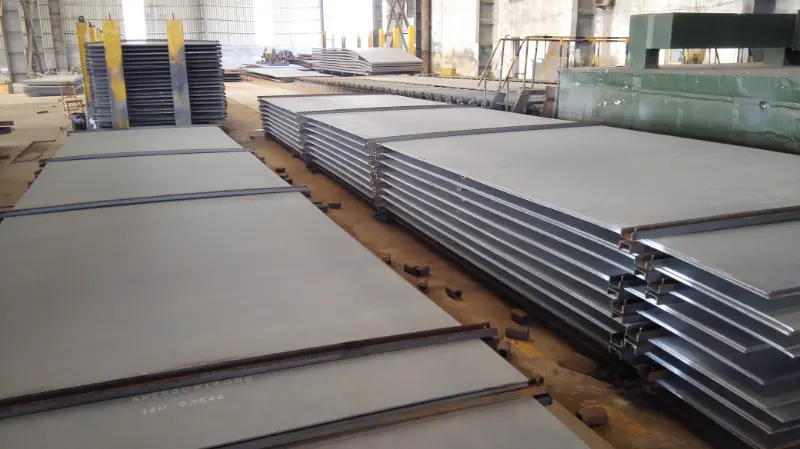
KR Grade E Shipbuilding Steel Plate
KR Grade E Shipbuilding Steel Plate - Normal Strength Hull Structural Steel as per KR Rules
Comprehensive material data and equivalent grades for KR Grade E shipbuilding steel plate, a normal strength structural steel for hull construction, with guaranteed low-temperature toughness at -40°C.
Hot rolling, normalizing, TMCP, cutting, welding, forming
- Phone : +8618037372205
- Email : [email protected]
- WhatsApp: Contact via Whtsapp
- WeChat: +8618037372205
KR Grade E Shipbuilding Steel Plate Introduction
KR Grade E is a normal strength hull structural steel defined by the Korean Register of Shipping (KR) Rules. It belongs to the family of standard strength shipbuilding plates and is intended for use in primary ship structures such as hulls, decks, and stiffeners. The steel is typically supplied in the hot-rolled, normalized, or thermo-mechanically controlled processed (TMCP) condition. It exhibits a minimum yield strength of 235 MPa and a tensile strength range of 400–520 MPa. A key distinguishing feature is its guaranteed Charpy V-notch impact toughness at -40°C, making it suitable for ships operating in cold environments. The material meets the requirements of IACS UR W11, ensuring international equivalence with other classification societies' Grade E steels. It offers good weldability, formability, and resistance to brittle fracture.
KR Grade E Shipbuilding Steel Plate Chemical Composition
The chemical composition of KR Grade E conforms to the IACS UR W11 requirements for normal strength hull structural steel. The specification sets maximum limits for carbon, phosphorus, and sulfur to ensure weldability and toughness. Manganese content is adjusted based on plate thickness to maintain strength. A minimum acid-soluble aluminum content is required to achieve fine grain size and guarantee the -40°C impact properties. No intentional addition of microalloying elements is required for this normal strength grade.
| Element | Required Value (wt. %) | Remarks |
|---|---|---|
| C | ≤ 0.18 | Applicable to all thicknesses |
| Mn | ≥ 0.70 (t ≤ 12.5 mm); ≥ 0.80 (t > 12.5 mm) | Minimum depends on product thickness |
| Si | ≤ 0.50 | |
| P | ≤ 0.035 | |
| S | ≤ 0.035 | |
| Al (acid soluble) | ≥ 0.015 | Total Al ≥ 0.020 if acid soluble method not used; required for grain refinement |
| N | ≤ 0.009 (if applicable) | Usually not specified, but may be limited when aluminium is added |
KR Grade E Shipbuilding Steel Plate Thermal and Electrical Physical Properties
The following physical properties are typical for normalized or hot-rolled carbon-manganese steel of this grade. They are not mandatory requirements of the product standard but serve as reliable engineering data for design calculations. Properties such as density, elastic moduli, and thermal expansion are largely independent of minor compositional variations within the specification. Electrical resistivity and thermal conductivity are average values at room temperature and may vary with temperature and microstructure.
| Property | Typical Value | Unit | Test Condition / Remarks |
|---|---|---|---|
| Density (ρ) | 7.85 | g/cm³ | At 20°C |
| Modulus of Elasticity (E) | 210 | GPa | At room temperature |
| Shear Modulus (G) | ≈ 80 | GPa | Calculated from E and Poisson's ratio |
| Poisson's Ratio (ν) | 0.3 | – | At room temperature |
| Thermal Expansion Coefficient (α) | 11.5 × 10⁻⁶ | 1/K | 20–100°C |
| Thermal Expansion Coefficient (α) | 12.1 × 10⁻⁶ | 1/K | 20–200°C |
| Thermal Expansion Coefficient (α) | 12.9 × 10⁻⁶ | 1/K | 20–300°C |
| Thermal Conductivity (λ) | 51.9 | W/(m·K) | At 20°C |
| Specific Heat Capacity (cp) | 486 | J/(kg·K) | At 20°C |
| Electrical Resistivity (ρₑ) | 0.16 × 10⁻⁶ | Ω·m | At 20°C, typical for low-carbon steel |
KR Grade E Shipbuilding Steel Plate Mechanical Properties
The mechanical properties are determined according to KR Rules and IACS UR W11 on standard tensile and impact test specimens taken in the longitudinal and, where indicated, transverse directions. The specified values apply to plate thicknesses up to 100 mm for yield and tensile strength, and up to 50 mm for elongation and Charpy impact test unless otherwise extended by classification society rules. The Charpy V-notch impact test is performed at -40°C for Grade E, and both longitudinal and transverse minimum energy values are specified. Bend tests are conducted with a mandrel diameter related to plate thickness to verify ductility.
| Property | Required Value | Unit | Test Condition |
|---|---|---|---|
| Yield Strength (ReH) | ≥ 235 | MPa | Room temperature, applicable for thickness ≤ 100 mm |
| Tensile Strength (Rm) | 400 – 520 | MPa | Room temperature |
| Elongation (A, L0=5.65√S0) | ≥ 22 | % | Longitudinal specimen, thickness ≤ 50 mm |
| Bend Test (180°) | d = 3t (t ≤ 25 mm); d = 4t (t > 25 mm) | No cracks permitted; t = specimen thickness | |
| Charpy Impact Energy (KV2), -40°C | ≥ 27 (longitudinal) | J | Thickness ≤ 50 mm; V-notch, test at -40°C |
| Charpy Impact Energy (KV2), -40°C | ≥ 20 (transverse) | J | Thickness ≤ 50 mm; V-notch, test at -40°C |
KR Grade E Shipbuilding Steel Plate Directly Equivalent Standards and Replaceable Grades
| Country/Region | Standard / Rules | Grade | Remarks |
|---|---|---|---|
| South Korea | KR Rules Part 2, Chapter 1 | KR Grade E | Identical; reference grade for this analysis |
| USA | ABS Rules | ABS Grade E | Equivalent under IACS UR W11 |
| UK | Lloyd's Register Rules | LR Grade E | Equivalent under IACS UR W11 |
| Norway/Germany | DNV Rules | DNV Grade E | Equivalent under IACS UR W11 |
| France | Bureau Veritas Rules | BV Grade E | Equivalent under IACS UR W11 |
| China | CCS Rules | CCS Grade E | Equivalent under IACS UR W11 |
| Japan | ClassNK Rules | NK Grade E | Equivalent under IACS UR W11 |
| Italy | RINA Rules | RINA Grade E | Equivalent under IACS UR W11 |
| International | IACS UR W11 | Normal Strength Grade E | Common international specification for all IACS members |
KR Grade E Shipbuilding Steel Plate Application Introduction
KR Grade E is specifically designed for welded structures in shipbuilding and offshore engineering where reliable low-temperature toughness is essential. It is used in the construction of the main hull envelope and primary strength members. The steel is readily weldable with standard shipyard procedures and can be formed by cold bending or pressing, provided adequate bending radii are maintained to avoid strain aging. When used in critical low-temperature service, attention must be paid to welding consumables and procedures to ensure the heat-affected zone retains sufficient toughness.
Product Applications: Hull shell plates for ice-classed vessels, Deck plating and stringer plates, Bulkhead and tank boundary structures, Main frames, stiffeners and longitudinal girders, Rudders, stern frames and sea chests, Modules and helidecks on offshore platforms
Processed into products: Shell plates formed into curved sections by cold rolling or press forming, Stiffening ribs, flat bars and angle sections, Weld-fabricated T-beams and built-up sections, Brackets, gussets and floor plates, Machined hatch coamings and foundation pads, Cut and welded assemblies such as rudder horns and stern tubes
Application industries: Shipbuilding (merchant ships, naval vessels, passenger ships), Offshore engineering (platforms, floating production units), Marine equipment (buoys, pontoons, lock gates), Structural steel construction (cold-climate buildings and bridges with toughness requirements)
KR Grade E Shipbuilding Steel Plate Similar / Alternative Material Recommendations
| Country/Region | Standard | Grade | Remarks |
|---|---|---|---|
| South Korea | KR Rules | KR Grade D | Same strength, but impact test at -20°C; only for applications not requiring -40°C toughness |
| EU | EN 10025-2 | S235J2 | Comparable strength (yield ≥235 MPa), Charpy -20°C; not a full substitute for -40°C service without additional verification |
| Japan | JIS G 3106 | SM400B | Tensile strength 400-510 MPa; impact test at 0°C; useful for moderate conditions but insufficient for low-temperature marine requirements |
| USA | ASTM A36 | A36 | Yield ≥250 MPa, tensile 400-550 MPa; not notch-toughness rated for -40°C; possible alternative only for mild environments |
Notes:
Additional Information:
- The data provided complies with IACS UR W11 and KR Rules.
- For thicknesses above 50 mm, mechanical properties should be confirmed with the classification society; impact test requirements may differ.
- Welding: Pre-heating is generally not required for thicknesses under 30 mm, but may be applied as per approved welding procedures for heavier plates.
- Strain aging sensitivity: Cold forming may affect impact properties; hot forming or post-forming stress relief is recommended when forming reduction exceeds 5%.
- Certification: KR Grade E plates are usually delivered with class inspection certificates (3.1 or 3.2 per EN 10204).
- Share



