
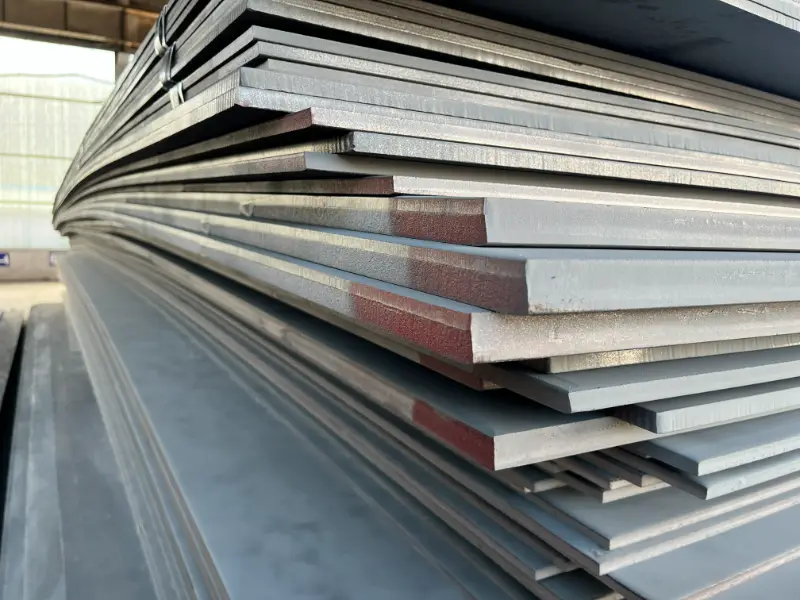
KR Grade E32 Shipbuilding Steel Plate
KR Grade E32 Shipbuilding Steel Plate - High Strength Hull Structural Steel (315 MPa Yield)
Comprehensive material data for KR Grade E32 shipbuilding steel plate: chemical composition, mechanical and physical properties, equivalent grades, and application guidance.
Suitable for welding (all common processes), hot/cold forming, cutting (flame, plasma, laser), and machining. Preheating may be required for thick sections.
- Phone : +8618037372205
- Email : [email protected]
- WhatsApp: Contact via Whtsapp
- WeChat: +8618037372205
KR Grade E32 Shipbuilding Steel Plate Introduction
KR Grade E32 is a high-strength hull structural steel certified by the Korean Register of Shipping (KR). It complies with the requirements of IACS UR W11 for normalized or thermomechanically rolled steels with a minimum yield strength of 315 MPa. The grade designation 'E' indicates that the material is subjected to Charpy V‑notch impact testing at -40 °C.
Typical applications include primary hull structures, decks, bottom shells, and offshore platform components. The steel offers good weldability, toughness and strength, and is generally delivered in as‑rolled, normalized, or TMCP condition.
KR Grade E32 Shipbuilding Steel Plate Chemical Composition
The chemical composition of KR E32 steel is defined by the Korean Register in accordance with IACS UR W11. The steel is fully killed and fine‑grain treated. Elements not listed below, such as residual elements, must not adversely affect the mechanical properties or weldability. Special care is taken to control phosphorous and sulfur for good low‑temperature toughness.
| Element | Standard Requirement (wt.%) | Remarks |
|---|---|---|
| Carbon (C) | ≤ 0.18 | Ladle analysis |
| Silicon (Si) | ≤ 0.50 | Killed steel |
| Manganese (Mn) | 0.90 – 1.60 | Higher Mn for strength |
| Phosphorus (P) | ≤ 0.035 | Maximized for toughness |
| Sulfur (S) | ≤ 0.035 | Maximized for toughness |
| Aluminum (acid‑soluble) | ≥ 0.015 | or total Al ≥ 0.020; grain refinement |
| Niobium (Nb) | 0.02 – 0.05 | Grain refiner |
| Vanadium (V) | 0.05 – 0.10 | Precipitation hardening |
| Titanium (Ti) | ≤ 0.02 | Optional; used for grain refinement and deoxidation |
| Copper (Cu) | ≤ 0.35 | Residual; may be controlled for hot shortness |
| Chromium (Cr) | ≤ 0.20 | Residual |
| Nickel (Ni) | ≤ 0.40 | Residual |
| Molybdenum (Mo) | ≤ 0.08 | Residual |
| Nitrogen (N) | ≤ 0.009 | Must be bound by Al/Ti |
| Nb+V | ≤ 0.06 % | Combined limitation |
| Nb+V+Ti | ≤ 0.12 % | Combined limitation |
KR Grade E32 Shipbuilding Steel Plate Thermal and Electrical Physical Properties
The following physical properties are representative for fine‑grained C‑Mn structural steel and can be used for engineering calculations. They are not specified in the ship classification rules but are commonly accepted data.
| Property | Typical Value | Unit | Test Condition / Temperature |
|---|---|---|---|
| Density (ρ) | 7.85 | g/cm³ | 20 °C |
| Modulus of Elasticity (E) | 205 | GPa | Room temperature |
| Shear Modulus (G) | ~80 | GPa | Room temperature |
| Poisson's Ratio (ν) | 0.3 | – | Room temperature |
| Thermal Expansion Coefficient (α) | 11.5 | ×10⁻⁶ /K | 20 – 100 °C |
| Thermal Expansion Coefficient (α) | 12.5 | ×10⁻⁶ /K | 20 – 200 °C |
| Thermal Expansion Coefficient (α) | 13.5 | ×10⁻⁶ /K | 20 – 400 °C |
| Thermal Conductivity (λ) | 51.9 | W/(m·K) | 100 °C |
| Specific Heat Capacity | 0.486 | J/(g·K) | 20 °C |
| Electrical Resistivity (ρₑ) | ~0.16 | ×10⁻⁶ Ω·m | 20 °C |
KR Grade E32 Shipbuilding Steel Plate Mechanical Properties
Tensile and impact properties are determined in accordance with KR Rules and IACS UR W11. The values apply to transverse test pieces taken from the product in the delivery condition. The Charpy impact test is performed at -40 °C; for thicknesses below 10 mm, miniaturized sub‑size specimens are used with adjusted energy minima.
| Property | Standard Requirement | Unit | Test Condition / Thickness |
|---|---|---|---|
| Yield Strength (ReH) | ≥ 315 | MPa | t ≤ 50 mm |
| Yield Strength (ReH) | ≥ 295 | MPa | 50 < t ≤ 70 mm |
| Yield Strength (ReH) | ≥ 275 | MPa | 70 < t ≤ 100 mm |
| Tensile Strength (Rm) | 440 – 590 | MPa | t ≤ 50 mm |
| Tensile Strength (Rm) | 440 – 590 | MPa | 50 < t ≤ 70 mm |
| Tensile Strength (Rm) | 420 – 570 | MPa | 70 < t ≤ 100 mm |
| Elongation (A5) | ≥ 22 | % | t ≤ 50 mm, gauge length 5.65√So |
| Elongation (A5) | ≥ 21 | % | 50 < t ≤ 70 mm |
| Elongation (A5) | ≥ 20 | % | 70 < t ≤ 100 mm |
| Bend Test (180°) | d = 3a | – | t ≤ 50 mm; no cracks |
| Bend Test | To be agreed | – | t > 50 mm |
| Charpy V‑notch Impact Energy (KV) | ≥ 34 (longitudinal) | J | ‑40 °C, standard specimen (10×10 mm) |
| Charpy V‑notch Impact Energy (KV) | ≥ 24 (transverse) | J | ‑40 °C, standard specimen (10×10 mm) |
KR Grade E32 Shipbuilding Steel Plate Full Equivalent Material Standards and Replaceable Grades
| Country / Region | Standard / Classification Society | Grade | Remarks |
|---|---|---|---|
| South Korea | KR | E32 | Original specification |
| International | IACS UR W11 | E32 | Common rule reference |
| USA / Americas | ABS | EH32 | American Bureau of Shipping |
| Norway / Northern Europe | DNV | E32 | Det Norske Veritas |
| UK / Worldwide | LR | EH32 | Lloyd's Register |
| France | BV | EH32 | Bureau Veritas |
| Japan | NK | EH32 | Nippon Kaiji Kyokai |
| Italy | RINA | EH32 | Registro Italiano Navale |
| China | CCS | EH32 | China Classification Society |
| Russia | RS | E32 | Russian Maritime Register of Shipping |
KR Grade E32 Shipbuilding Steel Plate Application Introduction
KR E32 steel is specifically designed for welded structures that require high strength and reliable low‑temperature toughness. It is widely employed in the maritime and offshore sectors.
Product Applications: Hull plates and shell plating (side, bottom, deck), Longitudinal stiffeners and stringers, Transverse and longitudinal bulkheads, Offshore platform decks, legs, and jack‑up rig components, Transition pieces and monopile foundations for offshore wind
Processed into products: Ship bottom plates, bilge plates, and sheer strakes, Deck plates and hatch coamings, Watertight/ weathertight bulkheads webs, Floor plates and girder webs in double bottom construction, Stiffening ribs, brackets, and tie‑coats, Welded tubular joints in jacket structures (after additional testing)
Application industries: Shipbuilding, Offshore oil & gas, Renewable energy (offshore wind foundations), Heavy civil engineering (bridge components, when class‑certified), Port and harbor construction
KR Grade E32 Shipbuilding Steel Plate Similar / Alternative Materials
| Country / Region | Standard | Grade | Remarks |
|---|---|---|---|
| South Korea | KR | E36 | Higher strength (min. yield 355 MPa); similar toughness, used when increased strength is required. |
| Various | IACS UR W11 | E32 | Other class societies' EH32 grades are interchangeable. |
| Various | EN 10025‑4 | S355ML | Thermomechanically rolled structural steel with comparable strength and low‑temperature toughness (-50 °C). Not directly equivalent but can substitute in some non‑marine applications. |
| Various | API 2H / ASTM A131 | EH32 | Offshore structural steel plate; overlaps in properties but with different certification. |
Notes:
- All data is based on the official requirements of the Korean Register and IACS UR W11 (latest revision).
- For thicknesses above 100 mm, the mechanical properties are subject to special agreement; typically the yield strength is reduced further.
- The steel is fully killed and made to fine‑grain practice. Micro‑alloying with Nb, V, and optionally Ti is used to achieve the required strength and toughness.
- Welding consumables should be selected to match the strength and toughness of the base metal; pre‑heating and interpass temperature control are recommended for thicker sections.
- When ordering, the delivery condition (AR, N, TMCP), thickness tolerance, and supplementary testing (e.g., ultrasonic testing) should be clearly defined.
- Share



