
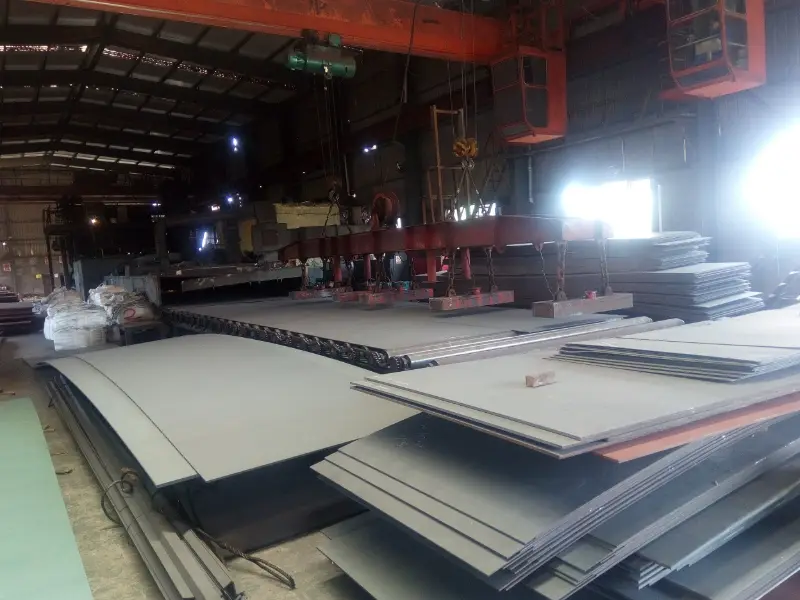
KR Grade F32 Shipbuilding Steel Plate
KR Grade F32 Shipbuilding Steel Plate | High-Strength Hull Structural Steel Data
Comprehensive material data for KR Grade F32 shipbuilding steel plate. Includes chemical composition, mechanical and thermal properties, equivalent international grades, and application guidance.
Hot rolling, controlled rolling, normalizing, TMCP, welding, cutting, forming
- Phone : +8618037372205
- Email : [email protected]
- WhatsApp: Contact via Whtsapp
- WeChat: +8618037372205
KR Grade F32 Shipbuilding Steel Plate Introduction
KR Grade F32 is a high-strength hull structural steel regulated by the Korean Register of Shipping (KR). It is designed for application in ship and offshore structures where increased load-bearing capacity and good low-temperature toughness are essential. The steel offers a minimum yield strength of 315 MPa and reliable weldability, making it suitable for critical parts such as hull plates, decks, and stiffeners. Typically supplied in normalized or thermo-mechanically controlled processed (TMCP) condition, KR F32 also meets stringent impact toughness requirements down to -40 °C, ensuring safe service in cold environments and heavy sea conditions.
KR Grade F32 Shipbuilding Steel Plate Chemical Composition
The following table lists the typical chemical composition limits for KR Grade F32 according to the KR Rules. All values are in weight percent. Aluminum is added for grain refinement, and microalloying elements such as niobium, vanadium, and titanium may be used individually or in combination to achieve the required strength. Residual elements like copper, chromium, and nickel are controlled to ensure weldability and toughness.
| Element | Standard Value (%) | Remarks |
|---|---|---|
| Carbon (C) | ≤ 0.16 | Ladle analysis |
| Silicon (Si) | ≤ 0.50 | Ladle analysis |
| Manganese (Mn) | 0.90 - 1.60 | Ladle analysis |
| Phosphorus (P) | ≤ 0.025 | Ladle analysis |
| Sulfur (S) | ≤ 0.025 | Ladle analysis |
| Aluminum (Al) acid soluble | ≥ 0.015 | Minimum, for grain refinement |
| Niobium (Nb) | 0.02 - 0.05 | Optional, alone or combined |
| Vanadium (V) | 0.05 - 0.10 | Optional, alone or combined |
| Titanium (Ti) | ≤ 0.02 | Optional, alone or combined |
| Copper (Cu) | ≤ 0.35 | Residual |
| Chromium (Cr) | ≤ 0.20 | Residual |
| Nickel (Ni) | ≤ 0.40 | Residual |
| Molybdenum (Mo) | ≤ 0.08 | Residual |
KR Grade F32 Shipbuilding Steel Plate Thermal and Electrical Physical Properties
The physical property values provided are typical for carbon‑manganese structural steels at ambient temperature unless a specific temperature range is indicated. Thermal expansion and thermal conductivity are given for reference in design calculations. The data are representative of the grade's behavior under common service conditions.
| Property | Typical Value | Unit | Test Condition |
|---|---|---|---|
| Density (ρ) | 7.85 | g/cm³ | At 20 °C |
| Modulus of Elasticity (E) | 200 - 210 | GPa | At 20 °C |
| Shear Modulus (G) | 79 - 81 | GPa | At 20 °C |
| Poisson's Ratio (ν) | 0.27 - 0.30 | – | At 20 °C |
| Thermal Expansion Coefficient (α) | 11.7 | ×10⁻⁶/K | 20 - 100 °C |
| Thermal Conductivity (λ) | 51.9 | W/(m·K) | At 100 °C |
| Specific Heat Capacity (cp) | 460 - 486 | J/(kg·K) | At 20 °C |
| Electrical Resistivity (ρe) | 0.15 - 0.20 | ×10⁻⁶ Ω·m (or μΩ·m) | At 20 °C |
KR Grade F32 Shipbuilding Steel Plate Mechanical Properties
Mechanical properties are determined on test specimens taken in the transverse direction unless otherwise agreed. The values apply to plates and sections with thickness ranges as noted. Impact test energy is measured with Charpy V-notch specimens at -40 °C in the longitudinal direction. Bend test requirements ensure formability without cracking.
| Property | Specified Value | Unit | Test Condition |
|---|---|---|---|
| Yield Strength (ReH) | ≥ 315 | MPa | Thickness ≤ 50 mm, transverse |
| Tensile Strength (Rm) | 440 - 590 | MPa | Thickness ≤ 50 mm, transverse |
| Elongation (A) | ≥ 22 | % | Gauge length 5.65√So, thickness ≤ 50 mm |
| Bend Test (Bend Diameter d) | d = 2a | - | Thickness ≤ 30 mm, 180° bend |
| Bend Test (Bend Diameter d) | d = 3a | - | 30 < thickness ≤ 50 mm, 180° bend |
| Charpy Impact Energy (KV2) -40°C | ≥ 31 | J | Longitudinal, average of 3 specimens |
| Charpy Impact Energy (KV2) -40°C (single min.) | ≥ 22 | J | Longitudinal, individual minimum value |
KR Grade F32 Shipbuilding Steel Plate Fully Equivalent Material Standards and Replaceable Grades
| Country/Region | Standard | Grade | Remarks |
|---|---|---|---|
| International | IACS UR W11 | EH32 | Common IACS specification |
| USA | ABS Rules | EH32 | American Bureau of Shipping |
| Norway/Germany | DNV GL Rules | NVE32 | DNV GL (now DNV) |
| UK | LR Rules | EH32 | Lloyd's Register |
| France | BV Rules | EH32 | Bureau Veritas |
| China | CCS Rules | EH32 | China Classification Society |
| Italy | RINA Rules | EH32 | Registro Italiano Navale |
| Japan | NK Rules | KE32 | Nippon Kaiji Kyokai (ClassNK) |
| Russia | RMRS Rules | E32 | Russian Maritime Register of Shipping |
KR Grade F32 Shipbuilding Steel Plate Application Introduction
KR F32 steel is predominantly utilized in the shipbuilding and offshore industry for structures that require high strength combined with excellent weldability and impact toughness at low temperatures. The steel can be processed by hot rolling, controlled rolling, normalizing, or TMCP, and is suitable for all common welding methods. It is often selected for critical load-bearing parts exposed to harsh marine environments.
Product Applications: Hull plates and shell plating, Deck plates and stringer plates, Bulkhead and inner bottom plates, Stiffeners, longitudinals, and frames, Keel plates and stem/stern frames, Offshore module structural panels and columns
Processed into products: Main hull girders and girder webs, Deck beams and deck longitudinals, Bilge keels and structural brackets, Transverse frames and web frames, Hatch coamings and machinery foundations, Jacket braces and nodes (offshore structures)
Application industries: Shipbuilding and marine engineering, Offshore oil and gas platform construction, Port and harbor machinery, Bridge and heavy infrastructure (marine sections), Renewable marine energy (wind turbine foundations)
KR Grade F32 Shipbuilding Steel Plate Similar / Alternative Material Recommendations
| Country/Region | Standard | Grade | Remarks |
|---|---|---|---|
| China | GB 712 | EH32 | Slightly higher C (≤0.18), equivalent properties |
| Europe | EN 10025-4 | S355ML / S355G10 | Offshore structural steels, similar yield, CTOD capable |
| Japan | JIS G 3106 | SM490YA / SM490YB | Welded structural steel, yield 365 MPa, special toughness class needed |
| USA | ASTM A131 / A131M | EH32 | Structural steel for ships, directly comparable |
| Korea/Japan | KR / NK | KA36 / KA36 | Higher yield strength (≥355 MPa) alternative, may need cold toughness verification |
Notes:
Actual chemical composition and mechanical properties shall be verified by the mill test certificate according to the relevant KR rules. For thicknesses above 50 mm, the mechanical property requirements may be subject to special agreement. Impact testing can also be required in the transverse direction for critical applications. In-service toughness and fatigue design should consider the actual delivery condition and any post-weld heat treatment.
- Share



