
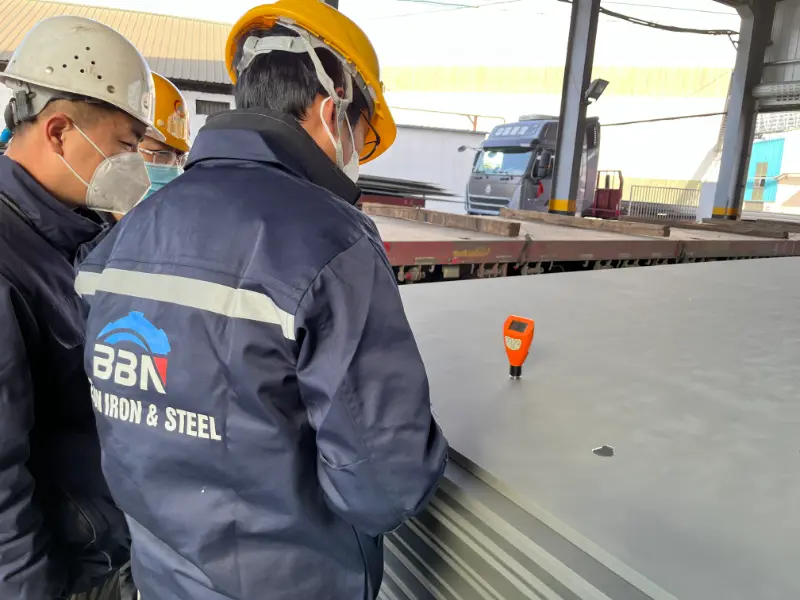
KR Grade A36 Shipbuilding Steel Plate
KR Grade A36 Shipbuilding Steel Plate: Comprehensive Properties, Equivalents & Applications
Complete technical data for KR Grade A36 shipbuilding steel, including chemical composition, mechanical and thermal properties, worldwide equivalent grades, and recommended applications.
Thermo-mechanical controlled processing (TMCP), normalizing, hot rolling, controlled rolling
- Phone : +8618037372205
- Email : [email protected]
- WhatsApp: Contact via Whtsapp
- WeChat: +8618037372205
KR Grade A36 Shipbuilding Steel Plate Introduction
KR Grade A36 is a high-strength shipbuilding structural steel plate certified by the Korean Register of Shipping (KR). It belongs to the AH36 strength level under IACS UR W11, delivering a minimum yield strength of 355 MPa (51 ksi) and tensile strength of 490–620 MPa. The grade is specifically designed for the construction of hulls and marine structures, offering an excellent balance of strength, weldability, and notch toughness at 0°C.
- Minimum yield strength: 355 MPa
- Excellent low-temperature impact toughness (Charpy V-notch at 0°C)
- Good weldability and formability
- Available in thicknesses up to 100 mm
- Supplied in normalized, thermo-mechanically controlled process (TMCP), or as-rolled condition
KR A36 is interchangeable with other IACS member society grades such as ABS A36, DNV A36, LR A36, and CCS A36, making it a globally accepted material for shipbuilding and offshore applications.
KR Grade A36 Shipbuilding Steel Plate Chemical Composition
The chemical composition of KR Grade A36 conforms to IACS UR W11 for AH36 high-strength hull steel. Carbon equivalent (Ceq) is controlled to ensure good weldability. Microalloying elements such as Nb, V, or Ti may be added singly or in combination to achieve the required mechanical properties. Residual elements are limited as shown. All values are maximum unless a range is given.
| Chemical Element | Standard Value | Remarks |
|---|---|---|
| Carbon (C) | ≤0.18 | Ladle analysis |
| Silicon (Si) | ≤0.50 | |
| Manganese (Mn) | 0.90–1.60 | Higher Mn allowed when microalloying |
| Phosphorus (P) | ≤0.035 | |
| Sulfur (S) | ≤0.035 | |
| Aluminium (Al, acid-soluble) | ≥0.015 | Or total Al ≥0.020% |
| Nitrogen (N) | ≤0.009 | If sufficient Al is present |
| Carbon Equivalent (Ceq) | ≤0.38 | Ceq = C + Mn/6 + (Cr+Mo+V)/5 + (Ni+Cu)/15 |
| Chromium (Cr) | ≤0.20 | Residual element |
| Nickel (Ni) | ≤0.40 | Residual element |
| Molybdenum (Mo) | ≤0.08 | Residual element |
| Copper (Cu) | ≤0.35 | Residual element |
| Niobium (Nb) (if added) | ≤0.05 | Optional grain refiner |
| Vanadium (V) (if added) | ≤0.10 | Optional grain refiner |
| Titanium (Ti) (if added) | ≤0.02 | Optional grain refiner |
KR Grade A36 Shipbuilding Steel Plate Thermal & Electrical Physical Properties
The physical constants listed below are typical for low-alloy high-strength steels and are not part of the mandatory IACS certification. They are valid for estimating purposes and may vary slightly with actual composition and heat treatment. Density is taken at room temperature; thermal properties are given for common service temperature ranges.
| Property | Typical Value | Unit | Test Condition / Temperature Range |
|---|---|---|---|
| Density (ρ) | 7850 | kg/m³ | Room temperature |
| Modulus of Elasticity (E) | 205 | GPa | Room temperature |
| Shear Modulus (G) | 80 | GPa | Room temperature, calculated from E and ν |
| Poisson's Ratio (ν) | 0.3 | – | Room temperature |
| Thermal Expansion Coefficient (α) | 12.0 | 10⁻⁶/K | 20–100°C |
| Thermal Expansion Coefficient (α) | 12.5 | 10⁻⁶/K | 20–200°C |
| Thermal Expansion Coefficient (α) | 13.0 | 10⁻⁶/K | 20–300°C |
| Thermal Conductivity (λ) | 51 | W/m·K | At 100°C |
| Thermal Conductivity (λ) | 48 | W/m·K | At 200°C |
| Thermal Conductivity (λ) | 44 | W/m·K | At 300°C |
| Specific Heat Capacity (cp) | 460 | J/kg·K | Around 20°C |
| Electrical Resistivity (ρ_e) | 0.20 | µΩ·m | At 20°C |
KR Grade A36 Shipbuilding Steel Plate Mechanical Properties
Mechanical properties are verified on transverse test pieces for plates up to 100 mm thickness in normalized or TMCP condition. Charpy V-notch impact tests are performed at 0°C (Grade A) for both longitudinal and transverse directions. Higher thicknesses reduce elongation and increase minimum absorbed energy requirements. Certified minimum values are shown.
| Property | Standard Requirement | Unit | Test Condition |
|---|---|---|---|
| Yield Strength (ReH) | ≥355 | MPa | Transverse, room temperature, all thicknesses ≤100 mm |
| Tensile Strength (Rm) | 490–620 | MPa | Transverse, room temperature, all thicknesses ≤100 mm |
| Elongation (A5) | ≥22 | % | Gauge length 5.65√S0, thickness ≤50 mm |
| Elongation (A5) | ≥21 | % | Gauge length 5.65√S0, 50 < t ≤70 mm |
| Elongation (A5) | ≥20 | % | Gauge length 5.65√S0, 70 < t ≤100 mm |
| Charpy Impact (KV, 0°C) | ≥34 | J | Longitudinal, thickness ≤50 mm |
| Charpy Impact (KV, 0°C) | ≥41 | J | Longitudinal, 50 < t ≤70 mm |
| Charpy Impact (KV, 0°C) | ≥50 | J | Longitudinal, 70 < t ≤100 mm |
| Charpy Impact (KV, 0°C) | ≥24 | J | Transverse, thickness ≤50 mm |
| Charpy Impact (KV, 0°C) | ≥27 | J | Transverse, 50 < t ≤70 mm |
| Charpy Impact (KV, 0°C) | ≥34 | J | Transverse, 70 < t ≤100 mm |
KR Grade A36 Shipbuilding Steel Plate Full Equivalent Grade Standards and Substitute Recommendations
| Country / Region | Standard (Class Society) | Grade Designation | Remarks |
|---|---|---|---|
| International (IACS) | UR W11 | AH36 | Base technical requirements |
| South Korea | Korean Register (KR) | KR Grade A36 | Original specification |
| USA | American Bureau of Shipping (ABS) | ABS Grade A36 | Fully equivalent |
| Norway | DNV (now DNV GL) | DNV Grade A36 | Fully equivalent |
| UK | Lloyd's Register (LR) | LR Grade A36 | Fully equivalent |
| China | China Classification Society (CCS) | CCS Grade A36 | Fully equivalent |
| France | Bureau Veritas (BV) | BV Grade A36 | Fully equivalent |
| Japan | Nippon Kaiji Kyokai (NK) | NK Grade A36 | Fully equivalent |
| Italy | Registro Italiano Navale (RINA) | RINA Grade A36 | Fully equivalent |
| Russia | Russian Maritime Register of Shipping (RS) | RS Grade A36 | Fully equivalent |
KR Grade A36 Shipbuilding Steel Plate Application Introduction
KR Grade A36 steel is a workhorse material in the shipbuilding and offshore sectors. Its high strength and good low-temperature toughness allow lighter structural designs without compromising safety. It is approved for critical structural members in vessels and ocean engineering structures. The steel can be processed by cutting, bending, welding, and machining. Preheating for welding may not be required under moderate thickness, but post-weld heat treatment should follow class society guidelines for thick sections.
Product Applications: Bulk carriers and ore carriers, Oil tankers and chemical tankers, Container ships and Ro-Ro vessels, Offshore platforms (jacket legs, decks, modules), FPSO hulls and topsides, Ship superstructures and hatch covers
Processed into products: Shell plating (side, bottom, sheer strake), Deck plates and deck stiffeners, Bulkhead plates and transverses, Bottom longitudinal and floor plates, Keel plates and bilge strakes, Web frames and brackets, Foundation plates for machinery
Application industries: Marine & Shipbuilding, Offshore Oil & Gas Engineering, Heavy Machinery Manufacturing, Bridge & Structural Construction
KR Grade A36 Shipbuilding Steel Plate Similar Substitute Materials with Comparable Performance
| Country / Region | Standard | Grade | Remarks |
|---|---|---|---|
| Europe/EN | EN 10025-2 | S355J2+N / S355J2+M | Similar 355 MPa yield; impact test at -20°C, improved toughness compared to A36 |
| Europe/EN | EN 10025-3 | S355N/NL | Normalized fine-grain steel, 355 MPa, excellent through-thickness properties |
| USA | ASTM A572 / A709 | Grade 50 | 345 MPa min yield; close in strength, may require Charpy at 0°C for A709 |
| China | GB/T 1591 | Q355D | 355 MPa yield, impact at -20°C; commonly used in building and bridge structures |
| International | IACS UR W11 | DH36 | IACS high-strength hull steel, impact at -20°C; slightly higher toughness requirement |
Notes:
KR Grade A36 is normally supplied with class society inspection and stamping. Many steel mills can also offer material with enhanced Z-direction properties (lamellar tearing resistance) in accordance with EN 10164 or equivalent under supplementary requirements. When used in corrosive marine environments, protective coatings or cathodic protection are recommended. For welded fabrications, the carbon equivalent (Ceq ≤0.38) ensures low susceptibility to cold cracking; however, consumable selection and heat input should follow appropriate welding procedure specifications approved by the classification society.
- Share



