
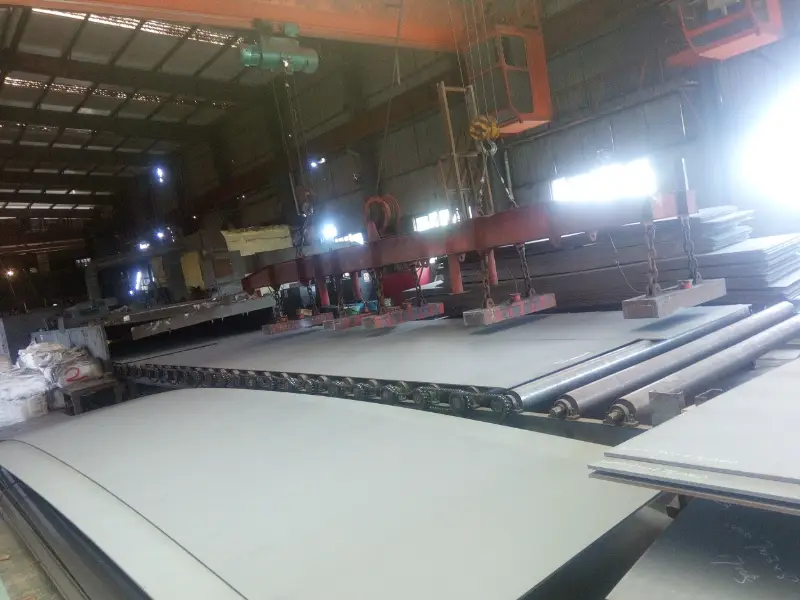
KR Grade D36 Shipbuilding Steel Plate
KR Grade D36 Shipbuilding Steel Plate: High-Strength Marine Grade for Ice-Class Vessels
Complete material data for KR Grade D36 steel plate under Korean Register rules: chemical analysis, mechanical properties, physical constants, and global equivalents for shipbuilding and offshore structures.
Thermomechanical controlled rolling (TMCP), normalizing, quenching and tempering (optional); can be hot rolled, welded, cut, cold formed, and machined.
- Phone : +8618037372205
- Email : [email protected]
- WhatsApp: Contact via Whtsapp
- WeChat: +8618037372205
KR Grade D36 Shipbuilding Steel Plate Introduction
KR Grade D36 is a high-strength hull structural steel plate certified by the Korean Register of Shipping (KR). It belongs to the higher-toughness category among normal and high-strength shipbuilding steels, with a specified minimum yield strength of 355 MPa and guaranteed impact toughness at -20 °C. The steel is primarily produced through thermomechanical controlled processing (TMCP) or normalizing, achieving a fine-grained microstructure that ensures excellent weldability, low-temperature notch toughness, and fatigue resistance. Typical plate thicknesses range from 8 mm to 100 mm. KR D36 is widely used in shell plating, decks, and stiffeners of ice-strengthened ships, Arctic-grade vessels, and offshore structures operating in cold environments. Its chemical composition is tightly controlled, with optional microlaying elements (Nb, V, Ti) for grain refinement, meeting the strength and toughness demands of modern shipbuilding codes.
KR Grade D36 Shipbuilding Steel Plate Chemical Composition
Chemical composition according to KR Rules for Grade D36. The steel is fully killed and fine-grained. Optional grain-refining elements (Nb, V, Ti) are added separately or in combination. All values are maxima unless a range is shown.
| Element | Standard Value (wt.%) | Remarks |
|---|---|---|
| C | ≤ 0.18 | |
| Si | ≤ 0.50 | |
| Mn | 0.90 - 1.60 | |
| P | ≤ 0.035 | |
| S | ≤ 0.035 | |
| Al (acid soluble) | ≥ 0.015 | When used for grain refining |
| Nb | 0.02 - 0.05 | Optional, singly or in combination |
| V | 0.05 - 0.10 | Optional, singly or in combination |
| Ti | ≤ 0.02 | Optional, singly or in combination |
| Cu | ≤ 0.35 | Residual element |
| Ni | ≤ 0.40 | Residual element |
| Cr | ≤ 0.20 | Residual element |
| Mo | ≤ 0.08 | Residual element |
| N | ≤ 0.009 | If not fixed by Al or other nitrogen binders |
KR Grade D36 Shipbuilding Steel Plate Physical and Thermal Properties
The values listed below are typical for carbon-manganese structural steels and are not part of the mandatory KR specification. They are provided for engineering calculations. Variations may occur depending on the actual composition and processing route.
| Property | Value | Unit | Test Condition / Remarks |
|---|---|---|---|
| Density (ρ) | 7.85 | g/cm³ | At 20 °C |
| Modulus of Elasticity (E) | 205 | GPa | At 20 °C, quasi-static |
| Shear Modulus (G) | 80 | GPa | At 20 °C |
| Poisson's Ratio (ν) | 0.3 | - | Elastic range |
| Thermal Expansion Coefficient (α) | 11.5 | 10⁻⁶/K | Between 20 °C and 100 °C |
| Thermal Expansion Coefficient (α) | 12.0 | 10⁻⁶/K | Between 20 °C and 200 °C |
| Thermal Conductivity (λ) | 50 | W/(m·K) | At 20 °C |
| Specific Heat Capacity | 460 | J/(kg·K) | At 20 °C |
| Electrical Resistivity (ρₑ) | 0.20 | μΩ·m | At 20 °C |
KR Grade D36 Shipbuilding Steel Plate Mechanical Properties
Mechanical properties are determined on transverse test pieces taken from the plate. ReH = upper yield strength or 0.2% proof stress, Rm = tensile strength, A = percentage elongation on gauge length 5.65√So . Bend test mandrel diameter is related to plate thickness a. Charpy V-notch impact energy is measured at -20 °C. All values are minimum unless a range is specified.
| Property | Requirement | Unit | Test Condition / Remarks |
|---|---|---|---|
| Yield Strength (ReH) | ≥ 355 | MPa | Plate thickness ≤ 100 mm; for thinner gauges the specification applies equally |
| Tensile Strength (Rm) | 490 – 620 | MPa | Transverse direction |
| Elongation (A) | ≥ 21 | % | Gauge length 5.65√S₀, transverse test piece |
| Bend Test (180°) | Crack free; mandrel diameter = 3a | Plate thickness a ≤ 25 mm | |
| Bend Test (180°) | Crack free; mandrel diameter = 4a | Plate thickness a > 25 mm | |
| Charpy Impact Energy (KV₂) | ≥ 34 (longitudinal) | J | -20 °C, 10×10 mm specimen, longitudinal |
| Charpy Impact Energy (KV₂) | ≥ 24 (transverse) | J | -20 °C, 10×10 mm specimen, transverse |
KR Grade D36 Shipbuilding Steel Plate Exact Equivalent Grades from Other Classification Societies
| Country / Society | Standard / Rules | Grade Designation | Remarks |
|---|---|---|---|
| American Bureau of Shipping (ABS) | ABS Rules, Part 2 | ABS Grade D36 | Identical strength and impact temperature |
| Bureau Veritas (BV) | BV Rules, Part D | BV Grade D36 | Identical strength and impact temperature |
| China Classification Society (CCS) | CCS Rules, Part 1 | CCS Grade D36 | Identical strength and impact temperature |
| DNV (DNV GL) | DNVGL Rules, Pt.2 Ch.2 | DNV Grade D36 (VL D36) | Identical strength and impact temperature |
| Lloyd's Register (LR) | LR Rules, Part 2 | LR Grade D36 | Identical strength and impact temperature |
| Nippon Kaiji Kyokai (ClassNK) | NK Rules, Part K | NK Grade KD36 | Identical strength and impact temperature |
| Registro Italiano Navale (RINA) | RINA Rules, Part C | RINA Grade D36 | Identical strength and impact temperature |
| Russian Maritime Register of Shipping (RS) | RS Rules, Part XIII | RS Grade D36 | Identical strength and impact temperature |
KR Grade D36 Shipbuilding Steel Plate Application Introduction
KR Grade D36 steel plate is designed for welded structures in ships and offshore units that are exposed to low temperatures (down to -20 °C design service temperature). It combines good formability with reliable notch toughness, making it suitable for critical load‑bearing elements in hulls, decks, and ice strengthening. The steel is compatible with all common welding processes and can be processed by flame cutting, plasma cutting, bending, and cold forming without loss of specified properties.
Product Applications: Ship hull shell plating, Main deck and strength deck plates, Longitudinal stiffeners and frames, Transverse bulkheads and watertight flats, Rudder horns and stern frames, Ice‑belt and bow reinforcement plates, Helideck support structures, Brackets and gusset plates
Processed into products: Shell plating panels, Deck stringer plates, Keel plates, Bilge keel and bilge strakes, Web frames and floors, Transverse web stiffeners, Hatch coaming and corner plates, Main bearing foundation brackets, Rudder blade skin plates, Ice belt doubling plates
Application industries: Commercial shipbuilding (container ships, bulk carriers, tankers), Naval and coast guard vessels, Ice‑class and Arctic expedition ships, Offshore oil and gas platforms (topsides, jackets, flare booms), Floating production storage and offloading units (FPSO), Heavy marine lifting equipment, Renewable energy offshore support structures (wind turbine foundations)
KR Grade D36 Shipbuilding Steel Plate Close Alternative Grades
| National / Society | Standard / Rules | Grade | Remarks |
|---|---|---|---|
| KR / IACS | KR Rules | KR Grade AH36 | Minimum impact temperature 0 °C; otherwise identical chemical composition and tensile properties. |
| KR / IACS | KR Rules | KR Grade EH36 | Minimum impact temperature -40 °C; otherwise identical chemical composition and tensile properties. |
| KR / IACS | KR Rules | KR Grade FH36 | Minimum impact temperature -60 °C; otherwise identical chemical composition and tensile properties. |
| KR / IACS | KR Rules | KR Grade D32 | Lower yield strength (≥ 315 MPa); same impact temperature category (-20 °C). Used where lower strength is acceptable. |
| KR / IACS | KR Rules | KR Grade E32 | Yield strength ≥ 315 MPa, impact temperature -40 °C. Alternative for structures requiring better low‑temperature toughness. |
| KR / IACS | KR Rules | KR Grade A36 | Minimum impact temperature 0 °C; same strength. Can be substituted where -20 °C toughness is not required. |
Notes:
KR Grade D36 may also be ordered with supplementary requirements, such as through‑thickness properties (Z‑quality), improved weldability (low carbon equivalent), or ultrasonic testing in accordance with the classification society's procedures. Plates are normally supplied with primer coating or as bare metal, depending on end‑user specifications. Tensile and impact tests are witnessed by a KR surveyor, and the plates are issued with a 3.1 or 3.2 inspection certificate according to EN 10204 or equivalent.
- Share



