
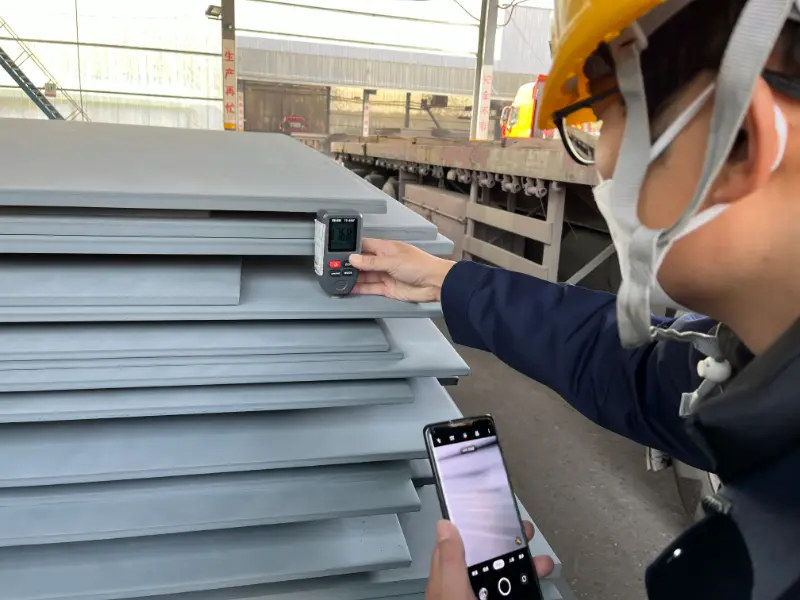
KR Grade E36 Shipbuilding Steel
KR Grade E36 Shipbuilding Steel - High-Strength Low-Temp Toughness for Marine Applications
Comprehensive material analysis of KR Grade E36 shipbuilding steel plate: chemical composition, mechanical properties, thermal and electrical physical properties, equivalent grades, similar substitutes, and application guidance.
Hot rolling, normalizing (N), thermo-mechanical control process (TMCP) or quenching and tempering (as agreed), cutting, welding, forming, machining
- Phone : +8618037372205
- Email : [email protected]
- WhatsApp: Contact via Whtsapp
- WeChat: +8618037372205
KR Grade E36 Shipbuilding Steel Introduction
KR Grade E36 is a high-strength shipbuilding structural steel certified by the Korean Register of Shipping (KR). It complies with the IACS (International Association of Classification Societies) UR W11 for high-strength steels for hull construction. E36 is designed for critical ship structures requiring yield strength of at least 355 MPa and excellent toughness at low temperatures down to -40°C. The steel is supplied in normalized or thermo-mechanically controlled processed (TMCP) condition, offering good weldability, formability, and resistance to brittle fracture. It is suitable for thick plates used in container ships, bulk carriers, offshore platforms, and polar vessels. The controlled micro-alloying with Nb, V, Ti ensures fine grain structure and uniform mechanical properties across thickness.
KR Grade E36 Shipbuilding Steel Chemical Composition per KR Rules Thickness ≤ 100 mm
The chemical composition of KR E36 steel is designed to ensure adequate strength, weldability, and low-temperature toughness. Carbon equivalent (CEV) is controlled to maintain good weldability (typically CEV ≤ 0.38% for TMCP). The steel is fully killed and made to fine grain practice, with aluminum as grain refiner. Micro-alloying elements like Nb, V, Ti are added singly or in combination, provided the sum of Nb+V+Ti ≤ 0.12% per IACS UR W11. The analysis below is based on ladle analysis from KR Rules and typical industry practice.
| Chemical Element | Standard Requirement Value (%) | Remarks |
|---|---|---|
| Carbon (C) | ≤ 0.18 | Ladle analysis; lower carbon for thinner TMCP products |
| Manganese (Mn) | 0.90 – 1.60 | Higher Mn for thicker plates to enhance strength |
| Silicon (Si) | ≤ 0.50 | Deoxidizer; typical for killed steel |
| Phosphorus (P) | ≤ 0.035 | Max allowed for product analysis |
| Sulfur (S) | ≤ 0.035 | Max allowed; generally lower in clean steel |
| Aluminum (Al) total | ≥ 0.015 (acid soluble) | Grain refining element; required for fine grain practice |
| Niobium (Nb) | ≤ 0.05 | Optional micro-alloy; sum Nb+V+Ti ≤ 0.12% |
| Vanadium (V) | ≤ 0.10 | Optional; part of micro-alloying |
| Titanium (Ti) | ≤ 0.02 | Optional; grain refiner and nitrogen binder |
| Nitrogen (N) | ≤ 0.012 (typically) | Not explicitly max, but controlled for toughness |
| Copper (Cu) | ≤ 0.35 | If intentionally added, otherwise residual |
| Chromium (Cr) | ≤ 0.20 | Residual (max not specified unless agreed) |
| Nickel (Ni) | ≤ 0.40 | Residual (not typically added for E36) |
| Molybdenum (Mo) | ≤ 0.08 | Residual |
| Carbon Equivalent (CEV) | ≤ 0.38 (TMCP) or ≤ 0.40 (Normalized) | CEV = C + Mn/6 + (Cr+Mo+V)/5 + (Ni+Cu)/15; exact value agreed with class |
KR Grade E36 Shipbuilding Steel Thermal and Electrical Physical Properties
The physical properties listed below are typical for E36 type shipbuilding steel (low carbon, micro-alloyed) in the as-delivered condition. These values are influenced by composition and microstructure but are representative of this steel grade. Density is standard for structural steel. Elastic modulus and shear modulus are typical for ferritic-pearlitic steels. Thermal expansion and thermal conductivity are provided for a range of temperatures useful for design and fabrication calculations. Electrical resistivity is given for completeness. These values are not mandatory by KR rules but derived from steel data handbooks.
| Property | Typical Value | Unit | Condition / Temperature |
|---|---|---|---|
| Density (ρ) | 7.85 | g/cm³ | 20°C |
| Elastic Modulus (E) | 205 – 210 | GPa | 20°C, tension |
| Shear Modulus (G) | ≈ 80 – 81 | GPa | 20°C, calculated from E and Poisson's ratio |
| Poisson's Ratio (ν) | 0.28 – 0.30 | — | 20°C |
| Thermal Expansion Coefficient (α) | 11.1 – 12.5 | 10⁻⁶/K | 20 – 100°C |
| Thermal Expansion Coefficient (α) | 12.5 – 13.5 | 10⁻⁶/K | 20 – 200°C |
| Thermal Expansion Coefficient (α) | 13.5 – 14.5 | 10⁻⁶/K | 20 – 400°C |
| Thermal Conductivity (λ) | 42 – 48 | W/(m·K) | 20°C |
| Thermal Conductivity (λ) | 38 – 42 | W/(m·K) | 200°C |
| Specific Heat Capacity (c) | ≈ 460 – 480 | J/(kg·K) | 20 – 100°C |
| Electrical Resistivity (ρₑ) | 0.20 – 0.25 | µΩ·m | 20°C |
KR Grade E36 Shipbuilding Steel Mechanical Properties
Mechanical tests are carried out on each rolling unit as per KR's approved testing regime. Yield strength and tensile strength must meet the minima specified below, based on thickness range. Elongation is measured on a gauge length 5.65√So (proportional test piece). Impact tests (Charpy V-notch) are performed at -40°C; average absorbed energy must be at least 34 J in longitudinal direction for specimens taken from surface or subsurface, with only one individual value allowed below 34 J but not below 24 J. For thicknesses above 50 mm, additional through-thickness properties may be required.
| Property | Standard Requirement | Unit | Test Condition |
|---|---|---|---|
| Yield Strength (ReH) | ≥ 355 (thk ≤ 50 mm) | MPa | Transverse test piece, ambient temperature |
| Yield Strength (ReH) | ≥ 335 (50 < thk ≤ 70 mm) | MPa | Transverse test piece |
| Yield Strength (ReH) | ≥ 315 (70 < thk ≤ 100 mm) | MPa | Transverse test piece |
| Tensile Strength (Rm) | 490 – 630 | MPa | All thicknesses up to 100 mm |
| Elongation (A5) | ≥ 21 (thk ≤ 100 mm) | % | Proportional gauge length 5.65√So; transverse |
| Charpy V-notch impact energy (KV) | ≥ 34 (average, longitudinal) | J | Test at -40°C; min individual 24 J |
| Bend test | No cracks or defects after bending 180° | — | Bend diameter 3t (t=thickness) for thickness ≤ 25 mm; wider requirements for thicker plates |
KR Grade E36 Shipbuilding Steel Fully Equivalent Material Standards and Substitutable Grades
| Country/Region | Standard Issue | Grade Designation | Remarks |
|---|---|---|---|
| International | IACS UR W11 | EH36 (High Strength) | Covers all IACS members; E36 with -40°C impact test |
| USA | ABS Rules | EH36 | American Bureau of Shipping |
| Norway | DNV GL Rules (now DNV) | E36 | Also formerly NV E36; identical requirements |
| United Kingdom | Lloyd's Register (LR) Rules | EH36 | LR Grade EH36 |
| France | Bureau Veritas (BV) Rules | EH36 | Identical to KR E36 |
| China | CCS Rules | E36 | China Classification Society |
| Japan | ClassNK Rules | E36 | Nippon Kaiji Kyokai |
| Italy | RINA Rules | E36 | IACS member; same grade |
| Germany | DNV GL (historic GL) | E36 | Former Germanischer Lloyd |
| Russia | Russian Maritime Register (RS) | E36 | Equivalent for cold service |
KR Grade E36 Shipbuilding Steel Application Introduction
KR E36 steel is optimized for large-scale welded ship structures and offshore components where a combination of high strength, excellent low-temperature toughness, and good weldability is essential. The steel can be processed by cold forming, bending, cutting, and welding using common shipyard practices. Preheating is generally not required for TMCP material with low carbon equivalent, but thicker sections may need interpass temperature control. The material is suitable for fatigue-loaded and dynamic environments. Applications demand compliance with KR survey during fabrication.
Product Applications: Container ship hulls and deck plating, Bulk carrier longitudinal and transverse stiffeners, Oil tanker bottom and side shell plating, LNG carrier outer hull and trunk decks, Icebreaker hull shell plates, Offshore jack-up rig legs and spudcans, Offshore platform nodes and tubular joints, Wind turbine monopiles and transition pieces
Processed into products: Ship main deck plates and sheer strakes, Bottom shell plates and bilge keels, Hatch coamings and coaming brackets, Longitudinal strength members (girders, stringers), Transverse web frames and floors, Rudder horns and steering gear supports, Crane pedestals on offshore vessels, Fatigue-critical welded connections
Application industries: Shipbuilding (commercial and naval), Offshore oil and gas platforms (topsides and substructures), Renewable energy (offshore wind turbine foundations), Polar and ice-class vessels, Port and marine terminal structures
KR Grade E36 Shipbuilding Steel Similar / Substitute Material Recommendations
| Country/Region | Standard / Common Name | Grade Designation | Remarks |
|---|---|---|---|
| Europe | EN 10025-4 | S355ML | TMCP option for offshore structures, yield 355 MPa, impact -50°C; not ship-classed but similar strength |
| USA | ASTM A131 / A131M | Grade EH36 | Same as ABS EH36; directly equivalent to KR E36 |
| China | GB/T 712 | E36 | Chinese ship steel standard; same mechanical and impact requirements |
| International | API 2W / 2Y | Grade 50 (355 MPa min yield) | For offshore platforms; similar plate properties but different certification |
| Europe | EN 10225 | S355G10+M | Fixed offshore structures, normalized, with good low temp toughness; yield 355 MPa |
| Japan | JIS G 3106 / JIS G 3128 | SM490YB (yield 365 MPa) / KA36 equivalent | JIS standards for welded structures; may need additional low-temp qualification |
| Russia | GOST R 52927 | E36 (категория 36) | Russian shipbuilding steel; similar category |
Notes:
KR E36 requires mandatory Charpy V-notch impact testing at -40°C with average absorbed energy ≥ 34 J in longitudinal direction. Ultrasonic testing per KR Part 2, Chapter 1, Annex 4 is often specified for critical applications. The steel must be produced by approved manufacturers and delivered with a KR inspection certificate (3.2). For thickness above 40 mm, through-thickness properties (Z35) may be required by the purchaser to prevent lamellar tearing. TMCP condition is preferred over normalized to achieve finer grain and higher toughness with lower alloy content, improving weldability and HAZ toughness.
- Share



