
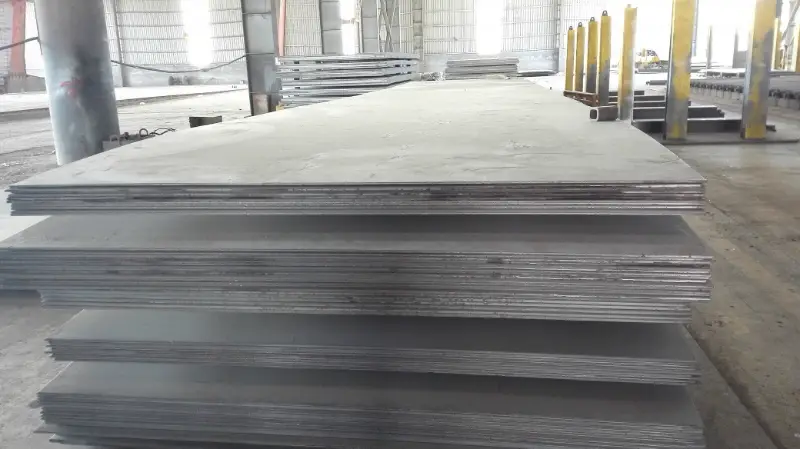
KR Grade A40 Shipbuilding Steel Plate
KR Grade A40 Shipbuilding Steel Plate: High-Strength Structural Steel for Shipbuilding
KR Grade A40 is a high-strength hull structural steel plate approved by the Korean Register of Shipping. With a minimum yield strength of 390 MPa, it is used in critical ship structures requiring high strength and excellent weldability. This page provides complete chemical composition, mechanical and physical properties, international equivalents, and application guidance.
Hot rolling, normalizing rolling, thermomechanical rolling, quenching and tempering (optional); suitable for welding, bending, and cold forming
- Phone : +8618037372205
- Email : [email protected]
- WhatsApp: Contact via Whtsapp
- WeChat: +8618037372205
KR Grade A40 Shipbuilding Steel Plate Introduction
KR Grade A40 is a high-strength shipbuilding steel plate standardized under the rules of the Korean Register (KR). It belongs to the A40 strength level, with a minimum yield strength of 390 MPa and excellent toughness at 0°C. This normalized or thermomechanically rolled steel is designed for critical structural components in ships and offshore platforms. Its chemical composition is balanced to offer good weldability and resistance to brittle fracture.
- Minimum yield strength: 390 MPa
- Tensile strength: 510–650 MPa
- Impact test temperature: 0°C
- Suitable for hull structures, decks, and offshore modules
KR Grade A40 Shipbuilding Steel Plate Chemical Composition
Chemical composition conforms to KR Rules, aligned with IACS UR W11 for high-strength hull structural steel. Limits are given for ladle analysis. Fine grain practice with aluminum and microalloying elements (Nb, V, Ti) is mandatory. Carbon equivalent (CEV) is controlled to ensure weldability.
- CEV max typically 0.38–0.41% depending on thickness
- Aluminum is added for grain refinement
- Nb, V, Ti may be added singly or in combination
| Element | Standard Value (max, %) | Notes |
|---|---|---|
| Carbon (C) | 0.18 | Thickness ≤ 100 mm |
| Silicon (Si) | 0.50 | max |
| Manganese (Mn) | 0.90 – 1.60 | Depending on thickness and CEV |
| Phosphorus (P) | 0.035 | max |
| Sulfur (S) | 0.035 | max |
| Chromium (Cr) | 0.20 | max |
| Nickel (Ni) | 0.40 | max |
| Molybdenum (Mo) | 0.08 | max |
| Copper (Cu) | 0.35 | max |
| Aluminum (Als) | 0.015 min | Acid-soluble aluminum, or total Al ≥ 0.020% |
| Niobium (Nb) | 0.02 – 0.05 | When added |
| Vanadium (V) | 0.05 – 0.10 | When added |
| Titanium (Ti) | 0.02 max | When added |
| Nitrogen (N) | 0.009 max | When aluminum or microalloying is present |
KR Grade A40 Shipbuilding Steel Plate Thermal and Electrical Physical Properties
The following values are typical for normalized or TMCP high-strength low-alloy steels and are provided as engineering reference. Actual properties may vary with composition and processing.
- Density: 7.85 g/cm³ is standard for carbon and low-alloy steels
- Elastic modulus and shear modulus are nearly independent of strength level
- Thermal expansion coefficient is for the range 20–100°C
| Property | Typical Value | Unit | Condition / Temperature |
|---|---|---|---|
| Density (ρ) | 7.85 | g/cm³ | At 20°C |
| Elastic Modulus (E) | 205 | GPa | At 20°C |
| Shear Modulus (G) | 80 | GPa | At 20°C |
| Poisson's Ratio (ν) | 0.30 | – | Within elastic range |
| Thermal Expansion Coefficient (α) | 12.0 | 10⁻⁶/K | 20–100°C |
| Thermal Expansion Coefficient (α) | 13.0 | 10⁻⁶/K | 20–200°C |
| Thermal Expansion Coefficient (α) | 14.0 | 10⁻⁶/K | 20–400°C |
| Thermal Conductivity (λ) | 50 | W/(m·K) | At 20°C |
| Thermal Conductivity (λ) | 45 | W/(m·K) | At 200°C |
| Specific Heat Capacity | 460 | J/(kg·K) | At 20°C |
| Electrical Resistivity (ρ_e) | 0.20 – 0.30 | μΩ·m | At 20°C |
KR Grade A40 Shipbuilding Steel Plate Mechanical Properties
Tensile test and impact test are performed on transverse specimens. Properties are valid for plate thickness ≤ 100 mm. For thickness > 50 mm, impact values may be different. KR A40 guarantees a minimum 0°C Charpy V-notch impact energy of 34 J average.
- Yield strength is specified as upper yield strength (ReH) or 0.2% proof strength
- Elongation is measured on gauge length 5.65√S₀
- Bend test: 180° over a mandrel diameter related to thickness
| Property | Specified Value | Unit | Test Conditions |
|---|---|---|---|
| Yield Strength (ReH) | ≥ 390 | MPa | Transverse, room temperature, t ≤ 100 mm |
| Tensile Strength (Rm) | 510 – 650 | MPa | Transverse, room temperature, t ≤ 100 mm |
| Elongation (A5) | ≥ 20 | % | Gauge length 5.65√S₀, t ≤ 50 mm |
| Elongation (A5) | ≥ 19 | % | Gauge length 5.65√S₀, 50 < t ≤ 70 mm |
| Elongation (A5) | ≥ 18 | % | Gauge length 5.65√S₀, 70 < t ≤ 100 mm |
| Charpy Impact (KV₂, longitudinal) | ≥ 34 (average), ≥ 24 (single) | J | 0°C, 10×10 mm specimen |
| Charpy Impact (KV₂, transverse) | ≥ 24 (average), ≥ 17 (single) | J | 0°C, 10×10 mm specimen |
| Bend Test (180°) | d = 3a | – | t ≤ 50 mm, a = specimen thickness |
| Bend Test (180°) | d = 4a | – | 50 < t ≤ 100 mm |
KR Grade A40 Shipbuilding Steel Plate Fully Equivalent Material Standards and Replaceable Grades
| Country / Region | Standard | Grade | Remarks |
|---|---|---|---|
| International (IACS) | IACS UR W11 | A40 | Basis for all classification societies |
| USA (ABS) | ABS Rules | AH40 | Identical strength, impact at 0°C |
| France (BV) | BV Rules | A40 | Same mechanical and chemical limits |
| Norway (DNV) | DNV Rules | A40 | Direct equivalent |
| UK (LR) | LR Rules | AH40 | Same strength, impact at 0°C |
| Japan (NK) | NK Rules | KA40 | Equivalent high-strength hull steel |
| Italy (RINA) | RINA Rules | A40 | Same designation |
| China (CCS) | CCS Rules | A40 | Direct equivalent |
| Germany (GL) | GL Rules | A40 | Equivalent, now part of DNV GL |
KR Grade A40 Shipbuilding Steel Plate Application Introduction
KR A40 steel plates are designed for welded structures in shipbuilding and offshore engineering that require high strength and good low-temperature toughness. The steel shows excellent formability and machinability in normalized or TMCP condition. Preheating is generally not necessary for thicknesses up to 40 mm under normal welding conditions.
- Preferred for longitudinal strength members and stress-concentrated areas
- Can be used in Arctic service hulls when combined with appropriate design and welding procedures
- Widely applied in commercial vessels, naval ships, and offshore platforms
Product Applications: Hull shell plates (bottom, side, deck), Longitudinal stiffeners and stringers, Web frames and girders, Bulkhead plates, Hatch coamings, Offshore platform decks and legs, Crane pedestals and heavy lift attachments
Processed into products: Shell plating panels (assembled into blocks), Transverse frame webs and brackets, Deck panels with welded stiffeners, Bottom plating with longitudinal stiffeners, Bulkhead plates with attached stiffeners, Stool plates for hatches, Transition pieces in offshore wind turbine substructures, Heavy lifting lugs and pad-eyes (after proper qualification)
Application industries: Shipbuilding (merchant ships, tankers, bulk carriers, container vessels), Offshore oil and gas (jacket structures, topside modules, FPSO hulls), Naval and defense (frigates, patrol vessels), Port and harbor engineering (caisson gates, fender systems), Bridge construction (heavy structural components when approved by the relevant authority)
KR Grade A40 Shipbuilding Steel Plate Similar / Substitute Materials with Comparable Performance
| Country / Region | Standard | Grade | Remarks |
|---|---|---|---|
| International (IACS) | IACS UR W11 | D40 | Higher impact toughness at -20°C, otherwise similar strength; may substitute where better toughness is needed |
| Europe (EN) | EN 10025-4 | S420M / S420ML | Thermomechanically rolled structural steel, minimum yield 420 MPa, similar weldability, suitable for non-marine structural use |
| USA (ASTM) | ASTM A131 / A131M | AH40 | Identical to ABS AH40; also suitable for marine applications |
| Russia (GOST) | GOST 5521 | A40 | Marine steel with comparable strength and impact properties |
| Japan (JIS) | JIS G3106 | SM490A / SM490YA | Yield ≥ 325–365 MPa, lower strength but good weldability; possible substitute for less demanding structures |
Notes:
Additional requirements: KR may specify through-thickness tensile testing (Z-quality) for plates under high stress in the thickness direction. Certificates of conformity must be issued by KR surveyors. Welding consumables must be approved and matched to the steel grade. For thicknesses above 50 mm, increased Charpy energy may be required.
- Ultrasonic testing is often required for plates with thickness ≥ 15 mm according to KR rules
- Marking includes steel grade, heat number, and KR stamp
- All materials shall be delivered with KR 3.2 certification
- Share



