
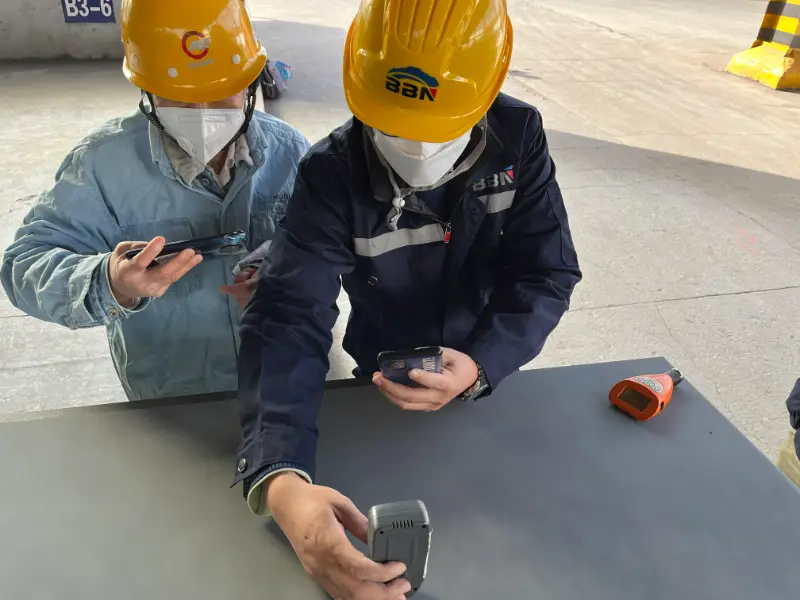
KR Grade D40 Shipbuilding Steel Plate
KR Grade D40 Shipbuilding Steel Plate - High Strength Marine Structural Steel
Complete material data for KR D40 shipbuilding steel plate per KR Rules: chemical composition, mechanical and physical properties, equivalent grades, and application guidance for ship and offshore structures.
Hot rolling, Normalizing (N), Thermo‑Mechanical Control Process (TMCP), Quenching & Tempering (Q&T) by agreement
- Phone : +8618037372205
- Email : [email protected]
- WhatsApp: Contact via Whtsapp
- WeChat: +8618037372205
KR Grade D40 Shipbuilding Steel Plate Introduction
KR Grade D40 is a normalized or thermo-mechanically rolled high strength hull structural steel plate defined by the Korean Register of Shipping (KR) Rules for the construction of seagoing vessels and offshore units. With a minimum yield strength of 390 MPa and Charpy V‑notch toughness guaranteed at –20 °C, D40 combines excellent weldability, high strength, and reliable low‑temperature impact properties. The steel is produced with fully killed fine‑grain practice and may be supplied in N (normalized) or TMCP (thermo‑mechanical control process) condition. It is widely used for critical structural members such as hull envelopes, decks, bottom plating, and stiffener systems in ships and offshore platforms.
KR Grade D40 Shipbuilding Steel Plate Chemical Composition
The chemical composition limits comply with KR Rules Part 2, Chapter 1 for D40 grade. Micro‑alloying elements (Nb, V, Ti) are typically added to achieve fine grain size and required strength.
- Values are ladle analysis; product analysis tolerances apply as per KR rules.
- Al total is required for fully killed steel. Cu, Cr, Ni, Mo may be present as residuals unless agreed otherwise.
| Element | Standard Value (%) | Remarks |
|---|---|---|
| C | ≤ 0.18 | Maximum |
| Si | 0.10 – 0.50 | Typical range |
| Mn | 0.90 – 1.60 | To meet mechanical properties |
| P | ≤ 0.035 | Maximum |
| S | ≤ 0.035 | Maximum |
| Al (total) | ≥ 0.015 | Acid‑soluble; fully killed |
| Nb | 0.02 – 0.05 | Micro‑alloying for grain refinement |
| V | 0.05 – 0.10 | Optional micro‑alloying |
| Ti | ≤ 0.02 | Optional micro‑alloying |
| Cu | ≤ 0.35 | Maximum residual |
| Cr | ≤ 0.20 | Maximum residual |
| Ni | ≤ 0.40 | Maximum residual |
| Mo | ≤ 0.08 | Maximum residual |
| N | ≤ 0.009 | Maximum; if Ti is added to fix N |
KR Grade D40 Shipbuilding Steel Plate Thermal and Electrical Physical Properties
The following physical properties are typical for normalized or TMCP rolled high‑strength hull steel. They may vary slightly with specific production route and test condition.
- Density and thermal expansion are provided for design calculations.
- Values are for reference; no guarantee values are implied.
| Property | Typical Value | Unit | Test Condition / Remarks |
|---|---|---|---|
| Density (ρ) | 7.85 | g/cm³ | At 20 °C |
| Elastic modulus (E) | 205 | GPa | Static, at room temperature |
| Shear modulus (G) | ~80 | GPa | Calculated from E and ν |
| Poisson's ratio (ν) | 0.29 – 0.30 | – | At room temperature |
| Thermal expansion coefficient (α) | 11.5 | 10⁻⁶/K | Between 20 °C and 100 °C |
| Thermal conductivity (λ) | ~50 | W/(m·K) | At 20 °C |
| Specific heat capacity (c) | ~460 | J/(kg·K) | At 20 °C |
| Electrical resistivity (ρₑ) | ~0.20 | 10⁻⁶ Ω·m | At 20 °C |
KR Grade D40 Shipbuilding Steel Plate Mechanical Properties
Mechanical properties are determined on longitudinal tensile specimens unless otherwise agreed.
- Values apply for plate thickness up to 100 mm. For thicker plates slightly reduced strength may be accepted.
- Impact test temperature corresponds to grade D requirement: –20 °C. Minimum average absorbed energy for Charpy V‑notch specimens is 27 J (longitudinal).
- Bend test (180°) is performed on full‑thickness strips with mandrel diameter = 3 × thickness.
| Property | Minimum Requirement | Unit | Test Condition |
|---|---|---|---|
| Yield strength (ReH) | ≥ 390 | MPa | Room temperature, longitudinal specimen, t ≤ 100 mm |
| Tensile strength (Rm) | 510 – 650 | MPa | Room temperature, longitudinal specimen |
| Elongation after fracture (A) | ≥ 20 | % | Gauge length 5.65√S₀ (A5), longitudinal, t ≤ 100 mm |
| Charpy V‑notch impact energy (KV₂) | ≥ 27 | J | Test temperature –20 °C, longitudinal specimens, average of three |
| Bend test (180°) | No cracks | – | Mandrel diameter = 3 × t, width ≥ 30 mm, ambient temperature |
KR Grade D40 Shipbuilding Steel Plate Fully Equivalent Material Standards and Replaceable Grades
| Country / Society | Standard | Grade | Notes |
|---|---|---|---|
| IACS (Members) | UR W11 | High strength hull steel with ReH ≥ 390 MPa, –20 °C impact | Same strength and toughness designation |
| ABS (America) | ABS Rules | ABS D40 | Identical yield strength and –20 °C impact requirement |
| BV (France) | BV Rules | BV D40 | Same characteristics and weldability |
| DNV (Norway) | DNV Rules | DNV D40 | Also accepted for offshore standards DNV‑OS‑C101 |
| GL (Germany) | GL Rules | GL D40 | Permitted substitution |
| LR (UK) | LR Rules | LR D40 | Fully equivalent |
| NK (Japan) | NK Rules | NK D40 | Same mechanical and toughness properties |
| RINA (Italy) | RINA Rules | RINA D40 | Can be ordered under RINA approval |
| CCS (China) | CCS Rules | CCS D40 | Corresponds to high strength hull steel D40 |
KR Grade D40 Shipbuilding Steel Plate Application Introduction
KR D40 steel plates are primarily intended for welded structures in the marine environment and offshore oil & gas installations.
- The combination of high strength and guaranteed notch toughness at –20 °C makes D40 ideal for weight‑sensitive ship designs and winter navigation.
- Good weldability with no or only moderate preheat (depending on thickness) ensures efficient shipyard fabrication.
Product Applications: Hull envelope plating, Deck stringer plates, Bottom plating and bilge keels, Longitudinal and transverse stiffeners, Web frames and girders, Transverse bulkheads, Hatch coamings and comings, Legs of jack‑up rigs
Processed into products: Ship shell plates, Inner bottom plates, Strength deck plates, Cargo hold structural members, Vertical and horizontal stiffeners, Bracket plates, Rudder horns, Offshore module support beams
Application industries: Shipbuilding (cargo ships, tankers, bulk carriers, container vessels, passenger ships), Offshore Engineering (platforms, jack‑up rigs, FPSO), Marine Construction (port cranes, bridges, breakwaters)
KR Grade D40 Shipbuilding Steel Plate Similar / Comparable Alternative Materials
| Country / Society | Standard | Grade | Notes |
|---|---|---|---|
| Korean Register | KR Rules | AH40 | Same yield strength (390 MPa) but impact test at 0 °C; lower toughness |
| Korean Register | KR Rules | E40 | Same strength with impact test at –40 °C; higher toughness; can replace D40 |
| Korean Register | KR Rules | DH36 | Yield strength 355 MPa; lower strength but similar toughness class; may be used in less stressed areas |
| IACS | UR W11 | DH36 / EH36 | Lower strength (355 MPa); –20 °C or –40 °C toughness; not direct strength replacement |
| DNV | DNV Rules | DNV E40 | Tougher variant; usable when low‑temperature resistance is critical |
Notes:
- Welding consumables should be matched to the strength level; typically low‑hydrogen electrodes are recommended.
- For plates ordered in TMCP condition, hot forming and post‑weld heat treatment may be restricted to preserve mechanical properties.
- Special through‑thickness (Z‑direction) properties can be ordered by adding suffix 'Z' (e.g., D40‑Z35) per KR rules.
- Share



