
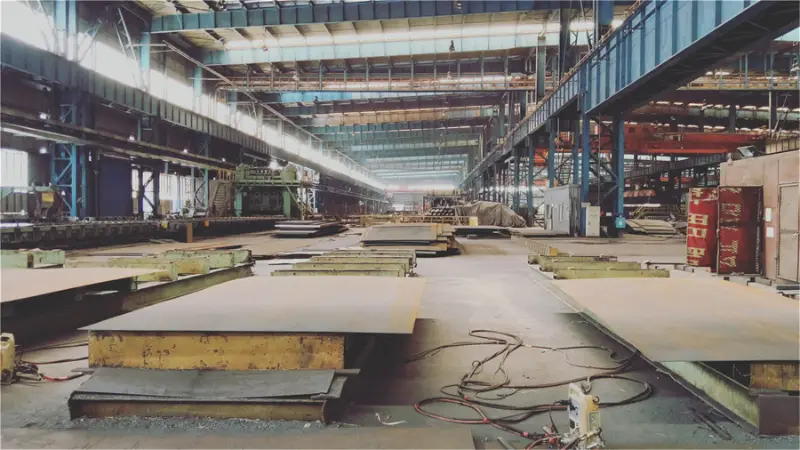
KR Grade E40 Shipbuilding Steel Plate
KR Grade E40 Shipbuilding Steel Plate: High-Strength Marine Structural Material for Extreme Conditions
Comprehensive data sheet for KR Grade E40 shipbuilding steel plate including chemical composition, mechanical and physical properties, international equivalents, and application guidance.
Hot rolling, thermomechanical rolling (TMCP), normalizing, quenching and tempering (if required), welding, cutting, forming
- Phone : +8618037372205
- Email : [email protected]
- WhatsApp: Contact via Whtsapp
- WeChat: +8618037372205
KR Grade E40 Shipbuilding Steel Plate Introduction
KR Grade E40 is a high-strength shipbuilding steel plate certified by the Korean Register of Shipping (KR). It belongs to the EH40 category under IACS UR W11, designed for critical structural applications in ships and offshore platforms operating at low-temperature environments. This normalized or thermomechanically rolled steel offers a minimum yield strength of 390 MPa and excellent notch toughness at -40°C, ensuring reliability in harsh marine conditions. The material exhibits good weldability, formability, and corrosion resistance, making it suitable for hulls, decks, and other load-bearing components. Its controlled chemistry with microalloying elements provides a fine-grain structure, enhancing strength without compromising ductility.
KR Grade E40 Shipbuilding Steel Plate Chemical Composition
Typical chemical composition according to Korean Register Rules and IACS UR W11 for Grade E40 (EH40). Values represent maximum limits unless a range is given. The steel is fully killed and fine-grain treated with aluminum or other grain-refining elements. Trace elements such as Nb, V, and Ti may be added singly or in combination to achieve required mechanical properties.
| Element | Standard Value | Remarks |
|---|---|---|
| Carbon (C) | ≤0.18% | Maximum |
| Silicon (Si) | ≤0.50% | Maximum |
| Manganese (Mn) | 0.90–1.60% | |
| Phosphorus (P) | ≤0.035% | Maximum |
| Sulfur (S) | ≤0.035% | Maximum |
| Aluminum (Al) (acid soluble) | ≥0.015% | Minimum for grain refinement |
| Niobium (Nb) | 0.02–0.05% | Optional microalloying |
| Vanadium (V) | 0.05–0.10% | Optional microalloying |
| Titanium (Ti) | ≤0.02% | Optional microalloying |
| Copper (Cu) | ≤0.35% | Maximum |
| Chromium (Cr) | ≤0.20% | Maximum |
| Nickel (Ni) | ≤0.40% | Maximum |
| Molybdenum (Mo) | ≤0.08% | Maximum |
| Nitrogen (N) | ≤0.012% | Maximum if not otherwise agreed |
KR Grade E40 Shipbuilding Steel Plate Thermal and Electrical Physical Properties
Physical properties at room temperature and representative values for low-carbon high-strength steel. These values are not regulatory requirements but typical engineering data used for design and simulation. Properties may vary slightly with exact composition and heat treatment.
| Property | Typical Value | Unit | Condition |
|---|---|---|---|
| Density (ρ) | 7.85 | g/cm³ | 20°C |
| Elastic modulus (E) | 210 | GPa | 20°C |
| Shear modulus (G) | 81 | GPa | 20°C, calculated from E and ν |
| Poisson's ratio (ν) | 0.3 | – | Room temperature |
| Thermal expansion coefficient (α) | 12.0 × 10⁻⁶ | 1/K | 20–100°C |
| Thermal conductivity (λ) | 46 | W/(m·K) | 20°C |
| Specific heat capacity (cp) | 460 | J/(kg·K) | 20°C |
| Electrical resistivity (ρe) | 2.2 × 10⁻⁷ | Ω·m | 20°C |
KR Grade E40 Shipbuilding Steel Plate Mechanical Properties
Mechanical properties as required by KR Rules for plates of thickness ≤50 mm. Testing is performed at ambient temperature unless stated. Impact test specimens are taken in the longitudinal direction. Bend test mandates a mandrel diameter of 3 times the specimen thickness (3a). Values may vary for thicker sections.
| Property | Requirement | Unit | Test Condition |
|---|---|---|---|
| Upper yield strength (ReH) | ≥390 | MPa | Room temperature, thickness ≤50 mm |
| Tensile strength (Rm) | 510–660 | MPa | Room temperature, thickness ≤50 mm |
| Elongation (A) | ≥22 | % | L0 = 5.65√S0, thickness ≤50 mm |
| Bend test (mandrel diameter) | 3a (180° bend) | – | a = specimen thickness, no cracks allowed |
| Charpy impact energy (KV, -40°C, longitudinal) | ≥50 | J | V-notch, -40°C, average of three tests (min. single value 70% average) |
| Charpy impact energy (KV, -40°C, transverse) | ≥34 | J | V-notch, -40°C, if specified by buyer (typical requirement) |
KR Grade E40 Shipbuilding Steel Plate Fully Equivalent Material Standards and Replaceable Grades
| Country/Region | Standard | Grade | Remarks |
|---|---|---|---|
| Norway/Germany | DNV Rules | E40 | IACS UR W11 compliant, same mechanical/chemical requirements |
| USA | ABS Rules | E40 | ABS Grade E40, identical specification |
| France | BV Rules | E40 | Bureau Veritas certified equivalent |
| China | CCS Rules | E40 | China Classification Society equivalent |
| Japan | NK Rules | E40 | Nippon Kaiji Kyokai equivalent |
| UK | LR Rules | LR E40 | Lloyd's Register grade |
| Italy | RINA Rules | E40 | Registro Italiano Navale equivalent |
| Russia | RS Rules | E40 | Russian Maritime Register equivalent |
KR Grade E40 Shipbuilding Steel Plate Application Introduction
KR Grade E40 steel plates are designed for severe marine conditions requiring high strength and low-temperature toughness. They are widely used in the construction of ocean-going ships, naval vessels, and offshore platforms. The material can be processed by cutting, bending, welding, and machining to form structural components. Post-weld heat treatment is generally not required for thicknesses up to 50 mm, but preheating may be applied according to welding procedure specifications. Typical applications and components are listed below.
Product Applications: Hull plates (bottom, side, deck), Structural stiffeners and girders, Bulkheads and watertight doors, Offshore wind turbine support structures (transition pieces, monopiles), Pontoon and floating dock components
Processed into products: Shell plates and keel plates, Longitudinal and transverse frames, Stringers and ribs, Rudder horns and stern frames, Mast and crane pedestals (marine), Anchor racks and fairleads, Offshore mooring brackets
Application industries: Shipbuilding and marine engineering, Offshore oil and gas (platforms, FPSOs), Naval defense (warships, submarines), Icebreaker and Arctic vessel construction, Heavy civil infrastructure (bridge components in marine environments)
KR Grade E40 Shipbuilding Steel Plate Similar / Closest Alternative Materials
| Country/Region | Standard | Grade | Remarks |
|---|---|---|---|
| International | IACS | AH40/DH40 | Lower impact test temperature: AH40 at 0°C, DH40 at -20°C. Chemistry almost identical, suitable where higher toughness is not required. |
| Europe | EN 10025-4 | S420ML/S420NL | Thermomechanical or normalized structural steel with yield strength 420 MPa, similar toughness classes. Suitable for non-marine heavy structures. |
| USA | ASTM A131 | EH40 | Essentially same as KR E40 under ASTM A131 for shipbuilding. |
| Japan | JIS G 3106 | SM490YA/SM490YB | Welded structural steel with min. yield 365 MPa, not exactly matching 390 MPa but often used for similar applications with thickness compensation. |
Notes:
Important considerations:
- For thicknesses >50 mm, mechanical properties and impact energy values may be subject to specific agreement. Consult the class rules.
- Hydrogen-induced cracking (HIC) resistance can be improved through controlled sulfur content (<0.005%) and calcium treatment, but these are not standard requirements.
- Through-thickness properties (Z-quality) may be requested for highly restrained joints per EN 10164 or class guidelines.
- Welding consumables should match the strength and toughness requirements; typical preheat temperature 50–100°C depending on plate thickness.
- Corrosion protection typically involves coatings or cathodic protection; the steel itself does not contain alloying for enhanced corrosion resistance.
- Share



