
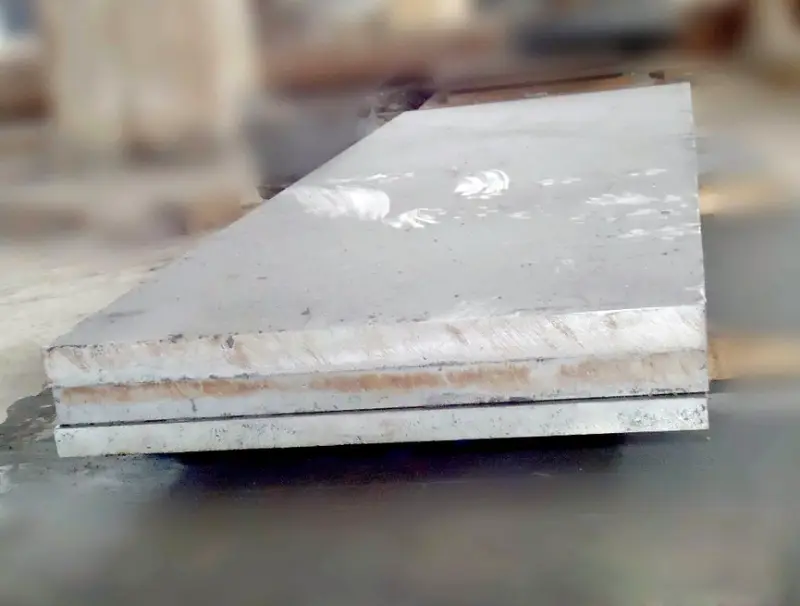
KR Grade F40 Shipbuilding Steel Plate
KR Grade F40 Shipbuilding Steel Plate – High Strength, Low-Temperature Toughness for Polar Vessels
Comprehensive data sheet for KR Grade F40 shipbuilding steel plate: chemical composition, mechanical and physical properties, international equivalents, and application guide for polar-class ships and offshore structures.
Cutting, machining, hot forming, welding (with low-hydrogen procedures), cold forming under specified bend radii
- Phone : +8618037372205
- Email : [email protected]
- WhatsApp: Contact via Whtsapp
- WeChat: +8618037372205
KR Grade F40 Shipbuilding Steel Plate Introduction
KR Grade F40 is a high-strength hull structural steel certified by the Korean Register of Shipping (KR) for use in shipbuilding and offshore engineering. With a minimum yield strength of 390 MPa and excellent low-temperature toughness guaranteed down to −60 °C, F40 is designated for critical structural components exposed to high stress and frigid environments. The grade is typically supplied in normalized or thermo-mechanical control processed (TMCP) condition, ensuring fine-grain microstructure and superior weldability. Its chemistry is microalloyed with niobium, vanadium, and titanium to achieve the required strength and impact resistance while maintaining good workability. Common delivery forms include plates, wide flats, and sections. KR F40 complies with the KR Rules for the Classification of Steel Ships and is internationally equivalent to other classification societies' FH40 grades. It is widely used in hull envelopes, decks, bottom structures, and ice-strengthened ship elements operating in Arctic or Antarctic waters.
KR Grade F40 Shipbuilding Steel Plate Chemical Composition per KR Rules
The chemical composition of KR F40 is designed to provide high strength and excellent low-temperature toughness. Maximum limits for impurities and microalloying elements are strictly controlled. Ladle analysis values are given; product analysis tolerances apply per KR standards. Carbon equivalent (CEV) is typically limited to ≤ 0.40% to ensure good weldability.
| Element | Specified Value (max, in %) | Remarks |
|---|---|---|
| C | ≤ 0.16 | For thickness ≤ 100 mm |
| Si | ≤ 0.50 | Deoxidizer, promotes strength |
| Mn | 0.90 – 1.60 | Enhances hardenability and strength |
| P | ≤ 0.025 | Controlled for low-temperature toughness |
| S | ≤ 0.025 | Improved cleanliness |
| Al (acid soluble) | ≥ 0.015 (if used) | Grain refinement; may be replaced by other grain refining elements |
| Nb | 0.02 – 0.05 | Grain refinement and precipitation strengthening |
| V | 0.05 – 0.10 | Precipitation strengthening |
| Ti | ≤ 0.02 | Grain refinement; optional |
| Cu | ≤ 0.35 | Residual element; subject to agreement for through-thickness properties |
| Cr | ≤ 0.20 | Can be specified for enhanced strength |
| Ni | ≤ 0.40 | Improves toughness at low temperatures; may be added for thick sections |
| Mo | ≤ 0.08 | Optional; for tensile strength adjustment |
| N | ≤ 0.009 (total) | Bound by nitride formers |
| CEV (typical) | ≤ 0.40 | Carbon equivalent, calculated from CEV = C + Mn/6 + (Cr+Mo+V)/5 + (Ni+Cu)/15 |
KR Grade F40 Shipbuilding Steel Plate Physical Properties
Physical property values are typical for high-strength low-alloy shipbuilding steels. They are not mandatory per classification rules but are essential for design calculations. Variability may occur depending on exact composition and processing route. Thermal expansion is given for temperature range 20–100 °C; for higher temperatures linear interpolation can be used as first approximation.
| Property | Typical Value | Unit | Test Condition / Remarks |
|---|---|---|---|
| Density (ρ) | 7.85 | g/cm³ | Room temperature |
| Modulus of Elasticity (E) | 205 | GPa | At 20 °C; decreases slightly with temperature |
| Shear Modulus (G) | 80 | GPa | Calculated from E and Poisson ratio |
| Poisson Ratio (ν) | 0.30 | – | Within elastic range |
| Coefficient of Thermal Expansion (α) | 11.5 × 10⁻⁶ | K⁻¹ | Mean value between 20 °C and 100 °C |
| Thermal Conductivity (λ) | 45 – 50 | W/(m·K) | At 20 °C; varies with temperature and alloy content |
| Specific Heat Capacity (cp) | 460 – 480 | J/(kg·K) | At 20 °C |
| Electrical Resistivity (ρₑ) | 0.25 – 0.30 | µΩ·m | At 20 °C |
KR Grade F40 Shipbuilding Steel Plate Mechanical Properties
Mechanical properties are verified on test specimens taken from plates in delivery condition. Yield strength, tensile strength, and elongation minimums depend on thickness range. Charpy V-notch impact energy is guaranteed at −60 °C (F grade) in longitudinal direction. Transverse impact values are typically 70% of longitudinal, subject to agreement. Bending test: 180° over former diameter 3t (t = thickness) for plates up to 50 mm.
| Property | Specified Value | Unit | Test Condition / Remarks |
|---|---|---|---|
| Yield Strength (ReH) | ≥ 390 | MPa | Plate thickness ≤ 50 mm |
| Yield Strength (ReH) | ≥ 370 | MPa | Plate thickness 50 < t ≤ 70 mm |
| Yield Strength (ReH) | ≥ 350 | MPa | Plate thickness 70 < t ≤ 100 mm |
| Tensile Strength (Rm) | 510 – 650 | MPa | All thickness ranges |
| Elongation (A5) | ≥ 20 | % | Gauge length 5.65√S₀, thickness ≤ 50 mm |
| Elongation (A5) | ≥ 19 | % | 50 < t ≤ 70 mm |
| Elongation (A5) | ≥ 18 | % | 70 < t ≤ 100 mm |
| Charpy Impact Energy (KV₂) at −60 °C, longitudinal | ≥ 41 (average of 3 tests) | J | Individual min 28 J; F-grade requirement |
| Charpy Impact Energy (KV₂) at −60 °C, transverse | ≥ 28 (average of 3 tests) | J | Individual min 20 J; optional for through-thickness properties |
| Bend Test (180°) | No cracks or defects | – | Former diameter 3t for t ≤ 25 mm; 4t for 25 < t ≤ 50 mm; 5t for 50 < t ≤ 100 mm |
KR Grade F40 Shipbuilding Steel Plate Fully Equivalent Material Standards and Substitutable Grades
| Country / Region | Standard | Grade | Remarks |
|---|---|---|---|
| Korea | KR Rules | F40 | Original certified grade; F indicates −60 °C impact test |
| International (IACS) | UR W11 | FH40 | IACS unified requirement for high-strength hull steel, F-grade |
| USA | ABS Rules | ABS FH40 | −60 °C impact, 390 MPa yield |
| Norway / Germany | DNV Rules | DNV FH40 | Identical requirements under IACS |
| UK | LR Rules | LR FH40 | Lloyd's Register equivalent |
| France | BV Rules | BV FH40 | Bureau Veritas equivalent |
| China | CCS Rules | CCS FH40 | China Classification Society equivalent |
| Japan | NK Rules | NK FH40 | Nippon Kaiji Kyokai equivalent |
| Italy | RINA Rules | RINA FH40 | Registro Italiano Navale equivalent |
| Russia | RS Rules | RS FH40 | Russian Maritime Register of Shipping equivalent |
KR Grade F40 Shipbuilding Steel Plate Application Introduction
KR F40 is purpose-designed for structural applications where high strength, weldability, and guaranteed low-temperature impact performance are critical. It is suitable for both open-sea and ice-class vessels, as well as offshore structures in arctic and cold climate regions. The material can be processed by all standard shipyard methods, including plasma/laser cutting, submerged arc welding, and cold forming within specified bend ratios. Strict heat input control during welding and post-weld drying are recommended to maintain toughness.
Product Applications: Ice-strengthened ship hull plates and stiffeners, Deck and bottom shell plates of LNG carriers, Offshore platform legs and bracings, Structural members of arctic floating production units, Hull elements of cruise ships navigating polar routes
Processed into products: Main deck stringers and sheer strakes, Bottom shell plates and bilge keels, Transverse and longitudinal bulkheads, Hatch coamings and structural brackets, Ice belt plating and frames, Offshore module support stools and crane pedestals
Application industries: Shipbuilding (commercial, naval, polar-class), Offshore oil & gas (platforms, FPSOs, ice-resistant structures), Renewable energy (offshore wind substructures in cold seas), Icebreaker and research vessel construction, Heavy engineering (barges, floating cranes operated in polar regions)
KR Grade F40 Shipbuilding Steel Plate Similar / Closely Equivalent Material Recommendations
| Country / Region | Standard | Grade | Remarks |
|---|---|---|---|
| International | IACS UR W11 | EH40 | Same strength (390 MPa) but impact temperature −40 °C, suitable for less severe cold service |
| International | EN 10025-6 | S460Q / S460QL1 | Higher strength (460 MPa yield), quenched and tempered; requires careful welding procedure |
| USA | ASTM A131 / API 2H | EH40 / Grade 50 | EH40 matches strength; F-grade requires −60 °C supplementary requirement |
| China | GB/T 712 | EH40 | Chinese standard hull steel with −40 °C impact; not full equivalent for −60 °C |
Notes:
Additional requirements for KR F40 may include through-thickness tensile testing (Z-direction properties) according to Z25 or Z35 quality levels, ultrasonic testing per EN 10160 or equivalent, and crack tip opening displacement (CTOD) tests for critical nodes. Surface conditions should meet KR requirements free of laminations and detrimental imperfections. Preheating before welding is recommended for thick sections (>50 mm) and when ambient temperature is below 5 °C. For use in seawater or corrosive atmosphere, protective coatings or cathodic protection is essential.
- Share



