
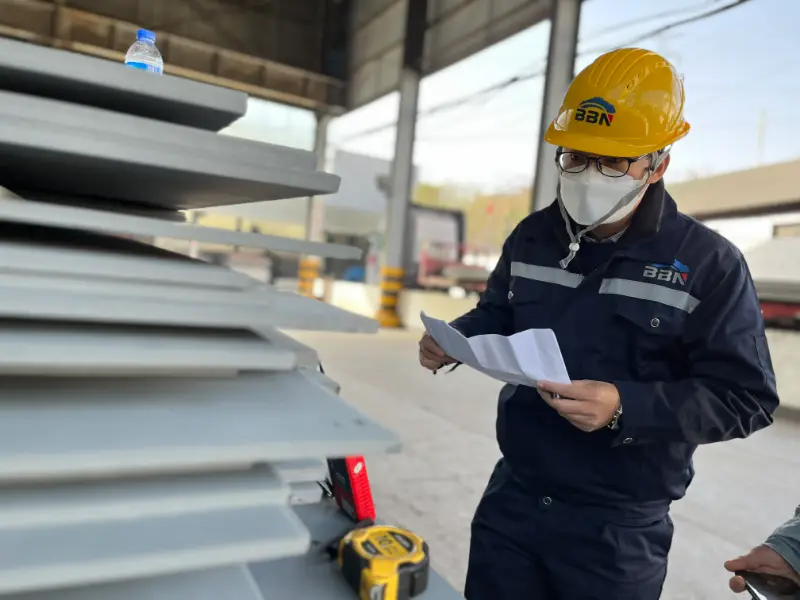
KR Grade D47 Shipbuilding Steel Plate
KR Grade D47 Shipbuilding Steel Plate: Chemical, Mechanical & Physical Properties
Comprehensive material data for KR Grade D47 shipbuilding steel plate according to Korean Register (KR) Rules. Includes chemical composition, mechanical properties, thermal and electrical properties, equivalent designations, similar materials, and application guide.
Hot rolling, controlled rolling, normalising, TMCP, Q&T; welding, cutting, cold or hot forming
- Phone : +8618037372205
- Email : [email protected]
- WhatsApp: Contact via Whtsapp
- WeChat: +8618037372205
KR Grade D47 Shipbuilding Steel Plate Introduction
KR Grade D47 is a high-strength, fine-grain structural steel plate supplied under the Korean Register of Shipping rules. It belongs to the group of hull structural steels with a minimum specified yield strength of 470 MPa. Key characteristics:
- Excellent toughness at low temperatures (D-class, impact tested at -20°C)
- High strength-to-weight ratio, enabling lighter ship structures
- Good weldability when appropriate preheating and heat input controls are observed
- Delivered in normalised, thermomechanically rolled (TMCP) or quenched-and-tempered condition as agreed
The grade is fully aligned with the unified requirements of the International Association of Classification Societies (IACS UR W11).
KR Grade D47 Shipbuilding Steel Plate Chemical Composition
The chemical composition of KR Grade D47 shipbuilding steel is controlled to achieve high strength and good low-temperature toughness. Maximum limits apply to carbon, phosphorus and sulfur to ensure weldability and cleanliness. Micro-alloying elements such as niobium, vanadium and titanium are used for grain refinement and precipitation hardening. Carbon equivalent (CEV) is strictly limited depending on thickness to prevent cold cracking.
| Element | Specified Value (max, unless range is given) | Remarks |
|---|---|---|
| Carbon (C) | ≤0.20% | Ladle analysis |
| Silicon (Si) | ≤0.50% | |
| Manganese (Mn) | 0.90% – 1.60% | |
| Phosphorus (P) | ≤0.030% | |
| Sulfur (S) | ≤0.030% | |
| Aluminium (acid soluble) | ≥0.015% | Sufficient for grain refining |
| Niobium (Nb) | ≤0.05% | |
| Vanadium (V) | ≤0.10% | |
| Titanium (Ti) | ≤0.02% | |
| Copper (Cu) | ≤0.35% | |
| Chromium (Cr) | ≤0.20% | |
| Nickel (Ni) | ≤0.40% | |
| Molybdenum (Mo) | ≤0.08% | |
| Nitrogen (N) | ≤0.009% | for Al-treated grades |
| Carbon Equivalent (CEV) | ≤0.43% (t≤50mm); ≤0.45% (50| CEV = C + Mn/6 + (Cr+Mo+V)/5 + (Ni+Cu)/15 | |
KR Grade D47 Shipbuilding Steel Plate Thermal & Electrical Physical Properties
These physical properties are typical for rolled low-alloy structural steels at room temperature and may vary slightly depending on the exact heat analysis and processing route. Values are provided for preliminary design calculations; they are not normally specified in the material standard.
| Property | Typical Value | Unit | Test Conditions |
|---|---|---|---|
| Density (ρ) | 7.85 | g/cm³ | ≈ 7850 kg/m³; room temperature |
| Elastic Modulus (E) | 205 – 210 | GPa | Room temperature |
| Shear Modulus (G) | ~80 | GPa | Room temperature |
| Poisson's Ratio (ν) | 0.3 | — | Room temperature, within elastic range |
| Coefficient of Thermal Expansion (α) | 11 – 13 | ×10⁻⁶/K | Between 20 °C and 100 °C |
| Thermal Conductivity (λ) | ~50 | W/(m·K) | Room temperature |
| Specific Heat Capacity (Cp) | ~460 | J/(kg·K) | Room temperature |
| Electrical Resistivity (ρ_e) | ~0.2 – 0.3 | ×10⁻⁶ Ω·m | Room temperature |
KR Grade D47 Shipbuilding Steel Plate Mechanical Properties
The mechanical properties of KR Grade D47 plates depend on thickness and heat treatment condition. The minimum yield strength is 470 MPa, and excellent elongation ensures good formability. Notch toughness testing is mandatory at -20°C with a minimum average absorbed energy of 41 J for longitudinal specimens. When multiple thickness ranges are defined, the most demanding values are indicated.
| Property | Specified Value | Unit | Test Conditions / Remarks |
|---|---|---|---|
| Yield Strength (ReH) | ≥470 | MPa | Upper yield or 0.2% proof stress; plate thickness t ≤ 50 mm |
| Tensile Strength (Rm) | 570 – 720 | MPa | All thicknesses |
| Elongation (A) | ≥17 | % | Gauge length 5.65√S₀; t ≤ 50 mm, longitudinal |
| Bend Test (180°) | d = 3a (t ≤ 50 mm) | — | Bend diameter d, specimen thickness a; no cracks acceptable |
| Charpy Impact (KV2) | ≥41 (longitudinal); ≥27 (transverse) | J | At -20 °C, average of three specimens, min single value ≥70% of specified avg. |
KR Grade D47 Shipbuilding Steel Plate Fully Equivalent Classification Society Grades for D47
| Country / Region | Standard / Society | Grade Designation | Remarks |
|---|---|---|---|
| USA | American Bureau of Shipping (ABS) | ABS Grade D47 | Same strength & -20°C impact requirement |
| Norway / Germany | DNV GL (now DNV) | DNV Grade D47 | IACS harmonised requirement |
| France | Bureau Veritas (BV) | BV Grade D47 | Equivalent to KR D47 |
| United Kingdom | Lloyd's Register (LR) | LR Grade D47 | Same designation, fully interchangeable |
| China | China Classification Society (CCS) | CCS Grade D47 | Conforming to IACS UR W11 |
| Japan | Nippon Kaiji Kyokai (ClassNK) | NK Grade D47 | Equivalent strength and toughness class |
| Italy | Registro Italiano Navale (RINA) | RINA Grade D47 | Fully harmonised grade |
KR Grade D47 Shipbuilding Steel Plate Application Introduction
KR Grade D47 plates are intended for the construction of heavily loaded ship hull structures and offshore units where high strength and reliable low-temperature toughness are required. Typical application areas include:
- Main deck plating, shell plating and side shell in large container vessels, tankers and bulk carriers
- Structural members in ice-going ships requiring resistance to brittle fracture
- Offshore platform topsides, flare booms, and legs of jack-up rigs
- Heavy-lift crane booms and pedestals in marine service
The steel can be formed, welded and machined using standard shipyard practices, provided that appropriate low-hydrogen welding consumables and preheat/interpass temperature controls are employed.
Product Applications: Container ships, bulk carriers, tankers, LNG/LPG carriers, Offshore platforms (jack-up rigs, semi-submersibles, FPSOs), Icebreakers and ice-strengthened vessels, Naval auxiliary vessels, Wind turbine installation vessels
Processed into products: Hull outer shell plates, Main deck and strength deck plates, Transverse bulkheads and web frames, Bottom and inner bottom plating, Bilge strakes and sheer strakes, Bracket plates and heavy floor plates, Pedestals for cranes and winches, Fatigue-critical offshore node sections
Application industries: Shipbuilding, Offshore oil & gas, Marine engineering, Port and harbour equipment, Heavy structural fabrication
KR Grade D47 Shipbuilding Steel Plate Near-Equivalent or Similar Grades
| Country / Region | Standard / Specification | Grade Designation | Remarks |
|---|---|---|---|
| Europe | EN 10025-6 | S460QL / S460QL1 | Quenched & tempered structural steel with YS ≥460 MPa, -20°C option (quality L or L1); CEV and toughness may differ from D47. |
| Europe | EN 10025-4 | S460ML | Thermomechanically rolled steel; YS ≥460 MPa, -50°C impact available but typical -20°C option closer to D47. |
| USA | ASTM A131 / A131M | EH47 | High-strength shipbuilding steel for offshore use; E-class (-40°C) is tougher, but strength equivalent to D47. |
| Japan | JIS G 3106 | SM570 | Welded structural steel with YS ≥460 MPa (for t≤16mm), not specifically a shipbuilding grade but sometimes accepted for minor structural parts. |
| International | API 2W / 2Y | API 2W-60 | Steel for offshore structures; minimum YS 450–480 MPa range, often with improved toughness; alternative with class approval. |
Notes:
Weldability: Low-hydrogen welding procedures are mandatory. Depending on plate thickness and carbon equivalent, pre-heating (typically 100–150 °C) may be required. Post-weld heat treatment is normally not required for thicknesses up to 50 mm when using correct filler metals. Tolerances: Thickness, flatness and surface conditions are in accordance with KR Rules and EN 10029 or equivalent. Certification: Material must be accompanied by inspection certificate type 3.1 or 3.2 per EN 10204, with ladle analysis, mechanical test results and impact test values stated.
- Share



