
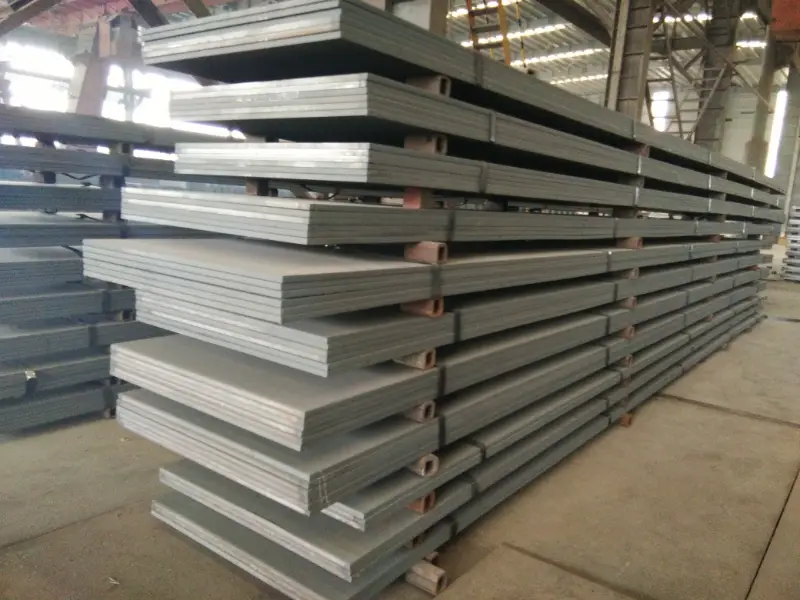
KR Grade F47 Shipbuilding Steel Plate
KR Grade F47 Shipbuilding Steel Plate: Technical Data & Equivalent Grades
Complete technical data for KR Grade F47 shipbuilding steel plate including chemical composition, mechanical properties, thermal and electrical properties, equivalent standards, and application guidance.
Thermo-mechanical control process (TMCP), normalized, quenched and tempered
- Phone : +8618037372205
- Email : [email protected]
- WhatsApp: Contact via Whtsapp
- WeChat: +8618037372205
KR Grade F47 Shipbuilding Steel Plate Introduction
KR Grade F47 is a high-strength shipbuilding steel plate certified by the Korean Register (KR). It belongs to the FH47 category under IACS UR W11, offering minimum yield strength of 460 MPa and excellent low-temperature toughness with impact energy of 46 J at -60 °C. Produced via thermo-mechanical control process (TMCP) or quenching and tempering (Q&T), F47 steel is used for critical structural components in ships and offshore platforms operating in harsh environments. Key attributes include high strength, good weldability (CEV u2264 0.43%), and low-temperature ductility.
KR Grade F47 Shipbuilding Steel Plate Chemical Composition
Chemical composition according to IACS UR W11 for FH47 grade. The steel is fully killed and contains grain-refining elements. Carbon equivalent (CEV) is limited to ensure weldability. Residual elements are strictly controlled.
| Chemical Element | Specified Value | Remarks |
|---|---|---|
| C (Carbon) | ≤ 0.18% | - |
| Si (Silicon) | ≤ 0.50% | - |
| Mn (Manganese) | 0.90 - 1.60% | - |
| P (Phosphorus) | ≤ 0.025% | - |
| S (Sulfur) | ≤ 0.025% | - |
| Al (Aluminium, acid soluble) | ≥ 0.015% | Grain refinement |
| Nb (Niobium) | ≤ 0.05% | Microalloying / grain refining |
| V (Vanadium) | ≤ 0.10% | Microalloying |
| Ti (Titanium) | ≤ 0.02% | Grain refinement |
| Cu (Copper) | ≤ 0.35% | Residual element |
| Cr (Chromium) | ≤ 0.20% | Residual element |
| Ni (Nickel) | ≤ 0.40% | Improves toughness |
| Mo (Molybdenum) | ≤ 0.08% | Residual element |
| N (Nitrogen) | ≤ 0.009% | - |
| CEV (Carbon Equivalent) | ≤ 0.43% (t ≤ 50 mm) | CEV = C + Mn/6 + (Cr+Mo+V)/5 + (Ni+Cu)/15 |
KR Grade F47 Shipbuilding Steel Plate Thermal and Electrical Physical Properties
The following physical properties are typical for high-strength structural steel grades similar to FH47. Actual values may vary slightly depending on specific composition and processing. Data intended for engineering reference.
| Property Item | Typical Value | Unit | Test Condition / Remarks |
|---|---|---|---|
| Density (ρ) | 7850 | kg/m³ | At room temperature |
| Elastic Modulus (E) | 210 | GPa | Static, 20 °C |
| Shear Modulus (G) | 80 | GPa | Derived from E and ν |
| Poisson's Ratio (ν) | 0.3 | - | Typical for steel |
| Thermal Expansion Coefficient (α) | 11.5 × 10⁻⁶ | K-1 | Between 20 °C and 100 °C |
| Thermal Conductivity (λ) | 45 | W/(m·K) | At 20 °C |
| Specific Heat Capacity (cp) | 460 | J/(kg·K) | At 20 °C |
| Electrical Resistivity (ρe) | 0.22 × 10⁻⁶ | Ω·m | At 20 °C |
KR Grade F47 Shipbuilding Steel Plate Mechanical Properties
Mechanical properties are valid for thickness up to 50 mm. Tensile test (transverse) according to ISO 6892-1; impact test (Charpy V-notch) according to ISO 148-1; bend test according to ISO 7438. Properties may vary for thicker sections; consult KR Rules.
| Property Item | Specified Value | Unit | Test Condition |
|---|---|---|---|
| Yield Strength (ReH) | ≥ 460 | MPa | t ≤ 50 mm |
| Tensile Strength (Rm) | 570 - 720 | MPa | t ≤ 50 mm |
| Elongation (A5) | ≥ 17 | % | t ≤ 50 mm, transverse |
| Charpy Impact Energy (KV2) | ≥ 46 | J | -60 °C, longitudinal |
| Charpy Impact Energy (KV2) | ≥ 31 (average) / ≥ 22 (single) | J | -60 °C, transverse (for guidance) |
| Bend Test (diameter) | d = 3a | mm | t ≤ 25 mm, ambient temperature |
| Bend Test (diameter) | d = 4a | mm | 25 < t ≤ 50 mm, ambient temperature |
KR Grade F47 Shipbuilding Steel Plate Fully Equivalent Grades – Standards & Substitute Designations
| Country/Region | Standard | Grade | Remarks |
|---|---|---|---|
| International (IACS) | UR W11 | FH47 | Base standard for ship classification societies |
| South Korea | KR | F47 (FH47) | Original grade |
| Norway / Germany (DNV GL) | DNV GL Rules | NV F47 | Direct equivalent |
| United Kingdom | LR Rules | LR FH47 | Lloyd's Register equivalent |
| USA | ABS Rules | ABS FH47 | American Bureau of Shipping equivalent |
| France | BV Rules | BV FH47 | Bureau Veritas equivalent |
| China | CCS Rules | CCS FH47 | China Classification Society equivalent |
| Europe (EN) | EN 10025-4 | S460ML (TMCP) / S460QL (Q&T) | European standard with similar strength and low-temperature impact; check full compliance with IACS requirements |
KR Grade F47 Shipbuilding Steel Plate Application Introduction
KR Grade F47 steel is designed for structures that demand high strength, low-temperature toughness, and excellent weldability. It is suitable for fabrication of heavyweight components exposed to ambient temperatures as low as -60 °C. Typical uses include:
Product Applications: Large container ships and bulk carriers, Arctic tankers and LNG carriers, Offshore wind turbine foundations, Ship bridges and superstructures, Submarine pressure hulls
Processed into products: Shell plates, Longitudinal and transverse stiffeners, Bilge keels and rudder parts, Deck panels, Heavy lift crane booms (marine), Hatch covers
Application industries: Marine shipbuilding (hulls, decks, bulkheads), Offshore engineering (jack-up rigs, platforms), Polar and ice-class vessels, Pressure vessels and storage tanks, Bridge and structural engineering in cold climates
KR Grade F47 Shipbuilding Steel Plate Similar/Alternative Material Recommendations
| Country/Region | Standard | Grade | Remarks |
|---|---|---|---|
| Europe | EN 10025-4 | S460ML (TMCP) / S460QL (Q&T) | Mechanical properties closely match FH47; low-temperature impact values (-60 °C) may differ for S460ML; S460QL offers quench & tempered option. |
| Europe | EN 10025-6 | S460Q, S500Q | Higher strength quenched and tempered steels; need to verify low-temperature impact requirements and weldability. |
| International | ASTM A514 / A517 | Grade E to S | Quenched and tempered alloy steel plates with yield strength ≥ 690 MPa, higher strength than FH47; requires careful welding and qualification for ship use. |
| International | API 2Y / ASTM A131 | EH40, FH40 | Lower strength grades (minimum 390 MPa yield) but often used in similar offshore applications; suitable where lower stress levels permit. |
Notes:
For thicknesses above 50 mm, the minimum yield strength may be reduced (e.g., 440 MPa for 50–70 mm). Additional testing like through-thickness properties (Z-grade), CTOD, or corrosion resistance may be agreed upon. All data are based on IACS UR W11 (Rev. 2020) and typical product experience; the actual supplier's mill certificate should be verified.
- Share



