
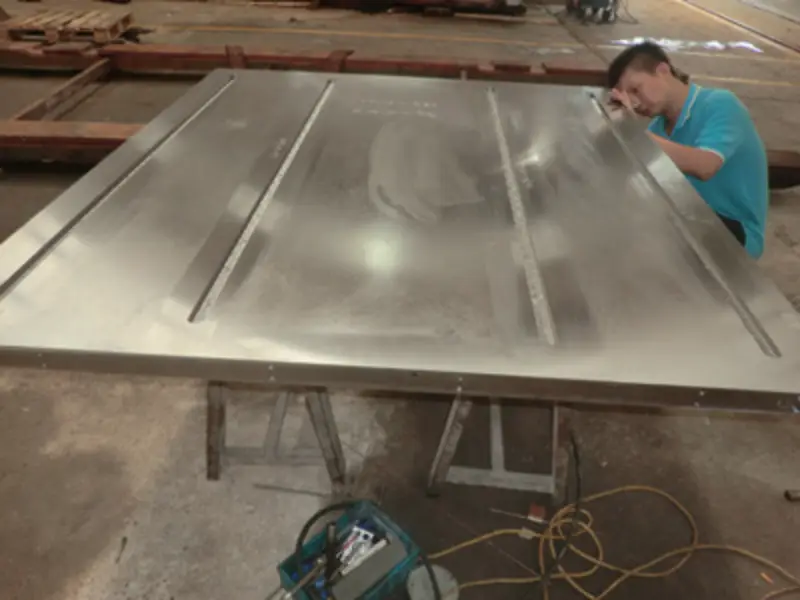
KR Grade F56 Shipbuilding Steel Plate
KR Grade F56 Shipbuilding Steel Plate: High-Strength Quenched & Tempered Marine Steel for Arctic Applications
Explore the properties, equivalent grades, and applications of KR Grade F56 high-strength shipbuilding steel plate. Compliant with Korean Register rules, it offers a minimum yield strength of 560 MPa and excellent low-temperature toughness down to -60°C.
Hot rolling, quench and temper heat treatment, gas cutting, cold forming (with limitations), welding (with low-hydrogen procedures)
- Phone : +8618037372205
- Email : [email protected]
- WhatsApp: Contact via Whtsapp
- WeChat: +8618037372205
KR Grade F56 Shipbuilding Steel Plate Introduction
KR Grade F56 is a high-strength quenched and tempered steel plate specifically designed for shipbuilding, classified under the Korean Register of Shipping (KR). It belongs to the HSLA (High-Strength Low-Alloy) steel category for marine applications. The 'F' indicates a minimum impact test temperature of -60°C, and '56' denotes a specified minimum yield strength of 56 kgf/mm² (approximately 550 MPa). This steel offers a well-balanced combination of high strength, excellent toughness at low temperatures, and good weldability, making it suitable for critical structural components in ships operating in Arctic or severe cold environments. Its delivery condition is quenched and tempered (Q&T), ensuring uniform mechanical properties through controlled heat treatment.
KR Grade F56 Shipbuilding Steel Plate Chemical Composition
The chemical composition of KR Grade F56 is carefully controlled to achieve the required strength and low-temperature toughness after quenching and tempering. Elements such as niobium, vanadium, and titanium are added for grain refinement and precipitation strengthening. Carbon equivalent (Ceq) is typically limited to ensure good weldability. The values below are based on the Korean Register rules, aligning with IACS UR W11 for the F550 grade.
| Element | Standard Value (max, unless range given) | Remarks |
|---|---|---|
| Carbon (C) | 0.20 | Max |
| Manganese (Mn) | 0.70 - 1.70 | Range |
| Silicon (Si) | 0.10 - 0.55 | Range |
| Phosphorus (P) | 0.035 | Max |
| Sulfur (S) | 0.035 | Max |
| Aluminum (Al, acid soluble) | ≥ 0.015 | Min, for grain refinement |
| Niobium (Nb) | 0.02 - 0.05 | Range |
| Vanadium (V) | 0.05 - 0.10 | Range |
| Titanium (Ti) | 0.007 - 0.05 | Range |
| Copper (Cu) | 0.35 | Max |
| Chromium (Cr) | 0.20 | Max |
| Nickel (Ni) | 0.40 | Max |
| Molybdenum (Mo) | 0.08 | Max |
| Nitrogen (N) | 0.020 | Max |
KR Grade F56 Shipbuilding Steel Plate Thermal and Electrical Physical Properties
The physical property data provided are typical for high-strength low-alloy steel in the quenched and tempered condition. These values are reference only and are not specified by the KR classification rules, but are useful for design and engineering calculations. Slight variations may occur depending on exact chemical composition and heat treatment.
| Property | Typical Value | Unit | Test Condition / Remarks |
|---|---|---|---|
| Density (ρ) | 7.85 | g/cm³ | Room temperature |
| Elastic Modulus (E) | 205 | GPa | Room temperature |
| Shear Modulus (G) | 80 | GPa | Room temperature |
| Poisson's Ratio (ν) | 0.3 | - | Room temperature |
| Thermal Expansion Coefficient (α) | 11.5 - 12.5 | 10⁻⁶/K | 20°C to 100°C |
| Thermal Conductivity (λ) | 40 - 45 | W/(m·K) | Room temperature |
| Specific Heat Capacity (c) | 460 - 480 | J/(kg·K) | Room temperature |
| Electrical Resistivity (ρe) | 0.25 - 0.35 | μΩ·m | Room temperature |
KR Grade F56 Shipbuilding Steel Plate Mechanical Properties
The mechanical properties are assured for plates in quenched and tempered condition. Tensile testing is performed in accordance with KR rules. Charpy V-notch impact tests are conducted on longitudinal specimens at the specified test temperature of -60°C. The minimum average absorbed energy is 34 J for thicknesses up to 50 mm; for thicker plates, the requirement may vary or be subject to agreement. Yield strength and tensile strength values are valid for plate thicknesses ≤ 100 mm; for thicker products, slightly lower values may be agreed upon.
| Property | Standard Requirement | Unit | Test Condition / Remarks |
|---|---|---|---|
| Yield Strength (ReH) | ≥ 550 | MPa | Thickness ≤ 100 mm, room temperature |
| Tensile Strength (Rm) | 670 - 830 | MPa | Thickness ≤ 100 mm, room temperature |
| Elongation after Fracture (A5) | ≥ 16 | % | Gauge length 5.65√S₀, room temperature |
| Charpy V-Notch Impact Energy (KV₂) | ≥ 34 (longitudinal, average of 3) | J | Test temperature -60°C |
| Bend Test (Diam. of former) | Not specified for Q&T grades in general rules | - | May be agreed upon |
KR Grade F56 Shipbuilding Steel Plate International Direct Equivalent Grades and Replaceable Designations
| Country / Region | Standard / Classification Society | Grade / Designation | Remarks |
|---|---|---|---|
| International (IACS) | IACS UR W11 | F550 | Identical technical requirements |
| United States & International | ABS | FQ56 | FQ denotes F temperature (-60°C), yield 56 ksi (≈550 MPa) |
| Norway / Germany | DNV (now DNV-Lloyd's) | F550 | Equivalent to KR F56 under IACS unified requirements |
| United Kingdom | Lloyd's Register (LR) | FH56 | H denotes high strength, 56 for yield strength in kgf/mm² |
| Japan | ClassNK (NK) | F56 | Directly equivalent under IACS |
| China | CCS | F550 | Corresponds to CCS Rules for F temperature high strength steel |
| France | Bureau Veritas (BV) | A550 (with F temperature supplementary marking) | BV uses A/D/E/F prefix and yield in MPa; F temperature designation |
KR Grade F56 Shipbuilding Steel Plate Application Introduction
KR Grade F56 is engineered for demanding marine and offshore structures where both high strength for weight reduction and reliable toughness at sub-zero temperatures are critical. Its primary use is in hulls of vessels navigating icy or Arctic waters, as well as in the structural components of offshore platforms exposed to severe cold. The quenched and tempered condition guarantees uniform mechanical properties across thick plates, and it can be processed using standard shipyard fabrication techniques, provided pre-heating and low-hydrogen welding procedures are strictly followed to avoid cold cracking.
Product Applications: Hull main plates (deck, bottom, side shell), Longitudinal stiffeners and transverses, Ice belt panels, Rudder horns and stern frames, Helideck support structures, Jack-up leg chords and racks
Processed into products: Ship deck plate panels, Bottom shell plate panels in ice-strengthened zones, Sponson structures for ice-going vessels, Longitudinal girders and floor stiffeners, Web frames and brackets, Crane pedestal plates and slewing rings
Application industries: Shipbuilding – ice-class vessels, LNG carriers, polar supply ships, Offshore oil & gas – jack-up legs, fixed platforms, FPSO hulls, Heavy engineering – crane booms, heavy-lift ship structures, Arctic infrastructure – port facilities, ice-resistant structures
KR Grade F56 Shipbuilding Steel Plate Similar / Comparative Material Grades
| Country / Region | Standard | Grade | Remarks |
|---|---|---|---|
| China | GB/T 1591 | Q550D / Q550E / Q550F | High strength low alloy structural steel, minimum yield 550 MPa, impact temperatures -20°C (D), -40°C (E), -60°C (F). Not for ship classification without additional approval, but similar chemistry and strength. Carbon equivalent may differ. |
| Europe | EN 10025-6 | S550QL / S550QL1 | Quenched and tempered high yield structural steel, minimum yield 550 MPa, with guaranteed low-temperature toughness at -40°C (QL) or -60°C (QL1). Not specifically a marine grade but close in performance; weldability and composition fine-tuned for structural engineering. |
| United States | ASTM A514 | A514 Grade B / other grades | High yield strength quenched and tempered alloy steel plate, minimum yield 690 MPa for thin plates, but some grades with lower yield (e.g., 100 ksi = 690 MPa). Overmatches in strength; may be considered a higher-strength substitution with careful design. Requires qualified welding procedures. |
| International | ISO 4950-3:1995 | S550Q···F | High yield strength flat products, Part 3: Quenched and tempered steels with improved formability. S550Q variants with a temperature suffix; similar to F56. |
Notes:
Due to the quenched and tempered nature, hot working or welding requires strict control of heat input and interpass temperatures. Post-weld heat treatment is generally not recommended for these steels as it can degrade the mechanical properties. The plate is usually supplied in the fully heat-treated condition, and any forming beyond the permitted radius must be followed by a re-quench and temper process. For thicknesses above 50 mm, property values (especially impact energy and strength) should be confirmed with the manufacturer according to the relevant KR Rules. Ultrasonic testing may be required as per class rules for critical applications.
- Share



