
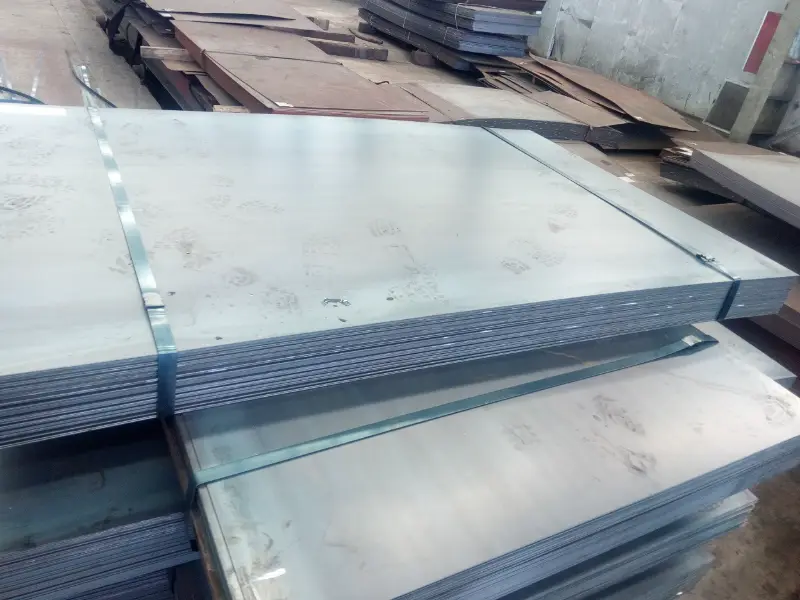
KR Grade D51 Shipbuilding Steel Plate
KR Grade D51 Shipbuilding Steel Plate: High-Strength Structural Steel for Marine Environments
Comprehensive material data for KR Grade D51 shipbuilding steel plate, including chemical composition, mechanical and physical properties, international equivalent grades, and application guidance. Certified by Korean Register of Shipping for high-strength marine structures.
Normalizing rolling, TMCP (Thermo-Mechanical Controlled Processing), normalized or TMCP as applicable, can be cold bent and welded with appropriate procedures
- Phone : +8618037372205
- Email : [email protected]
- WhatsApp: Contact via Whtsapp
- WeChat: +8618037372205
KR Grade D51 Shipbuilding Steel Plate Introduction
KR Grade D51 is a high-strength shipbuilding structural steel plate certified by the Korean Register of Shipping (KR). It is designed for critical ship structures such as outer shells, decks, and bulkheads operating in normal and low-temperature conditions. The designation D51 indicates a minimum nominal yield strength of 51 ksi (355 MPa) and suitability for service down to -20 °C. This grade exhibits excellent weldability, good toughness at low temperatures, and reliable crack arrest properties, fully complying with the KR Rules for the Classification of Steel Ships. It is often supplied in normalized or thermo-mechanically controlled processed (TMCP) condition to achieve the required strength and toughness. KR D51 plates are widely used in merchant ships, offshore structures, and marine equipment where high reliability and certification are mandatory.
KR Grade D51 Shipbuilding Steel Plate Chemical Composition , mass fraction %
The following chemical composition limits are specified by the Korean Register for grade D51 hull structural steel. The values are typical and shall be in accordance with the latest KR Rules. Micro-alloying elements such as Nb, V, Ti may be added singly or in combination to achieve the required mechanical properties. The carbon equivalent (CEV) is controlled to guarantee good weldability.
| Element | Standard Value (max or range) | Remarks / Details |
|---|---|---|
| Carbon (C) | ≤ 0.18 % | Depending on thickness and delivery condition |
| Manganese (Mn) | 0.90 – 1.60 % | High Mn for strength and toughness |
| Silicon (Si) | 0.10 – 0.50 % | Deoxidation |
| Phosphorus (P) | ≤ 0.025 % | |
| Sulfur (S) | ≤ 0.025 % | |
| Aluminum (Al, total) | ≥ 0.015 % | Min. acid-soluble Al for fine grain practice |
| Niobium (Nb) | 0.02 – 0.05 % | Optional: single or combined with V, Ti |
| Vanadium (V) | 0.05 – 0.10 % | Optional: may be present |
| Titanium (Ti) | 0.007 – 0.05 % | Microalloying for grain refinement |
| Carbon Equivalent (CEV) | ≤ 0.40 (typ.) | Calculated per IIW formula, depending on thickness |
KR Grade D51 Shipbuilding Steel Plate Thermal and Electrical Physical Properties
Physical properties are typical values for this type of low-alloy high-strength structural steel at room temperature and elevated temperatures. These are not specification requirements but are provided for design calculations. Data refer to the temperature range 20–100 °C unless otherwise noted. All values are approximate and can be used as a first reference.
| Property | Standard/ Typical Value | Unit | Test Condition / Temperature |
|---|---|---|---|
| Density (ρ) | 7.85 | g/cm³ | At 20 °C |
| Modulus of Elasticity (E) | 205 | GPa | At 20 °C |
| Shear Modulus (G) | 80 | GPa | Calculated from E and ν at 20 °C |
| Poisson's Ratio (ν) | 0.29 | – | At 20 °C |
| Thermal Expansion Coefficient (α) | 12.5 × 10⁻⁶ | K⁻¹ | 20–100 °C |
| Thermal Expansion Coefficient (α) | 13.5 × 10⁻⁶ | K⁻¹ | 20–200 °C |
| Thermal Conductivity (λ) | 45.0 | W/(m·K) | At 20 °C |
| Thermal Conductivity (λ) | 43.0 | W/(m·K) | At 100 °C |
| Specific Heat Capacity (c_p) | 460 | J/(kg·K) | At 20 °C |
| Electrical Resistivity (ρ_e) | 0.22 | Ω·mm²/m | At 20 °C |
KR Grade D51 Shipbuilding Steel Plate Mechanical Properties
Mechanical properties are determined on test pieces taken in the transverse (T) direction for plates and in the longitudinal (L) direction for sections, according to KR Rules. The specified values apply for room temperature tensile testing and impact testing at the prescribed temperature (-20 °C for grade D51). Actual values may vary with thickness and manufacturing process.
| Property | Standard Requirement (min) | Unit | Test Condition / Remarks |
|---|---|---|---|
| Yield Strength (ReH) | 355 (51 ksi) | MPa | Upper yield or 0.2% offset, plate thickness ≤ 150 mm |
| Tensile Strength (Rm) | 490 – 620 | MPa | Plates and wide flats |
| Elongation after fracture (A5) | 21 | % | Gauge length 5.65√S_o, for thickness ≤ 40 mm |
| Elongation after fracture (A5) | 19 | % | Thickness 40–100 mm |
| Elongation after fracture (A5) | 17 | % | Thickness 100–150 mm |
| Charpy Impact Toughness (KV) | 24 (transverse) | J | At -20 °C, standard 10x10 mm specimen, average value |
| Charpy Impact Toughness (KV) | 34 (longitudinal) | J | At -20 °C, min. individual value 70% of average |
| Bend Test (mandrel diameter) | 3t (t = thickness) | – | 180° bending; no cracks for thickness ≤ 25 mm. For greater thickness, 3t or agreed |
KR Grade D51 Shipbuilding Steel Plate Fully Equivalent Material Standards and Replaceable Grades
| Country/Region | Standard | Grade | Remarks |
|---|---|---|---|
| International | ASTM A131 / A131M | EH36 | Identical yield strength (51 ksi min.), impact tested at -40°C, superior low-temperature toughness |
| Europe | EN 10025-4 | S355ML | Thermo-mechanically rolled, comparable mechanical properties, requires verification under ship rules |
| China | GB 712 | EH36 | CCS certified; chemically and mechanically equivalent, widely used in Chinese shipyards |
| Japan | JIS G 3106 | SM490YB (modified) | Similar tensile class; requires agreement and supplementary impact test to match D51 |
| India | IS 3039 | Gr. EH 355 | Equivalent for hull structures, certified by Indian Register of Shipping |
KR Grade D51 Shipbuilding Steel Plate Application Introduction
KR D51 steel plates are specifically designed for marine and offshore structural applications where high strength, good weldability, and proven notch toughness at low service temperatures are mandatory. The material is supplied under class certificate and must be used according to the rules of the classification society. Typical end uses include:
Product Applications: Container ships and bulk carriers (hull plating, keel, sheer strake), Tankers and chemical carriers (deck plates, longitudinal stiffeners), Offshore platform modules and flare booms, Ice-class ship hulls (where D51 is used for lower stress areas), Heavy-lift crane barges
Processed into products: Main deck plates and sheer strakes, Bottom shell and bilge plates, Watertight bulkheads and swash bulkheads, Web frames and large brackets, Hatch coaming and coaming stays, Rudder horns and stern frames (when specified), Offshore structural tubulars and transition pieces (subject to separate approval)
Application industries: Shipbuilding (commercial, naval, and special vessels), Offshore oil & gas (fixed platforms, FPSO modules), Marine & harbor construction (caissons, jetties), Heavy engineering (crane booms, bridges over water)
KR Grade D51 Shipbuilding Steel Plate Similar / Alternative Material Recommendations
| Country/Region | Standard | Grade | Remarks |
|---|---|---|---|
| South Korea | KR Rules | D51 | Original grade; baseline for comparison |
| Worldwide | IACS UR W11 | DH36 / EH36 | DH36: same strength but min. impact at -20°C (similar to D51); EH36: same strength but impact at -40°C (superior) |
| Europe | EN 10025-4 | S355M / S355ML | M (TMCP) grades with similar yield strength; ML has low-temperature impact down to -50°C |
| Japan | JIS G 3106 | SM490YA / YB | Y grades with comparable tensile strength; need supplementary marine surveyor approval |
| USA | ABS Rules | EH36 | Identical performance class; certified by American Bureau of Shipping, interchangeable with KR D51 after approval |
| China | GB 712 | DH36 | Similar toughness level (D51: -20°C, DH36: -20°C); chemical composition may be adjusted |
Notes:
Material ordered as KR Grade D51 must be produced by a KR-approved manufacturer and stamped with the Register's brand. Welding shall be performed using consumables approved by KR, and a welding procedure qualification (WPQ) must be conducted according to KR Part 2. For applications requiring thicknesses >50 mm, additional through-thickness property testing (Z35) may be required by the end user. Mechanical test frequencies and acceptance criteria are specified in KR Rules; any retesting must follow those procedures. The carbon equivalent (CEV) maximum is typically agreed for improved weldability; a common value is CEV ≤ 0.38–0.40 depending on plate thickness.
- Share



