
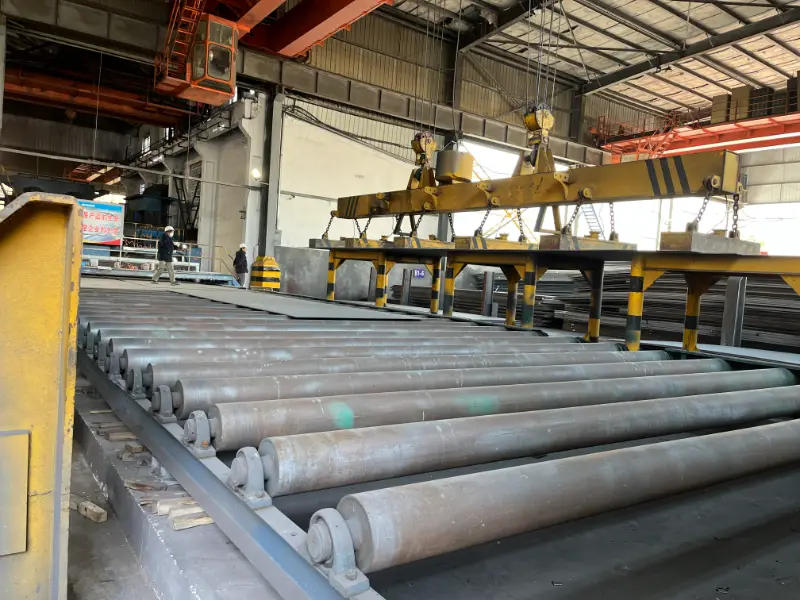
KR Grade E51 Shipbuilding Steel Plate
KR Grade E51 Shipbuilding Steel Plate - Full Material Data, Properties & Equivalents
In-depth technical data for KR Grade E51 shipbuilding plate, covering chemical composition, mechanical and thermal physical properties, international equivalent grades, and application guidance.
Hot rolling, normalizing, thermo-mechanical control process (TMCP), quenching and tempering (optional), cutting, forming, welding
- Phone : +8618037372205
- Email : [email protected]
- WhatsApp: Contact via Whtsapp
- WeChat: +8618037372205
KR Grade E51 Shipbuilding Steel Plate Introduction
KR Grade E51 is a high-strength shipbuilding structural steel plate certified by the Korean Register of Shipping (KR). It conforms to the IACS Unified Requirement UR W11 and is functionally equivalent to the widely used EH36 grade. The steel is designed for critical hull and offshore structures requiring a minimum yield strength of 51 ksi (approximately 355 MPa) combined with excellent low‑temperature notch toughness at -40 °C. The E designation guarantees impact properties down to -40 °C, making it suitable for cold‑climate operations. Manufacturing is typically carried out by controlled rolling, normalizing, or thermo‑mechanical control processing (TMCP), and the grade is supplied in normalized or as‑rolled condition depending on thickness and customer specification. KR Grade E51 offers good weldability, formability, and consistent mechanical performance across thicknesses up to 100 mm, ensuring reliable service in harsh marine environments. Its chemistry is carefully balanced with microalloying elements (Nb, V, Ti) to achieve the required strength without compromising ductility or weldability.
KR Grade E51 Shipbuilding Steel Plate Chemical Composition
The chemical composition complies with the KR Rules based on IACS UR W11 for EH36 grade. Maximum and minimum values are given. Fine‑grain microalloying elements (Nb, V, Ti) are added to ensure high strength and adequate toughness. Carbon equivalent (CEV) is usually controlled to guarantee good weldability.
| Chemical Element | Standard Value | Remarks |
|---|---|---|
| Carbon (C) | ≤0.18 | max |
| Silicon (Si) | ≤0.50 | max |
| Manganese (Mn) | 0.90 – 1.60 | min‑max |
| Phosphorus (P) | ≤0.025 | max |
| Sulfur (S) | ≤0.025 | max |
| Aluminium (Alsol) | ≥0.015 | acid soluble, min |
| Niobium (Nb) | 0.02 – 0.05 | min‑max |
| Vanadium (V) | 0.05 – 0.10 | min‑max |
| Titanium (Ti) | ≤0.02 | max |
| Copper (Cu) | ≤0.35 | max, residual |
| Chromium (Cr) | ≤0.20 | max, residual |
| Nickel (Ni) | ≤0.40 | max, residual |
| Molybdenum (Mo) | ≤0.08 | max, residual |
| Nitrogen (N) | ≤0.012 | if sufficient Al present |
KR Grade E51 Shipbuilding Steel Plate Thermal and Electrical Physical Properties
The physical properties listed are typical values for EH36 equivalent steel and are valid at room temperature unless otherwise stated. These data are for general engineering reference and may vary slightly with exact composition and microstructure. Density, elasticity, thermal expansion, and thermal conductivity are key design parameters.
| Property | Typical Value | Unit | Test Condition |
|---|---|---|---|
| Density (ρ) | 7.85 | g/cm³ | 20 °C |
| Elastic Modulus (E) | 200 | GPa | 20 °C |
| Shear Modulus (G) | 80 | GPa | 20 °C |
| Poisson's Ratio (ν) | 0.30 | – | 20 °C |
| Thermal Expansion Coefficient (α) | 12×10⁻⁶ | K⁻¹ | 20 – 100 °C |
| Thermal Conductivity (λ) | 50 | W/(m·K) | 20 °C |
| Specific Heat Capacity (cp) | 460 | J/(kg·K) | 20 °C |
| Electrical Resistivity (ρe) | 0.20×10⁻⁶ | Ω·m | 20 °C |
KR Grade E51 Shipbuilding Steel Plate Mechanical Properties
The mechanical properties are determined in accordance with IACS UR W11 for EH36. Values depend on product thickness. Yield strength (ReH) and elongation (A) are listed for different thickness ranges. Tensile strength (Rm) applies to all thicknesses. Impact energy is measured on full‑size (10×10 mm) Charpy V‑notch specimens at -40 °C, longitudinal direction. Bending test is performed at ambient temperature with a bend angle of 180°.
| Property | Standard Required Value | Unit | Test Condition |
|---|---|---|---|
| Yield Strength (ReH) | ≥355 | MPa | Thickness ≤ 50 mm |
| Yield Strength (ReH) | ≥345 | MPa | Thickness 50 mm < t ≤ 70 mm |
| Yield Strength (ReH) | ≥315 | MPa | Thickness 70 mm < t ≤ 100 mm |
| Tensile Strength (Rm) | 490 – 630 | MPa | All thicknesses |
| Elongation (A) | ≥21 | % | Thickness ≤ 50 mm, gauge length 5.65√S0 |
| Elongation (A) | ≥20 | % | Thickness 50 mm < t ≤ 100 mm |
| Bend Test (d = bend diameter, a = thickness) | d = 3a | – | 180° bend, thickness > 5 mm |
| Charpy Impact Energy (KV2) | ≥34 | J | Longitudinal, -40 °C, 10×10 mm specimen |
KR Grade E51 Shipbuilding Steel Plate Fully Equivalent Material Grades and Replaceable Designations
| Country/Region | Standard | Grade | Remarks |
|---|---|---|---|
| International | IACS UR W11 | EH36 | Original reference grade |
| South Korea | KR Rules | E51/EH36 | Certified by Korean Register |
| USA | ABS Rules | EH36 | American Bureau of Shipping |
| Norway/Germany | DNV Rules | EH36 | DNV GL (now DNV) classification |
| UK | LR Rules | EH36 | Lloyd's Register |
| France | BV Rules | EH36 | Bureau Veritas |
| China | CCS Rules | EH36 | China Classification Society |
| Japan | NK Rules | EH36 | ClassNK (Nippon Kaiji Kyokai) |
| Italy | RINA Rules | EH36 | Registro Italiano Navale |
| International | ISO 488-3 | E355 | Comparable to EH36 |
KR Grade E51 Shipbuilding Steel Plate Application Introduction
KR Grade E51 (EH36) is specifically engineered for heavy‑duty marine applications where high strength and excellent low‑temperature toughness are mandatory. It is used extensively in the construction of oceangoing vessels, offshore platforms, and ice‑class ships. The steel can be processed by cutting, cold forming, and all common welding methods, making it adaptable to modern shipyard practices.
Product Applications: Hull shell plates, Deck and bottom plates, Watertight bulkheads, Deck stringers and sheer strakes, Offshore platform structural nodes
Processed into products: Transverse and longitudinal framing members, Girders, beams, and stiffeners, Bracket plates and web frames, Hatch coamings and side shell plates, Foundations for machinery and deck equipment
Application industries: Shipbuilding and ship repair, Offshore oil & gas (jackets, FPSO, semisubmersibles), Marine engineering, Bridge construction (specific parts), Pressure vessel and tank fabrication (marine use)
KR Grade E51 Shipbuilding Steel Plate Similar/Closely Related Substitute Materials
| Country/Region | Standard | Grade | Remarks |
|---|---|---|---|
| International | IACS UR W11 | DH36 | Similar strength, impact test at -20 °C (D class) |
| International | IACS UR W11 | EH32 | Slightly lower yield strength (315 MPa), -40 °C impact |
| International | IACS UR W11 | FH36 | Higher toughness, impact test at -60 °C |
| Europe | EN 10025-4 | S355ML | Thermomechanical rolled fine‑grain structural steel, comparable strength |
Notes:
Welding: Preheating may be required for thicker sections (>30 mm) to avoid hydrogen cracking. Low‑hydrogen welding consumables are recommended. Heat treatment: Normalizing is the most common delivery condition to ensure uniform mechanical properties. TMCP supply can be specified to enhance weldability and reduce carbon equivalent. Certification: All plates are stamped with the KR mark and provided with 3.1 or 3.2 inspection certificates per EN 10204. Tolerances comply with KR or EN 10029.
- Share



