
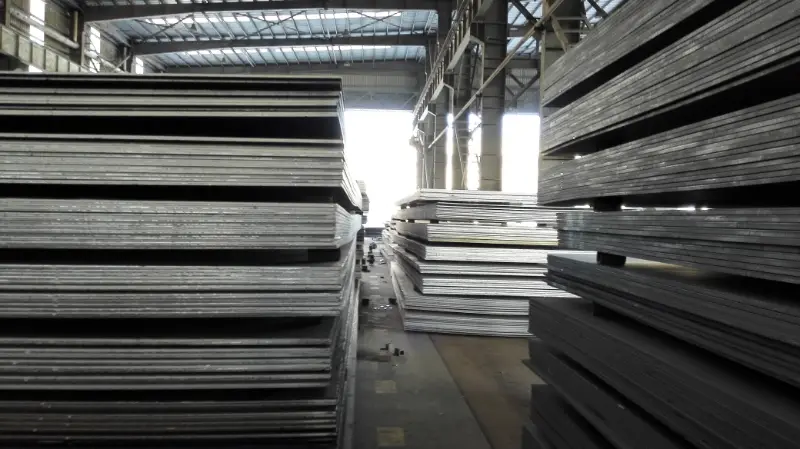
KR Grade F51 Shipbuilding Steel Plate
KR Grade F51 Shipbuilding Steel Plate: High-Strength Quenched & Tempered Steel for Extreme Marine Environments
Comprehensive data sheet for KR Grade F51 shipbuilding plate under Korean Register rules. Covers chemical composition, mechanical properties, physical properties, international equivalents, and application guidance for offshore and marine structures.
Quenching and tempering (Q+T); may also be produced by TMCP + tempering. Weldable by all common methods with appropriate preheat and interpass control.
- Phone : +8618037372205
- Email : [email protected]
- WhatsApp: Contact via Whtsapp
- WeChat: +8618037372205
KR Grade F51 Shipbuilding Steel Plate Introduction
KR Grade F51 is a high-strength quenched and tempered hull structural steel plate certified by the Korean Register (KR). It belongs to the F-grade category, requiring Charpy V-notch impact testing at -60°C with a minimum absorbed energy of 41 J. The '51' designation indicates a minimum yield strength of 510 MPa. This steel offers an excellent combination of strength, toughness, and weldability, making it suitable for critical structural components in ice-class vessels, offshore platforms, and other demanding marine applications.
The steel is produced via advanced processing such as thermo-mechanical controlled processing (TMCP) followed by quenching and tempering, ensuring fine grain size and uniform properties. Typical thickness ranges up to 100 mm. It is supplied according to KR Rules for the Classification of Steel Ships, Part 2, Chapter 2.
KR Grade F51 Shipbuilding Steel Plate Chemical Composition
The chemical composition conforms to the KR Rules for higher-strength quenched and tempered steels for shipbuilding. Limits are given for ladle analysis. The steel is fully killed with fine grain practice and contains micro-alloying elements to achieve the required strength and toughness.
- Carbon equivalent (CEV) is typically controlled to ensure good weldability.
- Residual and impurity elements are strictly limited.
| Chemical Element | Standard Value (max, except range) | Remarks |
|---|---|---|
| C (Carbon) | ≤ 0.18 | Typical 0.08–0.16 |
| Si (Silicon) | 0.10–0.55 | |
| Mn (Manganese) | 0.90–1.60 | Higher end for thick plates |
| P (Phosphorus) | ≤ 0.025 | Strict control for toughness |
| S (Sulfur) | ≤ 0.025 | Low sulfur improves ductility |
| Cu (Copper) | ≤ 0.35 | May be added for corrosion resistance |
| Cr (Chromium) | ≤ 0.20 | |
| Ni (Nickel) | ≤ 0.40 | Enhances low-temperature toughness |
| Mo (Molybdenum) | ≤ 0.08 | |
| Nb (Niobium) | ≤ 0.05 | Grain refinement |
| V (Vanadium) | ≤ 0.10 | Precipitation strengthening |
| Ti (Titanium) | ≤ 0.02 | Grain refinement and sulfide shape control |
| Al (Aluminum, total) | ≥ 0.020 | Deoxidation and grain refining |
| N (Nitrogen) | ≤ 0.009 | Limitation prevents strain aging |
| B (Boron) | ≤ 0.0005 | Optional micro-alloying |
KR Grade F51 Shipbuilding Steel Plate Thermal and Electrical Physical Properties
The following physical properties are representative for low-alloy quenched and tempered steels similar to KR F51. They are not part of the mandatory classification rules but are provided for design calculations.
- Values are valid at room temperature unless a temperature range is specified.
- Slight variations may occur depending on the exact heat treatment and composition.
| Property | Typical Value | Unit | Test Condition / Remarks |
|---|---|---|---|
| Density (ρ) | 7.85 | g/cm³ | At 20°C |
| Modulus of elasticity (E) | 205 | GPa | At 20°C |
| Shear modulus (G) | 80 | GPa | At 20°C |
| Poisson's ratio (ν) | 0.3 | – | Within elastic range |
| Thermal expansion coefficient (α) | 11.5 × 10⁻⁶ | K⁻¹ | 20–100°C |
| Thermal expansion coefficient (α) | 12.2 × 10⁻⁶ | K⁻¹ | 20–200°C |
| Thermal expansion coefficient (α) | 13.0 × 10⁻⁶ | K⁻¹ | 20–400°C |
| Thermal conductivity (λ) | 52 | W/(m·K) | At 20°C |
| Specific heat capacity (cₚ) | 460 | J/(kg·K) | At 20°C |
| Electrical resistivity (ρₑ) | 0.16 × 10⁻⁶ | Ω·m | At 20°C |
KR Grade F51 Shipbuilding Steel Plate Mechanical Properties
The following mechanical properties are specified by KR rules for thicknesses ≤ 50 mm unless otherwise noted. Test specimens are taken in the transverse direction.
- Tensile testing is performed at room temperature.
- Charpy V-notch impact tests are carried out at -60°C.
- Bend tests use 180° bending with a specified mandrel diameter.
| Property | Standard Required Value | Unit | Test Condition / Remarks |
|---|---|---|---|
| Yield strength (ReH) | ≥ 510 | MPa | Transverse, thickness ≤ 50 mm |
| Tensile strength (Rm) | 610 – 770 | MPa | Transverse, thickness ≤ 50 mm |
| Elongation (A) | ≥ 15 | % | Gauge length L₀ = 5.65√S₀, thickness ≤ 50 mm |
| Charpy V-notch impact energy (KV₂) | ≥ 41 (longitudinal) | J | At -60°C, average of 3 specimens, min single 70% of average |
| Charpy V-notch impact energy (KV₂) | ≥ 27 (transverse) | J | At -60°C, average of 3 specimens |
| Bend test (180°) | d = 3a | – | Mandrel diameter = 3 × plate thickness; no cracks, for thickness ≤ 25 mm |
KR Grade F51 Shipbuilding Steel Plate Fully Equivalent Material Standards and Substitutable Grades
| Country / Region | Standard | Grade | Remarks |
|---|---|---|---|
| USA | ABS Rules | FH51 | Identical strength and impact temperature (-60°C); Q&T delivery |
| Norway / Germany | DNV GL (now DNV) Rules | FH51 | Same specification; equivalent toughness and welding requirements |
| France | BV Rules | FH51 | Fully interchangeable for marine applications |
| UK | LR Rules | FH51 | Mechanical and chemical requirements aligned |
| China | CCS Rules | FH51 | Corresponds directly to KR F51; approved under IACS UR W31 |
| Italy | RINA Rules | FH51 | Reciprocal recognition through IACS |
| Japan | NK Rules | FH51 | Same strength category and test temperature |
| International | IACS UR W31 | FH51 | Unified Requirement for high-strength hull structural steel, grade FH51 |
KR Grade F51 Shipbuilding Steel Plate Application Introduction
KR Grade F51 is designed for extreme-service marine environments where high strength and exceptional low-temperature impact toughness are mandatory. Its -60°C guaranteed Charpy energy makes it the go-to choice for Arctic and Antarctic vessels, heavy icebreakers, and critical load-bearing members in offshore platforms.
The combination of yield strength above 510 MPa and good weldability enables reduced scantling dimensions, leading to lighter structures and increased payload capacity. Following proper workshop practices (preheating, low-hydrogen consumables, and controlled cooling), the steel can be efficiently fabricated into complex marine assemblies.
Product Applications: Arctic-capable hull shell plates and strength decks, Structural components for icebreaker bows and stern frames, Offload crane pedestals on floating production units, Reinforced bulkheads in LNG containment systems, Jack-up rig leg chords and rack plates
Processed into products: Transverse and longitudinal frames of ice-class ships, Bilge keel strakes and sheer strakes, Horizontal and vertical stiffeners on platform columns, Penetration pieces and inserts in hull structures, Flange plates for heavy-lift ship cranes
Application industries: Shipbuilding (ice-class vessels, LNG carriers, FPSOs), Offshore oil & gas (jacket legs, helidecks, platform decks), Naval defense (hull plates for frigates, submarines), Heavy lifting equipment (crane pedestals, booms), Renewable energy (offshore wind turbine foundation transition pieces)
KR Grade F51 Shipbuilding Steel Plate Similar / Alternative Materials with Close Performance
| Country / Region | Standard | Grade | Remarks / Analysis |
|---|---|---|---|
| South Korea | KR Rules | EH51 | Identical strength but impact temperature -40°C, suitable for less severe cold conditions |
| Europe | EN 10225 | S500G1+M/Q | Offshore structural steel with min yield 500 MPa; toughness down to -40°C (G1) or -60°C (G2) |
| USA | ASTM A514 / A517 | Grade F | Quenched & tempered alloy steel, yield ~690 MPa; higher strength, careful welding required |
| Japan | JIS G 3128 | SHY685 | High yield strength steel for welded structures, min yield 685 MPa; not specifically for ship classification |
| International | EN 10025-6 | S690Q | High-strength Q&T structural steel; yield ≥ 690 MPa, not certified for ship hull but used in offshore cranes |
Notes:
Additional requirements such as ultrasonic testing to EN 10160 Class S1E1, through-thickness properties (Z-quality), or high-temperature tensile testing may be agreed upon between the purchaser and the manufacturer. Welding consumables should match the strength and low-temperature toughness of the base metal; preheat temperature is typically 100–150°C depending on plate thickness and combined hydrogen level. The steel fulfills IACS UR W31, and certificates are endorsed by the attending classification society surveyor.
- Share



