
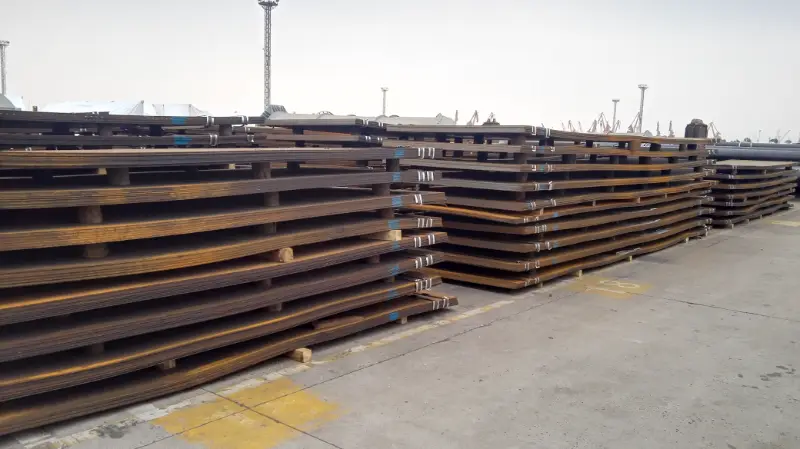
KR Grade A56 Shipbuilding Steel Plate
KR Grade A56 Shipbuilding Steel Plate - High Strength Marine Structural Material (Equivalent A550)
Detailed data sheet and properties of KR Grade A56 shipbuilding steel plate, equivalent to IACS UR W11 Grade A550. Covers chemical composition, mechanical and thermal properties, and international equivalents.
Hot rolling, controlled rolling, normalizing, thermo-mechanical control process (TMCP), quenching and tempering
- Phone : +8618037372205
- Email : [email protected]
- WhatsApp: Contact via Whtsapp
- WeChat: +8618037372205
KR Grade A56 Shipbuilding Steel Plate Introduction
KR Grade A56 is a high strength shipbuilding structural steel plate certified by the Korean Register of Shipping (KR). It corresponds to the higher strength hull structural steel grade A550 according to IACS Unified Requirement UR W11, with a minimum yield strength of 550 MPa and good toughness at 0°C. The grade is designed for critical structural components in modern large-scale vessels and offshore installations where weight reduction and superior strength are essential. Typically supplied in thermo-mechanically controlled processed (TMCP), normalized, or quenched and tempered condition, it offers excellent weldability and consistent mechanical properties. The designation "A56" reflects the historic naming convention using nominal strength in kgf/mm², synonymous with the current 550 MPa class.
KR Grade A56 Shipbuilding Steel Plate Chemical Composition
The chemical composition of KR Grade A56 (A550) is governed by the IACS UR W11 for higher strength hull structural steel. Micro-alloying elements such as niobium, vanadium, and titanium may be added individually or in combination to achieve the required strength and toughness. The table lists the maximum permissible values unless a range is specified.
| Chemical Element | Specified Value (wt%) | Notes |
|---|---|---|
| Carbon (C) | ≤ 0.18 | |
| Manganese (Mn) | 0.90 – 1.60 | |
| Silicon (Si) | ≤ 0.50 | |
| Phosphorus (P) | ≤ 0.025 | |
| Sulfur (S) | ≤ 0.025 | |
| Copper (Cu) | ≤ 0.35 | |
| Chromium (Cr) | ≤ 0.20 | |
| Nickel (Ni) | ≤ 0.40 | |
| Molybdenum (Mo) | ≤ 0.08 | |
| Nitrogen (N) | ≤ 0.020 | Total nitrogen |
| Aluminum (Al) | ≥ 0.020 | Acid-soluble (minimum) |
| Carbon Equivalent (Ceq) | Typically ≤ 0.43 | As per agreement, CE = C + Mn/6 + (Cr+Mo+V)/5 + (Ni+Cu)/15 |
KR Grade A56 Shipbuilding Steel Plate Thermal & Electrical Physical Properties
The following physical properties are typical for high strength low alloy structural steels and are provided as reference values. Actual properties may vary slightly depending on the exact composition and heat treatment condition. Thermal expansion coefficient and thermal conductivity are given for ambient conditions unless specified otherwise.
| Property | Typical Value | Unit | Condition |
|---|---|---|---|
| Density (ρ) | ~ 7850 | kg/m³ | Ambient |
| Modulus of Elasticity (E) | ~ 205 | GPa | Ambient |
| Shear Modulus (G) | ~ 80 | GPa | Ambient |
| Poisson's Ratio (ν) | ~ 0.30 | - | Ambient |
| Thermal Expansion Coeff. (α) | ~ 12.0 | 10⁻⁶/K | 20–100 °C |
| Thermal Conductivity (λ) | ~ 50 | W/(m·K) | Ambient |
| Specific Heat Capacity (c) | ~ 460 | J/(kg·K) | Ambient |
| Electrical Resistivity (ρe) | ~ 0.20 | 10⁻⁶ Ω·m | Ambient |
KR Grade A56 Shipbuilding Steel Plate Mechanical Properties
Mechanical testing is performed in accordance with KR Rules and IACS UR W11. Specimens are taken transverse to the rolling direction. The values apply to plate thicknesses up to 100 mm. Impact properties correspond to Grade A (impact test temperature 0°C).
| Property | Standard Requirement | Unit | Test Condition |
|---|---|---|---|
| Yield Strength (ReH) | ≥ 550 | MPa | Transverse, t ≤ 100 mm |
| Tensile Strength (Rm) | 610 – 770 | MPa | Transverse, t ≤ 100 mm |
| Elongation (A5) | ≥ 16 | % | Gauge length 5.65√S0, t ≤ 100 mm |
| Bend Test | d = 3a, 180° no cracks | - | t ≤ 100 mm |
| Charpy V-notch Impact (KV2) | ≥ 34 (longitudinal) | J | at 0°C (Grade A) |
| Charpy V-notch Impact (KV2) | ≥ 24 (transverse) | J | at 0°C (Grade A) |
KR Grade A56 Shipbuilding Steel Plate Identical Equivalent Material Standards & Replaceable Grades
The grades listed below align with the IACS Unified Requirement UR W11 for higher strength hull structural steel with minimum 550 MPa yield and Grade A (0°C) toughness. They can be considered directly substitutable for KR Grade A56, subject to the acceptance of the relevant classification society.
| Country/Region | Standard/Grading Society | Grade | Remarks |
|---|---|---|---|
| International | IACS UR W11 | A550 | Unified requirement for higher strength hull structural steel |
| South Korea | Korean Register (KR) | A56 (A550) | Identical grade |
| USA | American Bureau of Shipping (ABS) | Grade A550 | |
| Norway/Germany | DNV | VL A550 | |
| France | Bureau Veritas (BV) | A550 | |
| UK | Lloyd's Register (LR) | Grade A550 | |
| China | China Classification Society (CCS) | A550 | |
| Japan | Nippon Kaiji Kyokai (ClassNK) | KA550 | |
| Italy | RINA | A550 |
KR Grade A56 Shipbuilding Steel Plate Application Introduction
KR Grade A56 steel plates are utilized in the construction of modern, large-scale ships and offshore structures where high strength-to-weight ratio is critical. The material performs reliably in low-temperature marine environments and can be processed with conventional shipyard fabrication methods, including welding, cutting, and forming, provided appropriate procedures are followed.
Product Applications: Container ships, Bulk carriers, Oil tankers, LNG carriers, Offshore platforms, Crane structures
Processed into products: Hull plates (deck, bottom, side shell), Stiffeners, Girders, Hatch coamings, Transverse bulkheads, Longitudinal beams, Web frames
Application industries: Shipbuilding & Marine, Offshore Engineering, Heavy Construction
KR Grade A56 Shipbuilding Steel Plate Similar / Comparable Alternative Materials
These alternative grades exhibit similar chemical and mechanical property profiles but may differ in minimum yield strength or toughness class. They can serve as substitutes in less demanding applications or when higher/lower strength is acceptable.
| Country/Region | Standard/Grading Society | Grade | Remarks |
|---|---|---|---|
| International | IACS UR W11 | A460 | Lower minimum yield strength 460 MPa, good toughness at 0°C |
| International | IACS UR W11 | A500 | Minimum yield strength 500 MPa; intermediate strength option |
| International | IACS UR W11 | A620 | Higher minimum yield strength 620 MPa; requires higher welding preheat |
| International | IACS UR W11 | A690 | Higher minimum yield strength 690 MPa; more demanding fabrication |
Notes:
Welding consumables should be selected to match the base material strength and toughness. Preheating and interpass temperature control are recommended depending on plate thickness and carbon equivalent. This grade may be supplied with additional requirements for through-thickness properties (Z-grade) if specified.
- Share



