
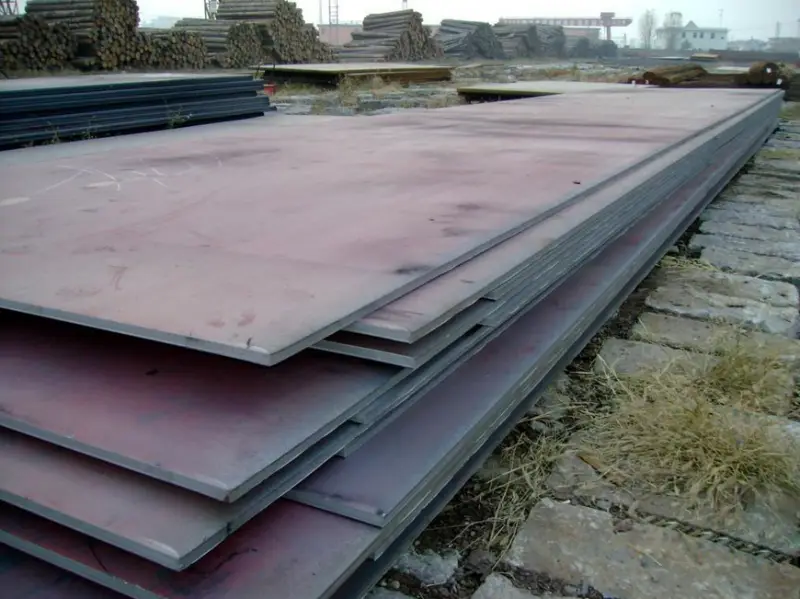
KR Grade D56 Shipbuilding Steel Plate
KR Grade D56 Shipbuilding Steel Plate: High-Strength Marine Structural Steel
Comprehensive technical data for KR Grade D56 shipbuilding steel plate, including chemical composition, mechanical and thermal properties, international equivalents, and application guidance.
Quenching and tempering (QT); suitable for hot forming with subsequent heat treatment, cold bending, welding under controlled procedures
- Phone : +8618037372205
- Email : [email protected]
- WhatsApp: Contact via Whtsapp
- WeChat: +8618037372205
KR Grade D56 Shipbuilding Steel Plate Introduction
KR Grade D56 is a high-strength quenched and tempered shipbuilding steel plate certified by the Korean Register of Shipping (KR). It belongs to the D series of extra-high-strength structural steels with a specified minimum yield strength of 560 MPa. The 'D' designation indicates a standard low-temperature toughness requirement at -20°C, making it suitable for critical components in ship hulls and offshore structures operating in cold climates. The steel exhibits excellent weldability, good formability, and high resistance to brittle fracture. It is supplied in a quenched and tempered (QT) condition, ensuring a fine-grained microstructure that meets stringent impact test requirements. Typical thickness ranges from 6 mm to 150 mm, with stringent controls on chemical composition to guarantee reliable mechanical performance in marine environments.
KR Grade D56 Shipbuilding Steel Plate Chemical Composition of KR Grade D56
The chemical composition of KR D56 steel is strictly controlled to achieve high strength and excellent low-temperature toughness. The alloying concept relies on low carbon with additions of manganese, nickel, and microalloying elements such as niobium, vanadium, and titanium. The carbon equivalent (CEV) is typically limited to ensure weldability. Data below represents the maximum values unless a range is indicated.
| Element | Standard Value (max %) | Remarks |
|---|---|---|
| Carbon (C) | 0.20 | Ladle analysis, max |
| Silicon (Si) | 0.55 | Ladle analysis, max |
| Manganese (Mn) | 0.90 - 1.60 | Range |
| Phosphorus (P) | 0.025 | Max, indicative, subject to KR rules |
| Sulfur (S) | 0.025 | Max, indicative |
| Chromium (Cr) | 0.25 | Max, residual content considered |
| Nickel (Ni) | 0.80 | Max |
| Molybdenum (Mo) | 0.08 | Max |
| Copper (Cu) | 0.35 | Max |
| Niobium (Nb) | 0.02 - 0.05 | Range, microalloy addition |
| Vanadium (V) | 0.05 - 0.10 | Range, microalloy addition |
| Titanium (Ti) | 0.02 | Max, optional for grain refinement |
| Aluminum (Al), acid soluble | 0.015 min | Required for fine grain practice |
| Nitrogen (N) | 0.012 | Max, unless sufficient Al, Ti are present |
KR Grade D56 Shipbuilding Steel Plate Thermal and Electrical Physical Properties of KR D56
Physical properties are based on data for similar quenched and tempered low-alloy steels with comparable chemical composition (e.g., S690Q). These values are indicative and may slightly vary with actual heat treatment condition and microstructure. Density, thermal expansion, thermal conductivity, and electrical resistivity are provided for engineering calculations.
| Property | Typical Value | Unit | Test Condition |
|---|---|---|---|
| Density (ρ) | 7850 | kg/m³ | At 20°C |
| Elastic Modulus (E) | 205 - 210 | GPa | Room temperature |
| Shear Modulus (G) | 80 | GPa | Room temperature |
| Poisson's Ratio (ν) | 0.3 | — | Room temperature |
| Thermal Expansion Coefficient (α) | 12.5 | 10⁻⁶/K | 20°C to 100°C |
| Thermal Expansion Coefficient (α) | 13.2 | 10⁻⁶/K | 20°C to 200°C |
| Thermal Expansion Coefficient (α) | 13.9 | 10⁻⁶/K | 20°C to 400°C |
| Thermal Conductivity (λ) | 35 - 40 | W/(m·K) | At 20°C |
| Specific Heat Capacity | 460 - 500 | J/(kg·K) | At 20°C |
| Electrical Resistivity (ρ_e) | 0.25 - 0.30 | μΩ·m | At 20°C |
KR Grade D56 Shipbuilding Steel Plate Mechanical Properties of KR Grade D56
The mechanical properties are determined on transverse or longitudinal test specimens taken from quenched and tempered plates. The yield strength (ReH) and tensile strength (Rm) depend on plate thickness. Charpy V-notch impact tests are performed at -20°C; minimum absorbed energy requirements vary with specimen orientation and thickness. Bend test requirements ensure formability without cracking. Values are based on KR Rules.
| Property | Standard Required Value | Unit | Test Condition / Remarks |
|---|---|---|---|
| Yield Strength (ReH) | min 560 | MPa | Thickness ≤ 50 mm, transverse |
| Yield Strength (ReH) | min 550 | MPa | Thickness > 50 mm ≤ 100 mm |
| Yield Strength (ReH) | min 540 | MPa | Thickness > 100 mm ≤ 150 mm |
| Tensile Strength (Rm) | 670 - 830 | MPa | Thickness ≤ 100 mm |
| Tensile Strength (Rm) | 630 - 790 | MPa | Thickness > 100 mm ≤ 150 mm |
| Elongation (A, Lo=5.65√So) | min 16 | % | Thickness ≤ 50 mm, transverse |
| Elongation (A) | min 16 | % | Thickness > 50 mm ≤ 100 mm |
| Elongation (A) | min 14 | % | Thickness > 100 mm ≤ 150 mm |
| Bend Test (180°) | d = 3a (up to 50 mm); d = 4a (>50 mm) | — | d = bend diameter, a = specimen thickness |
| Charpy V-notch Impact Energy (KV) | min 50 (longitudinal); min 34 (transverse) | J | At -20°C, average of 3 tests, one min ≥70% of average |
KR Grade D56 Shipbuilding Steel Plate Exact Equivalent Material Standards and Replaceable Grades for KR D56
| Country / Region | Standard | Grade | Remarks |
|---|---|---|---|
| International | IACS (International Association of Classification Societies) | E690, F690 etc. | Classification society equivalents; E690 for -40°C, D56 corresponds to -20°C toughness level. |
| Norway / International | DNV GL (now DNV) | E690 / F690 | DNV VL E690; toughness at -40°C exceeds D56; but composition and strength identical. |
| USA | ASTM A514 / A517 | Grade Q | Quenched and tempered, yield strength ≥690 MPa; S content limited to 0.025%; equivalent strength level. |
| European Union | EN 10025-6 | S690Q / S690QL / S690QL1 | Quenched and tempered; requires similar mechanical properties, minimum yield 690 MPa. |
| Japan | JIS G 3128 | SHY685 / SHY685N | High yield strength steel for welded structures; equivalent to D56 based on mechanical properties. |
| China | CCS (China Classification Society) | E690 | CCS Rules for Materials and Welding; E690 is the direct equivalent for high-strength hull structural steel. |
| United Kingdom | LR (Lloyd's Register) | E690 | LR grade E690 with toughness at -40°C, matches strength and chemistry of D56. |
| France | BV (Bureau Veritas) | E690 | BV E690 plate, extra high strength, equivalent to D56. |
| Italy | RINA | E690 | RINA grade E690 for hull structures; recognized as equivalent. |
| Japan | NK (ClassNK) | KE690 | Nippon Kaiji Kyokai grade KE690, direct equivalent in strength. |
KR Grade D56 Shipbuilding Steel Plate Application Introduction
KR Grade D56 steel is primarily intended for the construction of large, high-performance ship hulls and offshore structures where weight savings and high strength are critical. The combination of minimum yield strength of 560 MPa and good low-temperature impact toughness makes it suitable for applications exposed to dynamic loading and cold seawater. The material is delivered in the quenched and tempered condition, which ensures a uniform fine-grained microstructure. Fabrication typically involves cutting, bending, and welding under strict protocols. Due to its high strength, forming requires larger bending radii and controlled heat input during welding to avoid softening in the heat-affected zone. The following lists detail typical industries, products, and specific components.
Product Applications: Seagoing vessel hulls and superstructures, Jack-up rig legs and spudcans, Offshore wind turbine transition pieces and monopiles, Icebreaker shells and strengthening bars, Shipbuilding crane girders and booms, Submarine pressure hulls (subject to additional certifications)
Processed into products: Main deck and shell plating, Bottom and side longitudinal stiffeners, Transverse bulkheads and web frames, Hatch coamings and corner plates, Fatigue-critical welded joints in deck structures, Bracket plates and chocks, Offshore mooring equipment supports, Heavy-lift crane pedestals and housings
Application industries: Shipbuilding (container ships, bulk carriers, tankers, ice-class vessels), Offshore engineering (oil & gas platforms, wind turbine foundations), Heavy machinery (crane booms, heavy lifting equipment), Bridge construction (box girders, orthotropic decks), Pressure vessels and boilers (where low-temperature toughness is required)
KR Grade D56 Shipbuilding Steel Plate Similar/Alternative Materials with Comparable Performance
| Country / Region | Standard | Grade | Remarks |
|---|---|---|---|
| European Union | EN 10025-6 | S690Q | Slightly higher specified min. yield strength (690 MPa), but same family of QT steels; requires careful weld procedure. |
| USA | ASTM A514/A517 | Grade E / F / H | These grades have varying alloy contents but deliver similar strength and toughness; check CEV for welding. |
| Japan | JIS G 3128 | SHY685 | High yield strength steel for welded structures; often used in shipbuilding with prior approval. |
| International | IACS UR W11 | E690 | All IACS members accept E690 as the extra-high strength QT steel; D56 is one notch level lower in toughness (E vs D). |
| Norway / International | DNV | E690 | Fully interchangeable from a strength perspective; toughness slightly higher in E690. |
| China | GB/T 16270 | Q690D / Q690E | High strength quenched and tempered steel; D-grade requires -20°C impact test, E-grade -40°C. Q690D is the closest. |
Notes:
The Korean Register of Shipping certifies D56 plates after verification of chemical composition, tensile properties, impact toughness at -20°C, and non-destructive examination as per Part 2, Chapter 2 of the KR Rules. Welding: Preheating and interpass temperature control shall comply with the manufacturer's recommendations and recognized procedures; post-weld heat treatment (PWHT) is not mandatory but may be applied for stress relief. Tolerances: Thickness, flatness, and surface quality are in accordance with the applicable KR Rules or agreed standards (e.g., EN 10029). Certification: Mill test reports (MTR) or inspection certificates type 3.1 according to EN 10204 are typically issued. It is recommended to consult the latest KR Rules or authorized manufacturers for project-specific requirements.
- Share



