
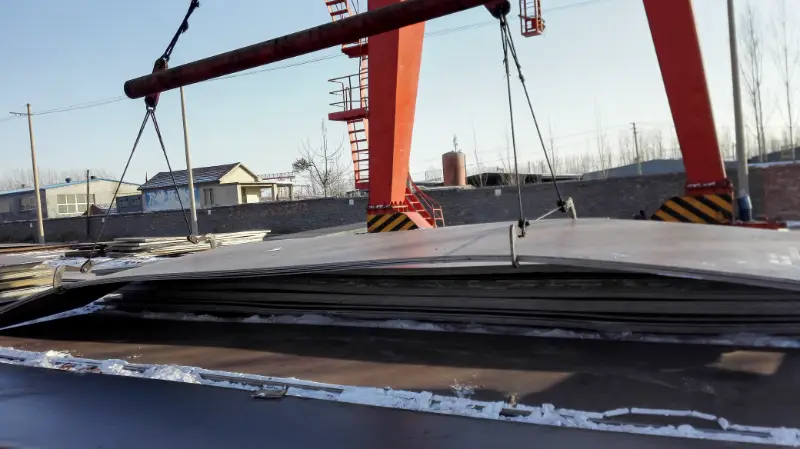
KR Grade E56 Shipbuilding Steel Plate
KR Grade E56 Shipbuilding Steel Plate - High-Strength Hull Structural Steel for Marine Applications
Comprehensive technical data for KR Grade E56 (EH56) shipbuilding steel plate, covering chemical composition, mechanical properties, thermal and electrical physical properties, international equivalents, and application guidelines in accordance with Korean Register standards.
Hot rolling, thermomechanical controlled processing (TMCP), normalizing, quenching and tempering (Q&T), cold forming, welding, machining
- Phone : +8618037372205
- Email : [email protected]
- WhatsApp: Contact via Whtsapp
- WeChat: +8618037372205
KR Grade E56 Shipbuilding Steel Plate Introduction
KR Grade E56 (designated as KR EH56) is a high-strength, low-alloy steel plate specifically developed for shipbuilding and offshore structures, certified by the Korean Register of Shipping. It belongs to the high-strength hull structural steel series with a minimum yield strength of 560 MPa, offering excellent weldability, toughness at low temperatures, and good corrosion resistance in marine environments. This grade is designed for critical components requiring high load-bearing capacity and resistance to brittle fracture at sub-zero temperatures, making it suitable for large container ships, ice-class vessels, and offshore platforms. The steel is produced through controlled rolling, normalizing, or quenching and tempering processes, and subjected to stringent impact testing at -40°C to ensure reliable performance in cold seas.
KR Grade E56 Shipbuilding Steel Plate Chemical Composition
The chemical composition complies with KR Rules, Part 2, Chapter 1, Section 3, Table 2.1.2-1 for Grade EH56 high-strength steel. All elements are within limits to ensure good weldability and mechanical properties. Ceq (IIW) is typically ≤ 0.42% for plates ≤ 50 mm. Refined grain structure is achieved through additions of Nb, V, Ti. Residual elements are strictly controlled.
| Chemical Element | Standard Value (max, %) | Remarks |
|---|---|---|
| Carbon (C) | ≤ 0.18 | Typical 0.06–0.12 for TMCP |
| Silicon (Si) | ≤ 0.55 | Deoxidizer and strength enhancer |
| Manganese (Mn) | 0.90–1.60 | Provides strength and toughness |
| Phosphorus (P) | ≤ 0.025 | Strictly controlled for low-temperature toughness |
| Sulfur (S) | ≤ 0.025 | Controlled to avoid hot cracking |
| Chromium (Cr) | ≤ 0.25 | Optional element; may be present from scrap |
| Nickel (Ni) | ≤ 0.80 | Improves toughness; may be added for low-temperature grades |
| Molybdenum (Mo) | ≤ 0.08 | Trace alloying for temper resistance |
| Copper (Cu) | ≤ 0.35 | Optional; can be present up to this limit |
| Aluminium (Al) | ≥ 0.015 total | Grain refiner; acid-soluble Al typical for fine grain practice |
| Niobium (Nb) | 0.02–0.05 | Microalloy for precipitation strengthening |
| Vanadium (V) | ≤ 0.10 | Microalloy; together with Nb/Ti refines grain |
| Titanium (Ti) | ≤ 0.02 | Grain refinement and weld improvement |
| Nitrogen (N) | ≤ 0.009 | Typically controlled to avoid strain ageing |
| Carbon Equivalent (Ceq) | ≤ 0.42 | Calculated as C+Mn/6+(Cr+Mo+V)/5+(Ni+Cu)/15 |
KR Grade E56 Shipbuilding Steel Plate Thermal and Electrical Physical Properties
Physical properties are representative for HSLA steel with similar composition and are not specified in the KR Rules. They serve as engineering guidelines.
- Values may change slightly with temperature; room-temperature values are given unless noted.
- Thermal expansion coefficient is for the range 20–100°C.
- Electrical resistivity is stated for 20°C.
| Property | Typical Value | Unit | Test Condition |
|---|---|---|---|
| Density (ρ) | 7850 | kg/m³ | 20°C |
| Young's Modulus (E) | 205 | GPa | 20°C, tension |
| Shear Modulus (G) | 80 | GPa | 20°C, torsion |
| Poisson's Ratio (ν) | 0.3 | — | Room temperature |
| Thermal Expansion Coefficient (α) | 11.7 × 10⁻⁶ | K⁻¹ | 20–100°C |
| Thermal Conductivity (λ) | 48 | W·m⁻¹·K⁻¹ | 20°C |
| Specific Heat Capacity (cₚ) | 460 | J·kg⁻¹·K⁻¹ | 20°C |
| Electrical Resistivity (ρₑ) | 0.25 × 10⁻⁶ | Ω·m | 20°C |
KR Grade E56 Shipbuilding Steel Plate Mechanical Properties
Mechanical properties are based on the KR Rules for high-strength steel plates with thickness ≤ 50 mm, transverse test specimens. Actual values may vary depending on final heat treatment and gauge.
- Yield strength is measured at 0.2% offset (Rp0.2) for quenched and tempered material.
- Impact test temperature for E-grade is -40°C, with energy values for longitudinal specimens.
- Bend test is performed with a former diameter (d) multiple of the specimen thickness (a).
| Property | Standard Requirement | Unit | Test Condition |
|---|---|---|---|
| Yield Strength (ReH / Rp0.2) | ≥ 560 | MPa | Transverse; room temperature; plate thickness ≤ 50 mm |
| Tensile Strength (Rm) | 670 – 830 | MPa | Transverse; room temperature; thickness ≤ 50 mm |
| Elongation (A) | ≥ 16 | % | Gauge length Lo = 5.65√So; transverse |
| Bend Test (D = bend diameter) | D = 3a | — | 180° bend; no cracks; a = specimen thickness |
| Impact Absorbed Energy (KV2), -40°C | ≥ 41 | J | Longitudinal; 2 mm V-notch; average of three individual values (min. single value 28 J) |
KR Grade E56 Shipbuilding Steel Plate Exact Equivalent Material Standards and Replacement Grades
International classification societies fully recognize the KR EH56 grade with their own designations. Mechanical and chemical requirements are harmonized through IACS UR W13, making these grades direct substitutes in marine applications.
| Country / Region | Standard | Grade / Designation | Remarks |
|---|---|---|---|
| International / USA | ABS Rules for Materials and Welding | ABS EH56 | Identical chemistry and mechanical properties; -40°C impact test |
| UK / International | Lloyd's Register Rules | LR EH56 | Full equivalence; recognized for hull construction |
| Norway / International | DNV Rules for Ships | DNV NV E560 | Formerly NVE56; same strength level and impact temperature |
| France / International | Bureau Veritas Rules | BV EH56 | Interchangeable in design without penalty |
| Japan | ClassNK Rules | NK KE56 | K-region; all requirements aligned |
| China | CCS Rules for Materials and Welding | CCS EH56 | National equivalent adopted by major Chinese shipyards |
| Italy / International | RINA Rules | RINA EH56 | Recognized for all marine constructions |
| India | IRS Rules / IS 3039 | IRS EH56 | Conforms to IACS W13; used in Indian shipbuilding |
| Russia | Rules of Russian Maritime Register of Shipping (RMRS) | RMRS E560 | Same yield grade and low-temperature impact requirement |
KR Grade E56 Shipbuilding Steel Plate Application Introduction
KR Grade E56 is engineered for use in the most demanding structural sections of modern ships and offshore installations where high strength, reliable toughness at -40°C, and excellent weldability are required.
- It is typically processed into plates of 6–100 mm thickness and delivered in accord with customer requirements for impact properties and surface condition.
- Welding consumables must be matched (e.g., AWS A5.29 E81T1-K2C or equivalent) and preheating may be necessary depending on thickness, following the HHI or KR welding guidelines.
- Post-weld heat treatment is normally not required if the plate is supplied in TMCP condition.
Product Applications: Hull structural members (shell plates, decks, bottom plates), Longitudinal stiffeners and frames, Bulkheads and girder webs, Helideck structures, Jack-up leg chords and rack plates, Transition pieces and main frames for wind turbine towers (onshore/offshore)
Processed into products: Welded beam assemblies, Bracket plates and gussets, Fabricated heavy-lift crane booms, Reinforcement pads and inserts, Bearing plates for propeller brackets
Application industries: Commercial and naval shipbuilding, Offshore oil and gas (platforms, FPSOs, subsea templates), Port and harbor construction, Wind energy (offshore turbine foundations and towers), Heavy engineering and lifting equipment
KR Grade E56 Shipbuilding Steel Plate Closely Related / Alternative Materials
For less demanding applications or when weldability and lower cost are priorities, other high-strength shipbuilding steels with slightly lower strength may be considered. These are not exact equivalents and require re-evaluation of design factors.
| Country / Region | Standard | Grade / Designation | Remarks |
|---|---|---|---|
| South Korea / International | KR Rules | KR EH47 | Yield strength 470 MPa; often used where 560 MPa is over-specified; more extensive track record |
| International | EN 10025-6 | S690QL | Quenched and tempered structural steel with 690 MPa yield; requires careful welding; not classified for marine environments in same manner |
| International | IACS | EH36 modified | Low-temperature high-strength grade (355 MPa) with extra V/Ni; cost-effective for secondary structures |
| China | GB/T 712 | EH560 | Chinese national standard for shipbuilding steel; similar strength class, may have slight elemental adjustments |
Notes:
- The impact test temperature of -40°C implies that this grade can be used for ships operating in all global sea areas including Arctic environments, provided matching welding and inspection procedures are followed.
- When ordering, the full specification should include plate thickness, width, length, quantity, surface condition, and any supplementary requirements such as ultrasonic testing (UT) as per KR Procedure No. XX or customer's own specification.
- For grades requiring greater resistance to lamellar tearing, through-thickness properties (Z35) can be specified in accordance with KR supplementary requirements.
- Ceq and PCM (cold cracking parameter) limits are usually agreed upon at the time of order to ensure optimum weldability.
- Share



