
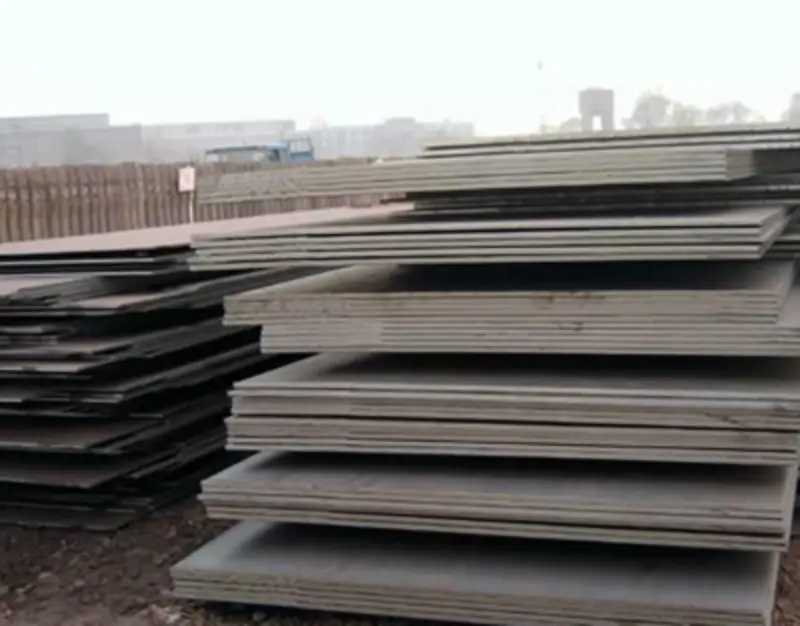
KR Grade E63 Shipbuilding Plate
KR Grade E63 (EH63) High-Strength Shipbuilding Steel – 620 MPa Yield for Low-Temperature Offshore Hulls
Comprehensive data sheet for KR Grade E63 (EH63) shipbuilding steel plate, including chemical composition, mechanical properties, thermal conductivity, and equivalent grades from ABS, DNV, LR, BV, and CCS.
Welding, cutting, cold/hot forming, bending, machining
- Phone : +8618037372205
- Email : [email protected]
- WhatsApp: Contact via Whtsapp
- WeChat: +8618037372205
KR Grade E63 Shipbuilding Plate Introduction
KR Grade E63 (designated as EH63 under Korean Register rules) is a high-strength, quenched and tempered or thermomechanically processed steel plate for welded ship structures. With a minimum yield strength of 620 MPa and tensile strength ranging from 720 to 890 MPa, this grade offers exceptional strength-to-weight performance for large container vessels, offshore platforms, and heavy marine structures operating down to -40 °C. The fine-grained microstructure ensures reliable notch toughness, enabling compliance with strict KR Part 3 requirements. Delivered primarily in TMCP or QT condition, EH63 exhibits good weldability when proper low-hydrogen procedures are followed, making it a preferred choice for critical hull members and dynamically loaded components in harsh environments.
KR Grade E63 Shipbuilding Plate Chemical Composition
Chemical requirements in accordance with KR Rules Part 3 for EH63 grade, ladle analysis. All additions of grain-refining elements must be reported. Fine-grain practice with sufficient aluminum, niobium, vanadium, or titanium is mandatory to guarantee the specified low-temperature toughness. Carbon equivalent (Ceq = C + Mn/6 + (Cr+Mo+V)/5 + (Ni+Cu)/15) is normally ≤0.45 for welding suitability.
| Element | Specified Value (max or range) | Remarks |
|---|---|---|
| Carbon (C) | ≤ 0.20 | Ladle analysis |
| Silicon (Si) | ≤ 0.55 | Ladle analysis |
| Manganese (Mn) | ≤ 1.70 | Ladle analysis |
| Phosphorus (P) | ≤ 0.025 | Ladle analysis |
| Sulfur (S) | ≤ 0.025 | Ladle analysis |
| Aluminum (Al, acid soluble) | ≥ 0.015 | Minimum for fine-grain practice |
| Niobium (Nb) | ≤ 0.05 | Typically 0.02-0.05 for grain refinement |
| Vanadium (V) | ≤ 0.10 | Optional microalloying |
| Titanium (Ti) | ≤ 0.02 | Optional microalloying |
| Copper (Cu) | ≤ 0.35 | May be specified for corrosion resistance |
| Chromium (Cr) | ≤ 0.30 | Residual plus intentional addition |
| Nickel (Ni) | ≤ 0.40 | May be increased for toughness |
| Molybdenum (Mo) | ≤ 0.08 | Residual plus intentional addition |
| Nitrogen (N) | ≤ 0.012 | Ladle analysis, if Ti added total N may be lower |
| Carbon Equivalent (Ceq) | ≤ 0.45 | For TMCP product, typical ≤ 0.43 |
KR Grade E63 Shipbuilding Plate Thermal and Electrical Physical Properties
These physical properties are typical for a high-strength QT/TMCP structural steel with a bainitic/martensitic structure and are not part of the KR specification. They are provided for design calculations. Thermal expansion coefficient and conductivity vary with temperature; values at different temperatures are given where available. Magnetic properties are ferromagnetic below the Curie point.
| Property | Typical Value | Unit | Test Condition / Remarks |
|---|---|---|---|
| Density (ρ) | 7.85 | g/cm³ | Ambient temperature |
| Young's Modulus (E) | 210 | GPa | Typical for steel, depends slightly on microstructure |
| Shear Modulus (G) | 80 | GPa | Calculated from E and ν |
| Poisson's Ratio (ν) | 0.3 | - | Elastic range, ambient |
| Thermal expansion coefficient (α) | 12.2 × 10⁻⁶ | 1/K | 20-100 °C |
| Thermal expansion coefficient (α) | 12.8 × 10⁻⁶ | 1/K | 20-200 °C |
| Thermal expansion coefficient (α) | 13.5 × 10⁻⁶ | 1/K | 20-400 °C |
| Thermal conductivity (λ) | 35 | W/(m·K) | At 20 °C, typical for low-alloy steel |
| Thermal conductivity (λ) | 33 | W/(m·K) | At 200 °C |
| Thermal conductivity (λ) | 30 | W/(m·K) | At 400 °C |
| Specific heat capacity (cp) | 460 | J/(kg·K) | Ambient to 100 °C, average |
| Electrical resistivity (ρₑ) | 0.25 | µΩ·m | At 20 °C |
KR Grade E63 Shipbuilding Plate Mechanical Properties
Tested at ambient temperature on transverse test specimens taken from product thickness ranges as noted. Yield strength (ReH), tensile strength (Rm), elongation (A%), and bend test must comply with KR Rules. Impact toughness is determined on Charpy V-notch specimens at -40 °C (E-grade requirement). Single values below the minimum specified may be accepted under certain averaging rules unless otherwise ruled.
| Property | Required Value | Unit | Test Condition / Thickness |
|---|---|---|---|
| Yield strength (ReH) | ≥ 620 | MPa | t ≤ 50 mm |
| Yield strength (ReH) | ≥ 580 | MPa | 50 < t ≤ 70 mm |
| Yield strength (ReH) | ≥ 550 | MPa | 70 < t ≤ 100 mm |
| Tensile strength (Rm) | 720 – 890 | MPa | t ≤ 100 mm |
| Elongation (A), Lo=5.65√So | ≥ 14 | % | t ≤ 50 mm |
| Elongation (A), Lo=5.65√So | ≥ 13 | % | 50 < t ≤ 70 mm |
| Elongation (A), Lo=5.65√So | ≥ 12 | % | 70 < t ≤ 100 mm |
| Bend test (180°) | d = 3a | - | t ≤ 20 mm, a = specimen thickness |
| Bend test (180°) | d = 4a | - | 20 < t ≤ 40 mm |
| Bend test (180°) | d = 5a | - | t > 40 mm |
| Charpy impact toughness, KV2, longitudinal | ≥ 41 | J | -40 °C, t ≤ 50 mm, single value ≥ 29 J may be accepted if average ≥ 41 J |
| Charpy impact toughness, KV2, transverse | ≥ 28 | J | -40 °C, t ≤ 50 mm, minimum single value 20 J |
KR Grade E63 Shipbuilding Plate Directly Equivalent Grades
| Country / Society | Standard / Rule | Grade Designation | Remarks |
|---|---|---|---|
| International Association of Classification Societies (IACS) | Common UR W11 | EH63 | General IACS model designation |
| American Bureau of Shipping (ABS) | ABS Rules Part 2 | EH63 | Identical yield (620 MPa) and E-temperature (-40 °C) |
| DNV GL (now DNV) | DNV Rules Pt.2 Ch.2 | E620 | Similar strength, may require separate approval |
| Bureau Veritas (BV) | BV Rules Pt. B Ch.1 | E620 | 620 MPa grade, low-temperature toughness |
| Lloyd's Register (LR) | LR Rules Pt.3 Ch.2 | EH63 | Direct equivalent in LR notation |
| China Classification Society (CCS) | CCS Rules Pt.3 Ch.3 | EH620 | Same mechanical and temperature requirements |
| ClassNK (NK) | NK Rules Pt. K | KE63 | Japanese class equivalent |
| RINA | RINA Rules Pt. C | E620 | Italian class equivalent |
KR Grade E63 Shipbuilding Plate Application Introduction
KR EH63 (E63) steel plate is engineered for critical structural members in large-scale marine and offshore construction where high strength, light weight, and dependable low-temperature toughness are essential. It is compatible with automated welding and forming processes typical in shipyard production.
Product Applications: Shell and deck plating of ultra-large container ships, Longitudinal strength members (bottom and side longitudinals), Ice-strengthened hull structures for arctic navigation, Offshore module main frames and nodes, Wind turbine tower flanges and door frame stiffeners, Heavy-duty subsea tooling frames and launch/recovery systems
Processed into products: Hull girder web and flange plates (thickness 10–100 mm), Bracket and sole piece forgings replacement by thick plate cutting, Stiffener through-deck penetrations and insert plates, Crane pedestal base rings and slewing ring adapters, Winch and mooring foundations on deck, Fatigue-critical welded connections (full penetration butt and fillet welds)
Application industries: Shipbuilding and ship repair (cargo ships, LNG carriers, naval vessels), Offshore oil & gas (jackets, topsides, flare booms, helideck supports), Renewable energy (monopile and transition piece connections for offshore wind), Heavy lifting and material handling (crane booms, A-frame legs), Port and harbor infrastructure (fender panels, pile driving components), Pressure vessel manufacturing (low-temperature process vessels requiring KR certification)
KR Grade E63 Shipbuilding Plate Similar Materials / Alternative Grades
| Country / Society | Standard / Rule | Grade | Remarks |
|---|---|---|---|
| KR / other IACS members | KR Rules / IACS | EH56 | Lower strength (min YS 550 MPa), same -40 °C toughness; may be suitable if 620 MPa not required |
| KR / other IACS members | KR Rules / IACS | FH63 | Same strength (620 MPa) but tougher – higher cost option for -60 °C applications |
| KR / other IACS members | KR Rules / IACS | EH69 | Higher strength (min YS 690 MPa), same -40 °C; can replace EH63 where weight savings justify higher price |
| European (EN) | EN 10025-6 | S690QL / S690QL1 | Quenched and tempered structural steel, YS ≥690 MPa, good low-temperature toughness, may need additional certification for marine use |
| ASTM (USA) | ASTM A514 / A517 | Grade F / other | High-strength QT plate up to 690 MPa, but not specifically a shipbuilding grade; can be used with supplementary marine approval |
| JIS (Japan) | JIS G 3128 | SHY 685 / SHY 685N | High yield strength steel for welded structures, similar level, but distinct from classed ship plate |
| GOST (Russia) | GOST 5521 | AБ2 (АБ2-ВК) | High-strength hull steel with yield around 620-690 MPa, often requiring additional low-temperature certification |
Notes:
Welding considerations: Use low-hydrogen processes (SMAW with H4 or H5 electrodes, SAW with basic flux, or GMAW/MAG with appropriate shielding gas). Preheating may be required for thicker sections (typically ≥75°C for t>30 mm), and interpass temperature must be controlled below 200°C. Post-weld heat treatment is generally not mandated but may be considered for stress relief, subject to approval by the classification society.
Forming: Cold forming with applicable radius constraints; hot forming should be within the temperature range 850–1050°C and followed by subsequent heat treatment (normalizing or QT) if mechanical properties are affected.
Ultrasonic testing: Usually performed to KR Part 3 Annex requirements when specified for critical applications.
- Share



