
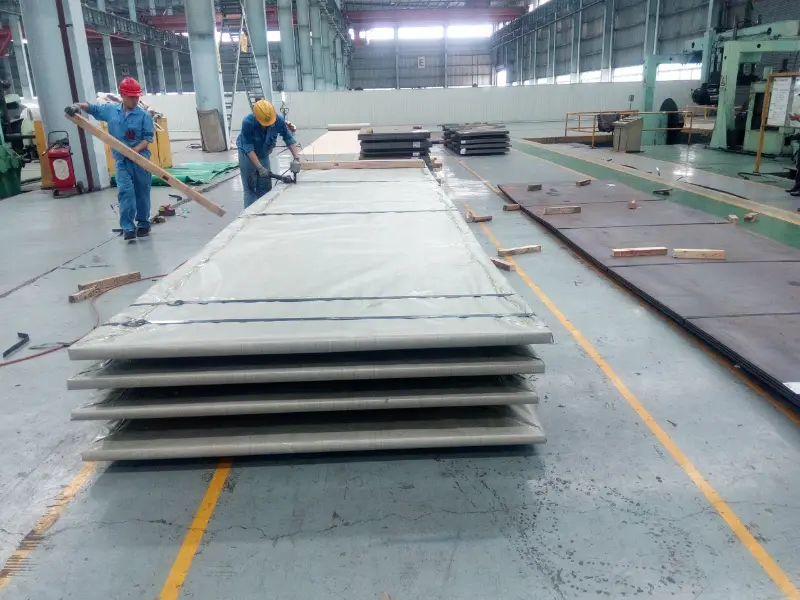
KR Grade F63 High-Strength Shipbuilding Steel Plate
KR Grade F63 High-Strength Shipbuilding Steel Plate: Technical Data, Properties & Equivalents
Complete material data sheet for KR Grade F63 shipbuilding steel plate. Covers chemical composition, mechanical properties, thermal properties, international equivalent grades, and application guide according to Korean Register (KR) rules.
Quenching and Tempering (Q&T), Cutting, Welding, Cold Bending, Hot Forming
- Phone : +8618037372205
- Email : [email protected]
- WhatsApp: Contact via Whtsapp
- WeChat: +8618037372205
KR Grade F63 High-Strength Shipbuilding Steel Plate Introduction
KR Grade F63 is a high-strength, quenched and tempered structural shipbuilding steel plate certified by the Korean Register of Shipping. It belongs to the F-series within the KR Rules, where the designation 'F' signifies that the steel has been refined with fine-grain practice and possesses specified minimum impact properties at -60°C. The number '63' indicates its minimum specified yield strength in kilograms-force per square millimeter (kgf/mm²), translating to a minimum yield strength of 620 MPa. This steel grade is engineered for critical structural applications in shipbuilding and offshore engineering where high strength, excellent low-temperature toughness, and superior weldability are paramount. It is typically used for key hull structures and components subjected to high stress in extremely cold environments, allowing for lighter structural designs without compromising safety.
KR Grade F63 High-Strength Shipbuilding Steel Plate Chemical Composition
The chemical composition of KR Grade F63 steel is designed for high strength and excellent low-temperature toughness. It is a low-carbon, micro-alloyed steel with additions of manganese, nickel, chromium, and molybdenum to promote hardenability during the quenching process. Vanadium and niobium provide grain refinement, and aluminum is used for deoxidation. The especially low phosphorus and sulfur contents ensure high purity and good impact properties at cryogenic temperatures. The final composition is subject to agreement between the manufacturer and the classification society, with the table below showing typical guideline ranges based on KR Rules and common industrial practice for F-grade high-strength steels.
| Element | Standard Value (Typical, %) | Remarks |
|---|---|---|
| Carbon (C) | 0.18 max | Maximum limit for weldability |
| Silicon (Si) | 0.10 - 0.55 | Deoxidizer and strength contributor |
| Manganese (Mn) | 1.00 - 1.70 | Primary strengthening element |
| Phosphorus (P) | 0.020 max | Strict low limit for toughness |
| Sulfur (S) | 0.010 max | Strict low limit for toughness and internal quality |
| Nickel (Ni) | 1.00 - 2.00 | For low-temperature toughness |
| Chromium (Cr) | 0.25 - 1.00 | Hardenability enhancement |
| Molybdenum (Mo) | 0.20 - 0.60 | Hardenability and tempering resistance |
| Copper (Cu) | 0.30 - 0.50 | Corrosion resistance, minor strengthening |
| Aluminum (Al) | 0.020 min (acid-soluble) | Grain refining element |
| Niobium (Nb) | 0.02 - 0.05 | Micro-alloying for grain refinement |
| Vanadium (V) | 0.05 - 0.10 | Micro-alloying for precipitation strengthening |
| Boron (B) | 0.0005 - 0.0015 | Strong hardenability agent, if required |
| Carbon Equivalent (CEV) | 0.50 - 0.55 typ. | Calculated value for weldability assessment |
KR Grade F63 High-Strength Shipbuilding Steel Plate Thermal and Electrical Physical Properties
Physical properties are essential for engineering calculations involving heat transfer, thermal stress, and electrical applications. The values provided here are typical reference values for quenched and tempered high-strength alloy steels similar in composition to KR Grade F63. These properties are temperature-dependent; values are given for room temperature unless otherwise specified.
| Property | Standard Value | Unit | Test Condition |
|---|---|---|---|
| Density (ρ) | 7.85 | g/cm³ | 20 °C |
| Elastic Modulus (E) | 210 | GPa | 20 °C |
| Shear Modulus (G) | 81 | GPa | 20 °C, estimated from E and ν |
| Poisson's Ratio (ν) | 0.3 | - | 20 °C |
| Thermal Expansion Coefficient (α) | 11.1 | 10<sup>-6</sup>/K | 20–100 °C |
| Thermal Expansion Coefficient (α) | 12.5 | 10<sup>-6</sup>/K | 20–200 °C |
| Thermal Expansion Coefficient (α) | 14.0 | 10<sup>-6</sup>/K | 20–400 °C |
| Thermal Conductivity (λ) | 25 | W/(m·K) | 20 °C |
| Thermal Conductivity (λ) | 30 | W/(m·K) | 200 °C |
| Specific Heat Capacity (Cp) | 460 | J/(kg·K) | 20 °C |
| Specific Heat Capacity (Cp) | 550 | J/(kg·K) | 200 °C |
| Electrical Resistivity (ρe) | 0.25 | Ω·mm²/m | 20 °C |
KR Grade F63 High-Strength Shipbuilding Steel Plate Mechanical Properties
These mechanical properties are typical for KR Grade F63 steel plates in the quenched and tempered condition. The specified yield strength is 620 MPa minimum. This grade retains excellent ductility and notch toughness down to -60°C, making it suitable for extreme environments. The values are based on standard test methods (e.g., ISO, EN, ASTM) and are subject to KR approval. Actual properties may vary based on plate thickness and specific manufacturing practices, but must meet the minimums defined by the KR Rules.
| Property | Standard Value | Unit | Test Condition |
|---|---|---|---|
| Minimum Yield Strength (ReH) | 620 | MPa | Ambient Temperature |
| Tensile Strength (Rm) | 720 - 890 | MPa | Ambient Temperature |
| Minimum Elongation (A) | 15 | % | Gauge length 5.65√So |
| Elongation (A) | 17 | % | Typical value for plates <50mm |
| Charpy V-Notch Impact Energy (KV) | 27 (Longitudinal) | J | -60 °C |
| Charpy V-Notch Impact Energy (KV) | 20 (Transverse) | J | -60 °C |
| Bend Test (Bending angle 180°) | No cracks | - | Mandrel diameter = 3t (t=plate thickness) |
KR Grade F63 High-Strength Shipbuilding Steel Plate Completely Equivalent Material Standards and Replaceable Grades
| Country/Region | Standard | Grade | Remarks |
|---|---|---|---|
| International | DNV GL Rules | F620 | Direct equivalent concept from another major IACS member society. |
| USA | ASTM A131 / A131M | EH62 | Similar strength and toughness class. Exact compositional and property matching must be verified. |
| Europe | EN 10025-6 | S620QL | European structural steel with comparable minimum yield strength. For offshore and structural use. |
| UK | Lloyd's Register Rules | FH63 | LR equivalent grade with same yield strength (63 kgf/mm²) and low-temperature impact requirements. |
| France | Bureau Veritas Rules | F620 | BV equivalent grade with 620 MPa minimum yield strength. |
| Norway | NORSOK M-120 | M-120 Y62 | Norwegian standard for offshore structural steel with similar strength level, requiring stringent toughness. Exact equivalence must be checked. |
| Japan | JIS G 3106 | SM570 | A comparable strength grade, but without the specific low-temperature (F-grade) guarantee. Requires modification or separate agreement for cryogenic toughness. |
KR Grade F63 High-Strength Shipbuilding Steel Plate Application Introduction
KR Grade F63 steel is specifically engineered for the most demanding structural applications where high strength and low-temperature toughness are non-negotiable. Its use allows naval architects and engineers to design lighter, more fuel-efficient vessels without sacrificing operational safety in harsh, cold climates. The steel's properties are optimized through a strict Q&T heat treatment process, ensuring uniformity and reliability. Key industries and applications include:
Product Applications: Large container ships and bulk carriers (high-stress deck and bottom areas), Liquefied Natural Gas (LNG) carriers (cryogenic containment system supports), Icebreakers and arctic-going vessels (ice belts and hull shells), Semi-submersible drilling rigs and jack-up platforms (columns, braces, and deck structures), Permanent offshore structures subject to extreme wind, wave, and ice loads
Processed into products: Main deck plates and stringer plates, Bottom shell and bilge strakes, Longitudinal and transverse bulkheads, Hatch coamings and top side rails for large vessels, Critical structural nodes and cantilever beams on offshore platforms, Wind turbine tower flanges and transition pieces, Rigid foundations for heavy machinery (e.g., cranes, thrusters)
Application industries: Shipbuilding (commercial and naval), Offshore Oil & Gas (platforms, FPSO topsides), Renewable Energy (offshore wind turbine foundations, substations), Arctic Engineering (icebreakers, ice-class vessels), Heavy Lifting and Transport
KR Grade F63 High-Strength Shipbuilding Steel Plate Similar/Comparable Substitute Material Recommendations
| Country/Region | Standard | Grade | Remarks |
|---|---|---|---|
| Europe | EN 10025-6 | S690QL / S690QL1 | Higher strength class (690 MPa) quenched and tempered steel. Requires careful welding and design review for substitution. |
| Sweden | SSAB | WELDOX 700 E / STRENX 700 | Premium high-strength structural steel with excellent toughness and weldability. Suitable for demanding offshore structures. |
| Germany | DIN EN 10028-6 | P690QH1 | Quenched and tempered steel for pressure vessels with similar high strength properties and good weldability. |
| China | GB/T 712 | F620 | Chinese standard shipbuilding steel with a specified minimum yield strength of 620 MPa, designed for arctic applications. |
| USA | MIL-S-16216 | HY-100 | Military specification high-yield steel with a yield strength of 100 ksi (690 MPa). Possesses excellent toughness but requires highly controlled welding procedures, similar to F63. |
Notes:
Welding Note: Welding KR F63 steel requires strict adherence to approved welding procedures (WPS/PQR) using low hydrogen consumables with matching strength and toughness. Controlled heat input and precise preheating/interpass temperatures are critical to avoid cold cracking and maintain Heat-Affected Zone (HAZ) toughness. Heat Treatment: This steel must be used in the Quenched and Tempered (Q&T) condition. Post-weld heat treatment (PWHT) is generally not recommended and can degrade the mechanical properties of the base metal unless specifically qualified. Certification: The material must be certified by the Korean Register of Shipping (KR), with stamps and 3.2 inspection certificates to EN 10204 typically required, detailing chemical analysis and full mechanical property test results for each plate.
- Share



