
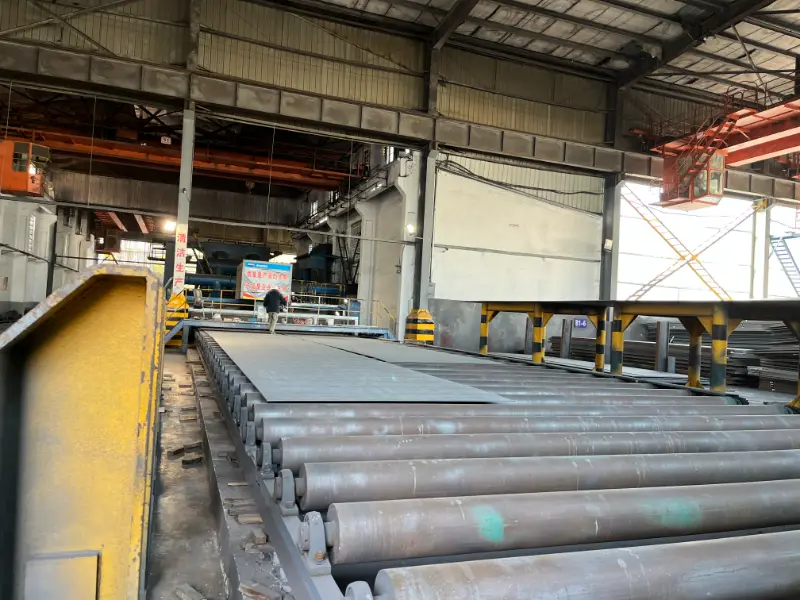
KR Grade A70 Shipbuilding Steel Plate
KR Grade A70 Shipbuilding Steel Plate – High Strength Hull Structural Steel
Detailed material data for KR Grade A70 shipbuilding steel plate according to KR Rules, including chemical composition, mechanical properties, physical properties, and international equivalents.
Hot rolling, controlled rolling, TMCP, normalizing (as required), cutting, welding, cold forming
- Phone : +8618037372205
- Email : [email protected]
- WhatsApp: Contact via Whtsapp
- WeChat: +8618037372205
KR Grade A70 Shipbuilding Steel Plate Introduction
KR Grade A70 (designated AH70) is a high-strength shipbuilding steel plate certified by the Korean Register of Shipping (KR). It offers a minimum yield strength of 490 MPa and excellent weldability, making it suitable for critical hull structures, decks, and bottom shells of large vessels. The steel is produced via controlled rolling or thermo-mechanical control process (TMCP) and can be supplied in normalized or as-rolled condition. Its low carbon equivalent ensures good toughness and cold forming properties, while meeting strict impact requirements at 0°C.
KR Grade A70 Shipbuilding Steel Plate Chemical Composition
Typical ladle analysis limits according to KR Rules for Grade A70. Elements like Nb, V, Ti may be added singly or in combination. Carbon Equivalent (CEV) typically max 0.38% for crack-free welding.
| Chemical Element | Standard Value | Remarks |
|---|---|---|
| Carbon (C) | ≤0.18 | Ladle analysis |
| Manganese (Mn) | 0.90–1.60 | Dependent on thickness |
| Silicon (Si) | 0.10–0.50 | |
| Phosphorus (P) | ≤0.035 | |
| Sulfur (S) | ≤0.035 | |
| Aluminum (Al, acid soluble) | ≥0.015 | Minimum for grain refinement |
| Niobium (Nb) | 0.02–0.05 | |
| Vanadium (V) | 0.05–0.10 | |
| Titanium (Ti) | ≤0.02 | |
| Copper (Cu) | ≤0.35 | |
| Chromium (Cr) | ≤0.25 | |
| Nickel (Ni) | ≤0.40 | |
| Molybdenum (Mo) | ≤0.08 |
KR Grade A70 Shipbuilding Steel Plate Thermal and Electrical Physical Properties
Properties listed are typical for low-alloy structural steel at ambient temperature unless stated otherwise. They are not mandatory but widely accepted for design calculations. Density used for weight estimation; thermal expansion and thermal conductivity are applicable for welded fabrications.
| Property | Reference Value | Unit | Test Conditions |
|---|---|---|---|
| Density (ρ) | 7.85 | g/cm³ | 20°C |
| Elastic Modulus (E) | 205 | GPa | 20°C |
| Shear Modulus (G) | 80 | GPa | 20°C (typical) |
| Poisson's Ratio (ν) | 0.3 | – | 20°C |
| Thermal Expansion Coefficient (α) | 12.5 | 10⁻⁶/K | 20–100°C |
| Thermal Expansion Coefficient (α) | 13.2 | 10⁻⁶/K | 20–200°C |
| Thermal Expansion Coefficient (α) | 13.9 | 10⁻⁶/K | 20–300°C |
| Thermal Conductivity (λ) | 46 | W/(m·K) | 100°C |
| Specific Heat Capacity | 475 | J/(kg·K) | 20–100°C |
| Electrical Resistivity (ρ_e) | 0.25 | 10⁻⁶ Ω·m | 20°C |
KR Grade A70 Shipbuilding Steel Plate Mechanical Properties
Tensile testing performed at ambient temperature on transverse specimens unless otherwise agreed. Impact test specimens are longitudinal Charpy V-notch; values are minimum average. C: cold forming ability confirmed by bend test.
| Property | Required Value | Unit | Test Conditions / Remarks |
|---|---|---|---|
| Yield Strength (ReH) | ≥490 | MPa | Transverse, thickness ≤100 mm |
| Tensile Strength (Rm) | 620–770 | MPa | Transverse, thickness ≤100 mm |
| Elongation (A) | ≥14 | % | Gauge length 200 mm (8 in.), thickness ≤20 mm |
| Elongation (A) | ≥14 | % | Gauge length 200 mm (8 in.), thickness >20 ≤40 mm |
| Elongation (A) | ≥14 | % | Gauge length 200 mm (8 in.), thickness >40 ≤50 mm |
| Bend Test (180°) | d=3a | – | Thickness ≤25 mm, a = specimen thickness |
| Bend Test (180°) | d=4a | – | Thickness >25 ≤50 mm |
| Impact Test (KV) at 0°C | ≥42 | J (avg) | Longitudinal, A-grade (0°C) |
| Impact Test (KV) at -20°C | ≥42 | J (avg) | When ordered as D-grade (DH70) |
| Impact Test (KV) at -40°C | ≥42 | J (avg) | When ordered as E-grade (EH70) |
| Impact Test (KV) at -60°C | ≥42 | J (avg) | When ordered as F-grade (FH70) |
KR Grade A70 Shipbuilding Steel Plate Fully Equivalent Material Standards and Substitutable Grades
| Country/Region | Standard | Grade | Remarks |
|---|---|---|---|
| Korea | KR Rules | KR Grade A70 | Original specification |
| USA / International | ASTM A131/A131M | ASTM AH70 | Equivalent chemical and mechanical requirements |
| USA / International | ABS Rules | ABS Grade AH70 | American Bureau of Shipping equivalent |
| Norway / International | DNV Rules | DNV Grade A70 | Det Norske Veritas equivalent |
| France / International | BV Rules | BV Grade A70 | Bureau Veritas equivalent |
| China | CCS Rules | CCS Grade A70 | China Classification Society equivalent |
| Japan | NK Rules | NK Grade A70 | Nippon Kaiji Kyokai equivalent |
KR Grade A70 Shipbuilding Steel Plate Application Introduction
KR Grade A70 is designed for welded structures requiring high strength and good low-temperature toughness. It is widely used in shipbuilding and marine engineering. Key advantages:
- Excellent weldability with low carbon equivalent
- High yield strength (490 MPa) enables weight reduction
- Good notch toughness at 0°C (A-grade) and optional sub-zero grades
- Can be supplied as TMCP or normalized for improved workability
Product Applications: Bulk carriers, Container ships, Oil tankers, Ice-going vessels, Jack-up rig legs, Offshore wind turbine foundations, Heavy-lift crane booms
Processed into products: Hull shell plates, Deck plates and deck girders, Bottom and side longitudinals, Transverse webs and frames, Watertight bulkheads, Anchor racks and hawse pipes, Structural columns and bracings
Application industries: Shipbuilding and ship repair, Offshore oil & gas platforms, Marine engineering, Port and harbor structures, Heavy machinery and construction equipment
KR Grade A70 Shipbuilding Steel Plate Similar / Alternative Materials
| Country/Region | Standard | Grade | Remarks |
|---|---|---|---|
| USA | ASTM A131 | DH70 / EH70 / FH70 | Higher toughness grades with lower test temperatures (-20/-40/-60°C); similar strength |
| Europe | EN 10025-6 | S690QL | Quenched and tempered steel with higher strength (≥690 MPa yield); not a direct substitute but used for heavy lifting structures |
| Japan | JIS G3106 | SM570 | Rolled steel for welded structures with min. 460 MPa yield; slightly lower strength but good weldability |
| USA | ASTM A572 | Grade 65 [450 MPa] | High-strength low-alloy structural steel; lower yield strength but widely available |
Notes:
Certification: Products must be certified by KR surveyors or approved third-party inspectors. Ultrasonic testing (UT) according to class requirements is often specified. Welding: Preheating may be required for thicker sections; low-hydrogen welding consumables are recommended. Forming: Cold flanging and bending can be performed; hot forming should be carefully controlled to avoid grain coarsening. For sub-zero service, DH70, EH70, or FH70 grades with enhanced impact properties at lower temperatures should be selected.
- Share



