
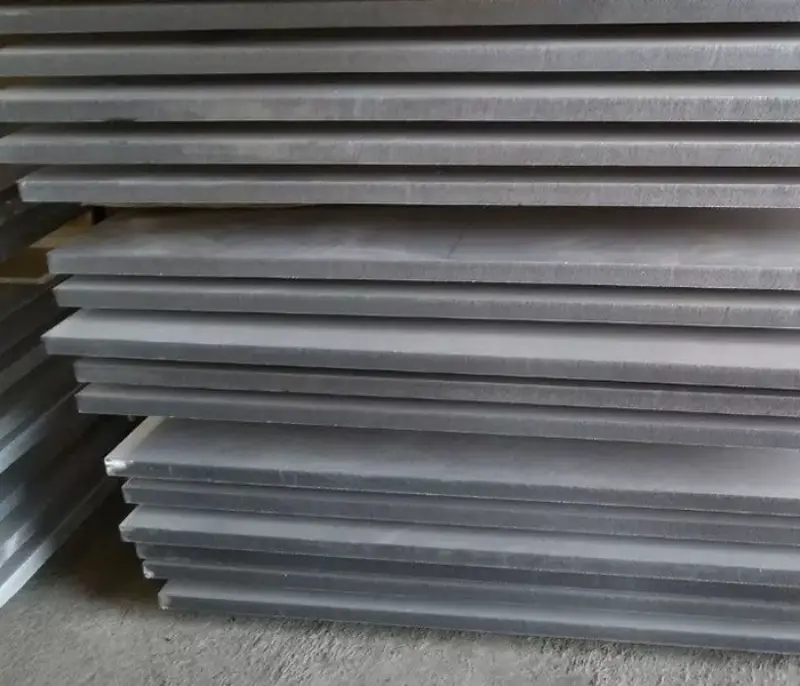
KR Grade D70 Shipbuilding Steel Plate
KR Grade D70 Shipbuilding Steel Plate: High Strength & Excellent Low-Temperature Toughness
Comprehensive datasheet for KR Grade D70 shipbuilding plate: chemical composition, mechanical properties, physical data, equivalent grades and key applications.
Suitable for thermal cutting, cold forming, hot bending, welding (all common arc techniques), and moderate machining.
- Phone : +8618037372205
- Email : [email protected]
- WhatsApp: Contact via Whtsapp
- WeChat: +8618037372205
KR Grade D70 Shipbuilding Steel Plate Introduction
KR Grade D70 is a high-strength, weldable structural steel plate primarily designed for ship and offshore constructions in accordance with the rules of Korean Register (KR). The designation "D70" indicates that the material is required to provide a minimum yield strength of 70 ksi (approximately 483 MPa) combined with guaranteed Charpy-V impact properties down to -20 °C (grade "D").
- Typical thickness range: 6 mm to 50 mm (thicker gauges may require adjusted properties).
- Supplied in thermo-mechanically controlled (TMCP), normalised, or quench-and-tempered condition, depending on thickness and customer specification.
- Features low carbon equivalent to ensure good weldability and resistance to cold cracking.
- Finds extensive use in hull structures, deck stiffeners, crane booms, jack-up rig legs, and other critical load-bearing components.
- Often selected where high strength-to-weight ratio and reliable low-temperature impact resistance are mandatory.
KR Grade D70 Shipbuilding Steel Plate Chemical Composition
The chemical composition of KR Grade D70 is tightly controlled to achieve a balance between strength and toughness. Maximum limits are set for detrimental elements such as phosphorus and sulfur. Grain-refining microalloying elements (Nb, V, Ti) are added to enhance mechanical properties. Carbon Equivalent Value (CEV) is typically kept below 0.40–0.43 % (depending on thickness) to ensure excellent weldability.
- Values provided are typical for plates ≤ 50 mm thickness and are in accordance with KR Rules for high-strength shipbuilding steels.
- Fine-grain practice with sufficient aluminium is mandatory.
- Additional elements such as Cu, Ni, Cr, and Mo may be present as residuals or deliberate additions for thicker products.
| Chemical Element | Standard Value (wt %) | Remarks |
|---|---|---|
| Carbon (C) | ≤ 0.18 | Maximum |
| Manganese (Mn) | 1.00 – 1.60 | Typical range |
| Silicon (Si) | 0.10 – 0.50 | Fully killed (Al-killed) |
| Phosphorus (P) | ≤ 0.025 | Maximum |
| Sulfur (S) | ≤ 0.015 | Maximum |
| Aluminium (Al, total) | ≥ 0.015 | Minimum, fine grain requirement |
| Niobium (Nb) | ≤ 0.05 | Typical maximum |
| Vanadium (V) | ≤ 0.10 | Typical maximum |
| Titanium (Ti) | ≤ 0.02 | Typical maximum |
| Copper (Cu) | ≤ 0.35 | Residual (unless specified) |
| Nickel (Ni) | ≤ 0.30 | Residual (unless specified) |
| Chromium (Cr) | ≤ 0.20 | Residual (unless specified) |
| Molybdenum (Mo) | ≤ 0.08 | Residual (unless specified) |
| Nitrogen (N) | ≤ 0.012 | Bound by Al, V, Ti |
| CEV (IIW) | ≤ 0.43 (t ≤ 50 mm) | Carbon equivalent for weldability |
KR Grade D70 Shipbuilding Steel Plate Physical & Thermal Properties
The data below represent typical physical properties for high-strength shipbuilding steel of the same composition class as KR D70. Actual values may vary slightly with heat treatment and exact chemical analysis.
- Density is used for weight calculations.
- Elastic constants are valid at room temperature and near-linear up to ~200 °C.
- Thermal conductivity and specific heat are essential for welding heat flow simulations and fire engineering.
| Property | Typical Value | Unit | Test Condition / Reference |
|---|---|---|---|
| Density (ρ) | 7.85 | g/cm³ | Room temperature |
| Elastic modulus (E) | 200 – 210 | GPa | Room temperature, tensile test |
| Shear modulus (G) | ≈ 80 | GPa | Room temperature, calculated |
| Poisson's ratio (ν) | 0.3 | – | Room temperature, typical |
| Thermal expansion coefficient (α) | 11.5 – 12.5 | ×10⁻⁶ K⁻¹ | 20 °C – 100 °C |
| Thermal expansion coefficient (α) | 12.5 – 13.5 | ×10⁻⁶ K⁻¹ | 20 °C – 200 °C |
| Thermal conductivity (λ) | 42 – 48 | W/(m·K) | Room temperature |
| Thermal conductivity (λ) | 38 – 44 | W/(m·K) | At 100 °C |
| Specific heat capacity (c_p) | 460 – 500 | J/(kg·K) | Room temperature |
| Electrical resistivity (ρ_e) | 0.22 – 0.28 | μΩ·m | Room temperature |
KR Grade D70 Shipbuilding Steel Plate Mechanical Properties
The mechanical properties listed below correspond to the longitudinal direction of plates with a maximum thickness of 50 mm, tested in accordance with KR Rule requirements. Yield strength (ReH) is specified in ksi (70 ksi minimum), but values are also given in MPa for convenience. Charpy-V impact tests are performed at -20 °C for the D-grade level.
- Requirements for thicker plates (e.g., 50–100 mm) may be slightly reduced – consult the material certificate.
- Bend test is performed with 180° bending over the specified mandrel diameter.
- Through-thickness properties (Z-quality) can be supplied if ordered with suffix Z25/Z35.
| Property | Standard Required Value | Unit | Test Condition |
|---|---|---|---|
| Yield strength (ReH) | ≥ 483 (min. 70 ksi) | MPa (ksi) | Ambient, t ≤ 50 mm, transverse |
| Tensile strength (Rm) | 570 – 720 (82.5 – 104 ksi) | MPa (ksi) | Ambient, t ≤ 50 mm |
| Elongation (A5) | ≥ 15 | % | Gauge length 50 mm (2″), longitudinal |
| Elongation (A200) | ≥ 18 | % | Gauge length 200 mm (8″), longitudinal |
| Bend test (180°) | No cracks | – | Mandrel diameter = 3 × thickness (t ≤ 25 mm) |
| Bend test (180°) | No cracks | – | Mandrel diameter = 4 × thickness (25 < t ≤ 50 mm) |
| Charpy impact (KV₂, -20 °C) | ≥ 27 (average, longitudinal) | J | V-notch, 10×10 mm specimen (if thickness permits) |
| Charpy impact (KV₂, -20 °C) | ≥ 20 (individual, longitudinal) | J | V-notch, 10×10 mm specimen |
| Charpy impact (KV₂, -20 °C) | ≥ 27 / 20 (transverse) | J | Available upon request (transverse specimens) |
KR Grade D70 Shipbuilding Steel Plate Fully Equivalent Standards & Replaceable Grades
| Country / Region | Standard | Grade | Remarks |
|---|---|---|---|
| South Korea / International | KR Rules | Grade D70 (KR D70) | Original grade – main specification |
| International (IACS member) | American Bureau of Shipping (ABS) | Grade D70 / DH70 | Equivalent when approved by ABS (check specific thickness) |
| International (IACS member) | DNV Rules for Ships | Grade D70 / DH70 (NV D70) | DNV optional notation: NV D70 |
| International (IACS member) | Lloyd's Register (LR) | Grade D70 / DH70 | Subject to LR approval of material and welder qualification |
| International (IACS member) | Bureau Veritas (BV) | Grade D70 / DH70 | May require additional tests for fatigue or CTOD |
| China | CCS Rules | Grade D70 / DH70 | Same chemistry and tensile requirements; impact at -20 °C |
KR Grade D70 Shipbuilding Steel Plate Application Introduction
KR Grade D70 combines high strength with dependable toughness at sub-zero service temperatures, making it an ideal choice for weight-critical marine and offshore structures.
- Excellent weldability when correct preheat and heat input ranges are observed.
- Good cold formability – inner bending radius ≥ 3 t recommended.
- Can be supplied with additional through-thickness tensile properties (Z15, Z25, Z35) to resist lamellar tearing.
- Often used in harsh environments where corrosion fatigue and low-cycle fatigue performance are design drivers.
Product Applications: Hull plates and shell plates of very large crude carriers (VLCC) and bulk carriers, Deck plating and longitudinal stiffeners in offshore modules, Legs, spud cans, and rack plates of jack-up rigs, Transition pieces and platform connections for offshore wind turbines, Crane booms, slewing rings, and chassis of heavy mobile cranes, Structural frames in polar-class icebreakers and LNG carriers
Processed into products: Bottom and side shell strakes in ice-strengthened vessels, Heavy doubler plates at load concentration points, Stiffeners, brackets, and web frames, Flange plates and web plates in built-up girders, Box structures for barge connection systems, Mooring system foundations and fairlead supports
Application industries: Shipbuilding (commercial, naval, and Arctic-class vessels), Offshore oil & gas platforms (jack-ups, semi-submersibles, TLPs), Renewable energy offshore wind turbine foundations (transition pieces, monopile connection details), Heavy lifting and port machinery (crane pedestals, boom luffing frames), Bridge construction (structural steel in cold climates), Pressure vessels and large storage tanks (subject to approval)
KR Grade D70 Shipbuilding Steel Plate Similar / Alternative Materials
| Country / Region | Standard | Grade | Remarks |
|---|---|---|---|
| International | ASTM A131 / A131M | Grade EH70 (if available) or Grade FH70 | Higher toughness temperature (EH = -40 °C); FH = -60 °C. Slightly different chemistry may apply. |
| Europe | EN 10025-6 | S460QL / S460QL1 | Quenched and tempered high-strength steel; yield ≥ 460 MPa, similar strength class but not specific to shipbuilding. Impact temperature as low as -40 °C. |
| International | API 2W / 2Y | Grade 70 (API 2W Gr.70) | Steel for offshore structures; minimum yield 70 ksi. Not exactly same shipbuilding chemistry but often interchangeable. |
| Japan / Korea | JIS G 3106 | SM570 / SM570-TMC | Rolled steel for welded structures; yield ≥ 460 MPa, tensile 570–720 MPa. No mandatory low-temperature impact but can be supplied with designated class. |
Notes:
- This datasheet is based on the general requirements of Korean Register Rules for high-strength shipbuilding steels and typical published data. For exact limits applicable to a specific project, always refer to the original material certificate and the latest revision of the KR Rules.
- Welding consumables should be matched to provide undermatched or overmatched weld metal strength as per design; preheating (100–150 °C) is recommended for thicknesses above 30 mm to avoid hydrogen cracking.
- Post-weld heat treatment (if required) must be agreed with the classification society, as it may affect mechanical properties.
- When the steel is specified for critical applications (e.g., primary structural members in offshore units), additional CTOD or wide-plate tests may be requested.
- Share



