
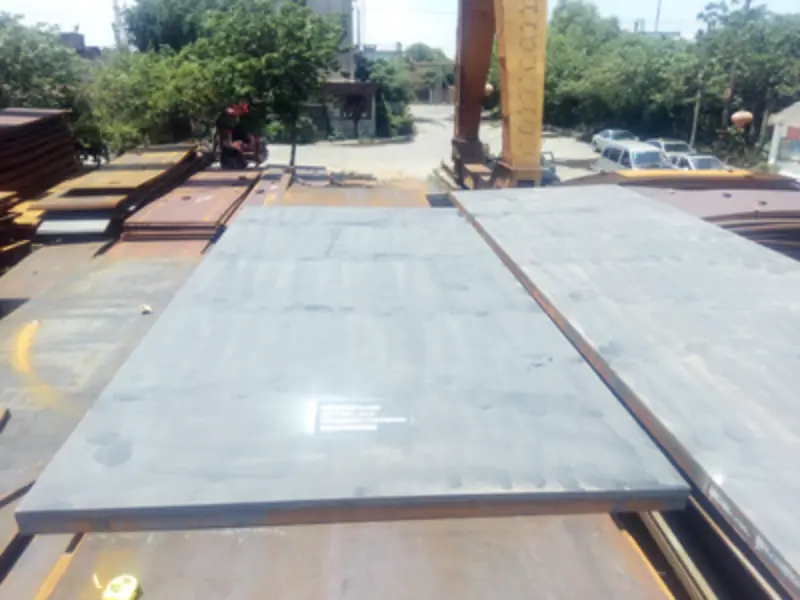
KR Grade E70 Shipbuilding Steel Plate
KR Grade E70 Shipbuilding Steel Plate - High Strength Quenched & Tempered Steel
Comprehensive technical data for KR Grade E70 shipbuilding steel including chemical composition, tensile strength, impact energy at -40°C, and physical properties in compliance with Korean Register rules.
Thermal cutting, cold forming, welding (with preheat and controlled heat input), machining
- Phone : +8618037372205
- Email : [email protected]
- WhatsApp: Contact via Whtsapp
- WeChat: +8618037372205
KR Grade E70 Shipbuilding Steel Plate Introduction
KR Grade E70 is a high-strength quenched and tempered steel plate certified by the Korean Register (KR) for ship and offshore structures. Designed for heavy-load applications, it offers a minimum yield strength of 690 MPa and excellent low-temperature toughness (E-grade, impact tested at -40°C). The steel exhibits good weldability when proper procedures are followed and is typically supplied in the quenched and tempered (Q&T) condition.
- Yield strength ≥690 MPa
- Tensile strength 770–940 MPa
- Charpy V-notch impact ≥50 J at -40°C
- Typical thickness range up to 150 mm (subject to KR approval)
KR Grade E70 Shipbuilding Steel Plate Chemical Composition
Ladle analysis as specified in KR rules for E70 grade. Typical values reflect narrow melting practice to achieve required strength and toughness. Residual elements are controlled; CEV typically ≤0.65% for good weldability.
| Element | Standard Value (%) | Remarks |
|---|---|---|
| Carbon (C) | ≤0.20 | Max. 0.20 % to ensure weldability and toughness |
| Silicon (Si) | ≤0.55 | Killed steel practice; may be lower depending on thickness |
| Manganese (Mn) | 0.70–1.70 | Provides strength and hardenability |
| Phosphorus (P) | ≤0.025 | Max. 0.025 % for low-temperature toughness |
| Sulfur (S) | ≤0.025 | Max. 0.025 %; low S for ductility and lamellar tearing resistance |
| Chromium (Cr) | ≤0.25 | Optional; total combined with Ni+Mo+Cu limited to ≤1.00 % |
| Nickel (Ni) | ≤0.80 | Optional; improves toughness at low temperatures |
| Molybdenum (Mo) | ≤0.30 | Optional; enhances hardenability |
| Copper (Cu) | ≤0.35 | Optional; may be present from scrap |
| Niobium (Nb) | ≤0.06 | Grain-refining element |
| Vanadium (V) | ≤0.10 | Precipitation strengthening; limited to avoid toughness loss |
| Titanium (Ti) | ≤0.05 | Grain refinement; typical 0.01–0.02 % |
| Aluminium (Al, total) | ≥0.015 | Minimum for grain refinement / killed steel |
| Nitrogen (N) | ≤0.015 | Keep low to avoid strain ageing and impact on toughness |
| Boron (B) | ≤0.0008 | If added, it must be strictly controlled to avoid hot shortness |
KR Grade E70 Shipbuilding Steel Plate Thermal and Electrical Physical Properties
Physical properties apply to the ambient temperature range unless otherwise noted. These values are typical for quenched and tempered steels with a similar composition and are not mandatory in the shipbuilding standard. Thermal properties can vary with heat treatment and orientation.
| Property | Typical Value | Unit | Test Condition / Remarks |
|---|---|---|---|
| Density (ρ) | 7850 | kg/m³ | Room temperature (20°C) |
| Modulus of Elasticity (E) | 205-210 | GPa | Tension, 20°C |
| Shear Modulus (G) | 80 | GPa | Calculated from E and Poisson's ratio |
| Poisson's Ratio (ν) | 0.30 | – | Elastic range |
| Thermal Expansion Coefficient (α) | 11.5–12.5 ×10⁻⁶ | /K | 20°C to 100°C |
| Thermal Expansion Coefficient (α) | 12.5–13.5 ×10⁻⁶ | /K | 20°C to 300°C |
| Thermal Conductivity (λ) | 40–45 | W/(m·K) | At 20°C |
| Specific Heat Capacity (cₚ) | 460–500 | J/(kg·K) | 20°C to 100°C |
| Electrical Resistivity (ρₑ) | 0.25–0.30 | µΩ·m | At 20°C |
KR Grade E70 Shipbuilding Steel Plate Mechanical Properties
Tensile and impact properties according to KR rules for E70 grade. All tests are performed on transverse specimens unless otherwise agreed. Charpy V-notch impact energy is measured on longitudinal samples at -40°C. Values are valid for plates up to 50 mm thickness; thicker plates may have slightly reduced impact requirements subject to special agreement.
| Property | Requirement (Min.) | Unit | Test Condition |
|---|---|---|---|
| Yield Strength (ReH) | ≥690 | MPa | Ambient temperature, tensile test |
| Tensile Strength (Rm) | 770–940 | MPa | Ambient temperature |
| Elongation (A) | ≥14 | % | Gauge length 5.65√So (proportional) |
| Elongation (A50) | ≥15 | % | Gauge length 50 mm (optional standard) |
| Reduction of Area (Z) | ≥40 | % | For information only, typical value |
| Bend Test (180°) | No cracks | – | Diameter = 3t (t = specimen thickness) |
| Charpy V-Notch Impact Energy (KV) | ≥50 | J | Longitudinal, -40°C (E-grade) |
| Charpy V-Notch Impact Energy (KV) | ≥35 | J | Transverse, -40°C (if agreed) |
KR Grade E70 Shipbuilding Steel Plate Full Equivalent Material Standards and Substitutable Grades
| Country/Region | Standard/ Society | Grade | Remarks |
|---|---|---|---|
| International | IACS UR W11 | E690 | Equivalent high-strength Q&T hull structural steel |
| USA | ABS | E70 | Same designation in ABS Rules |
| Norway/ DNV | DNV (VL) | E700 (VL E690) | Now designated as VL E690 in latest DNV rules |
| United Kingdom | LR | E70 | Lloyd's Register equivalent |
| France | BV | E70 | Bureau Veritas equivalent |
| China | CCS | E690 | China Classification Society; same strength and toughness |
| Japan | NK (ClassNK) | E70 | Nippon Kaiji Kyokai equivalent |
KR Grade E70 Shipbuilding Steel Plate Application Introduction
KR E70 steel is employed in critical strength-driven components where weight saving is essential and low-temperature toughness must be guaranteed.
- Typical delivery condition: quenched and tempered, giving a fine tempered martensite/bainite structure.
- Welding requires close control of heat input (1.5–3.0 kJ/mm), preheat (>100°C), and interpass temperature; post-weld heat treatment may be required for thick sections.
- Cold forming should be followed by stress-relief annealing when deformation exceeds 5%.
- The steel should not be used in as-welded condition without qualification of the welding procedure according to KR standards.
Product Applications: Ship hulls – high-stress areas like sheer strakes, bilge keels, Jack-up rig legs and spud cans, Heavy-lift crane booms and frames, Deck equipment foundations (windlasses, towing bitts), Pressure hulls for deep-submergence vehicles
Processed into products: Rack and chock systems for jack-up rigs, Crane pedestals and slew rings, Transverse and longitudinal stiffeners in heavy-load zones, Main engine bedplates and thrust bearing supports, Mating flanges for high-pressure piping systems
Application industries: Shipbuilding, Offshore Oil & Gas, Heavy Lifting Equipment, Salvage & Heavy Transport, Naval and Defence
KR Grade E70 Shipbuilding Steel Plate Similar / Alternative Materials for Reference
| Country/Region | Standard/ Society | Grade | Remarks |
|---|---|---|---|
| EU | EN 10025-6 | S690QL / S690QL1 | Structural steel, not ship-classed; similar mechanical properties, may need additional certification |
| EU | EN 10225 | S690G1+M / S690G2+M | Steels for offshore structures; may be accepted with separate KR approval |
| USA | ASTM A514 | Grade B / H / F | High-strength Q&T plate; similar strength but lacks automatic ship approval |
| Japan | JIS G 3128 | SNCM 690 / SHT 690 | High-strength steel for bridges; comparable properties |
| Korea | KS | SMA690 / SH690Q | Korean industrial standard; may be accepted as alternate |
Notes:
Note: The above data are based on the Korean Register Rules for Steel Ships and should be verified against the latest edition of the rules and any specific project requirements. Chemical composition and mechanical properties can be further restricted by supplementary specifications (e.g., through-thickness properties, extra low sulfur, or specific heat treatment). Always confirm with the mill certificate and design authority.
Typical CEV (IIW) is ≤0.65% for E70; plates may be ordered with Z35 through-thickness characteristics complying to KR or IACS requirements to resist lamellar tearing.
For severe cyclic loading (e.g., in jack-up legs), consider using premium grade with tighter chemical control to improve fatigue life.
- Share



