
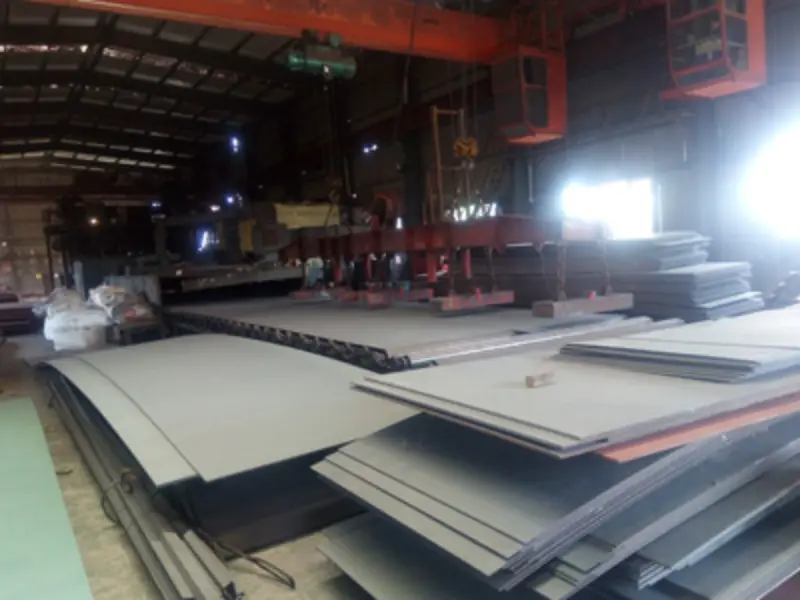
KR Grade F70 Shipbuilding Steel Plate
KR Grade F70 Shipbuilding Steel Plate: High Strength, Low-Temperature Toughness for Offshore Structures
In-depth material data for KR Grade F70 shipbuilding steel plate, including chemical composition, mechanical properties, thermal and electrical physical properties, equivalent grades, and application guidance for marine and offshore engineering.
Hot rolling, normalizing, quenching and tempering (Q&T), thermo-mechanical controlled processing (TMCP), welding (SMAW, SAW, GMAW, FCAW)
- Phone : +8618037372205
- Email : [email protected]
- WhatsApp: Contact via Whtsapp
- WeChat: +8618037372205
KR Grade F70 Shipbuilding Steel Plate Introduction
KR Grade F70 is an extra-high-strength shipbuilding steel plate designated by the Korean Register (KR), corresponding to the FH69 grade in the KR standard system. It offers a minimum yield strength of approximately 690 MPa (70 kgf/mm²) and is supplied in the F-class with guaranteed impact toughness at −60°C, ensuring excellent brittle-fracture resistance under the most severe service conditions. The steel is produced via advanced thermo-mechanical controlled rolling or quenched and tempered (QT) processing, delivering a fine-grained bainitic/martensitic microstructure.
- Typical applications include the construction of high-strength hulls, offshore platforms, icebreakers, and critical structural members subjected to extreme loads and low temperatures.
- Good weldability is maintained through low carbon equivalent (CE) and controlled microalloying with Nb, V, and Ti.
- Thickness range typically available from 6 mm up to 100 mm, depending on mill capabilities.
KR Grade F70 Shipbuilding Steel Plate Chemical Composition
Chemical composition according to KR Rules for FH69 (F70) grade. Maximum limits unless a range is specified. All values are ladle analysis unless otherwise noted. The steel is microalloyed for grain refinement and precipitation strengthening. CE is controlled to ≤0.52% (typical) to ensure weldability.
- Nb, V, Ti may be added singly or in combination.
- If Cu is added, Cu mainly contributes to precipitation strengthening; Cu+Ni+Cr+Mo are kept low for weldability.
| Element | Standard Value (max, %) | Remarks |
|---|---|---|
| Carbon (C) | 0.18 | Ladle analysis |
| Silicon (Si) | 0.10 – 0.55 | Typical range |
| Manganese (Mn) | 0.90 – 1.60 | Ladle analysis |
| Phosphorus (P) | 0.020 | Maximum |
| Sulfur (S) | 0.010 | Maximum |
| Chromium (Cr) | 0.20 | Maximum |
| Nickel (Ni) | 0.80 | Maximum |
| Molybdenum (Mo) | 0.50 | Maximum |
| Copper (Cu) | 0.50 | Maximum |
| Aluminium (Al, total) | 0.020 – 0.050 | Minimum fine grain practice |
| Niobium (Nb) | 0.02 – 0.05 | Typical range, max may be higher |
| Vanadium (V) | 0.05 – 0.10 | Typical range |
| Titanium (Ti) | 0.007 – 0.025 | Combined with Nb/V |
| Carbon Equivalent (CE) | ≤ 0.54 | CE = C+Mn/6+(Cr+Mo+V)/5+(Ni+Cu)/15 |
KR Grade F70 Shipbuilding Steel Plate Thermal & Electrical Physical Properties
Typical physical properties at room temperature (20°C) for high‑strength quenched and tempered steel similar to KR F70. Values are approximate and can vary depending on exact heat treatment and composition.
- Thermal conductivity decreases with increasing alloy content; electrical resistivity increases.
- For design purposes, data conform to International Standards (BS EN 1993‑1‑10 etc.).
| Property | Typical Value | Unit | Test Condition |
|---|---|---|---|
| Density (ρ) | 7.85 | g/cm³ | At 20°C |
| Modulus of Elasticity (E) | 205 | GPa | At 20°C |
| Shear Modulus (G) | 80 | GPa | Calculated from E and ν |
| Poisson's Ratio (ν) | 0.28 – 0.30 | – | Elastic range |
| Thermal Expansion Coefficient (α) | 11.5 × 10⁻⁶ | /K | 20°C – 100°C |
| Thermal Expansion Coefficient (α) | 12.5 × 10⁻⁶ | /K | 20°C – 200°C |
| Thermal Conductivity (λ) | 38 – 42 | W/(m·K) | At 20°C |
| Specific Heat Capacity (cp) | 460 – 480 | J/(kg·K) | At 20°C |
| Electrical Resistivity (ρe) | 0.24 × 10⁻⁶ | Ω·m | At 20°C |
KR Grade F70 Shipbuilding Steel Plate Mechanical Properties
Mechanical properties as required by KR Rules for FH69 (F70) steel plates. Data are for test pieces taken in the transverse direction. Yield strength and tensile strength values are for thickness ≤ 100 mm. Impact test temperature −60°C, longitudinal Charpy V-notch. For thicker sections properties may be agreed at the time of enquiry and order.
- Elongation measured on a gauge length of 5.65√So (A5).
- Bend test with former diameter = 2 × thickness for samples taken transverse for thickness ≤ 25 mm; larger D for higher thickness.
| Property | Required Value | Unit | Test Condition |
|---|---|---|---|
| Yield Strength (ReH) | ≥ 690 | MPa | Room temperature, t ≤ 100 mm |
| Tensile Strength (Rm) | 770 – 940 | MPa | Room temperature, t ≤ 100 mm |
| Elongation (A5) | ≥ 14 | % | Longitudinal / Transverse, gauge 50 mm |
| Bend Test (180°) | D = 2t (t ≤ 25 mm) | Bend diameter, no cracks, flatwise transverse | |
| Charpy Impact (KV, longitudinal) | ≥ 46 | J | −60°C, average of 3 tests (min. single 31 J) |
| Charpy Impact (KV, transverse) | ≥ 31 | J | −60°C, average of 3 tests (min. single 21 J) |
KR Grade F70 Shipbuilding Steel Plate Exact Equivalent Standards & Replaceable Grades
| Country/Region | Standard | Grade | Note |
|---|---|---|---|
| International | IACS UR W31 | FH690 | Common IACS class |
| USA | ABS Rules | FH70 (FH485 or FH690) | FH70 ksi grades; strength level must match 690 MPa |
| Norway/Germany | DNV GL Rules | F690 (FH690) | FH690: F-class, 690 MPa |
| UK | Lloyd's Register Rules | FH69 | Equivalent to KR FH69 |
| France | Bureau Veritas Rules | E690 | May be F class at −60°C |
| China | CCS Rules | EH690 or FH690 | FH690: −60°C class |
| Japan | ClassNK Rules | KE690 or KF690 | KF690 |
| Italy | RINA Rules | 690F | F-class 690 MPa |
KR Grade F70 Shipbuilding Steel Plate Application Introduction
KR F70 is specifically developed for the most demanding marine and offshore applications where high strength-to-weight ratio and low‑temperature toughness are essential. It enables lighter designs while maintaining structural integrity in ice‑covered waters and deep‑sea environments.
- Welding: Requires low hydrogen welding processes and pre‑/post‑heat treatment per KR procedures; consumables must match the strength level (e.g., AWS A5.28 ER110S-1).
- Corrosion: Standard marine corrosion protection applies; alloying does not deliver significant inherent corrosion resistance.
- Forming: Can be cold formed within permitted strain limits; hot forming above Ac3 with subsequent re‑heat treatment is encouraged.
Product Applications: Hull shell and deck plates of ice‑breaking ships, Riser tensioner frames and mooring brackets, Jack‑up rig leg chords and rack plates, Transition pieces between monopile and wind tower, Heavy‑lift crane box girders and booms
Processed into products: Bottom longitudinal stiffeners and girders of ultra‑large container ships, Bulb‑flat and angle stiffeners with high fatigue resistance, Offshore crane pedestals and slewing rings, Pin‑jointed braces for semisubmersible platforms, Connectors and node blocks in tubular jacket structures
Application industries: Shipbuilding – large container ships, LNG carriers, ice‑class vessels, Offshore oil & gas – fixed platforms, FPSO hulls, jack‑up rigs, Naval defence – aircraft carriers, submarines (non‑magnetic variants possible), Heavy engineering – cranes, excavator booms, heavy transport, Renewable energy – offshore wind turbine foundations and transition pieces
KR Grade F70 Shipbuilding Steel Plate Similar / Nearby Substitute Materials
| Country/Region | Standard | Grade | Note |
|---|---|---|---|
| European | EN 10025‑6 | S690QL, S690QL1 | 690 MPa QT steel; not classified for ship; requires additional testing for marine |
| European | EN 10225 | S690G1+M | Offshore structural steel with enhanced toughness |
| USA | ASTM A514/A514M | Grade Q (690 MPa) | Quenched & tempered (limited marine approval) |
| USA | ASTM A517/A517M | Grade Q | Pressure vessel plate, similar strength |
| Japan | JIS G 3128 | SHY685 | High yield strength ship plate (685 MPa) |
| China | GB/T 712 | FH690 | National shipbuilding steel standard, close properties |
Notes:
Testing: Each plate is subjected to tensile, Charpy V‑notch, and bend tests as per KR Rules. Ultrasonic examination (UT) is frequently required with acceptance Class C (EN 10160). Dimension tolerances: Plates are supplied with Mill tolerance according to EN 10029, or as agreed. Low‑temperature service: For design temperatures below −60°C, extra‑low‑temperature toughness may be agreed (e.g., −80°C Charpy). Ordering note: When specifying KR Grade F70, it is advisable to reference KR FH69 in the purchase order to avoid ambiguity because 'F70' may be interpreted as FH485 (70 ksi) by some suppliers. The required minimal yield strength shall be clearly stated (690 MPa).
- Share



