
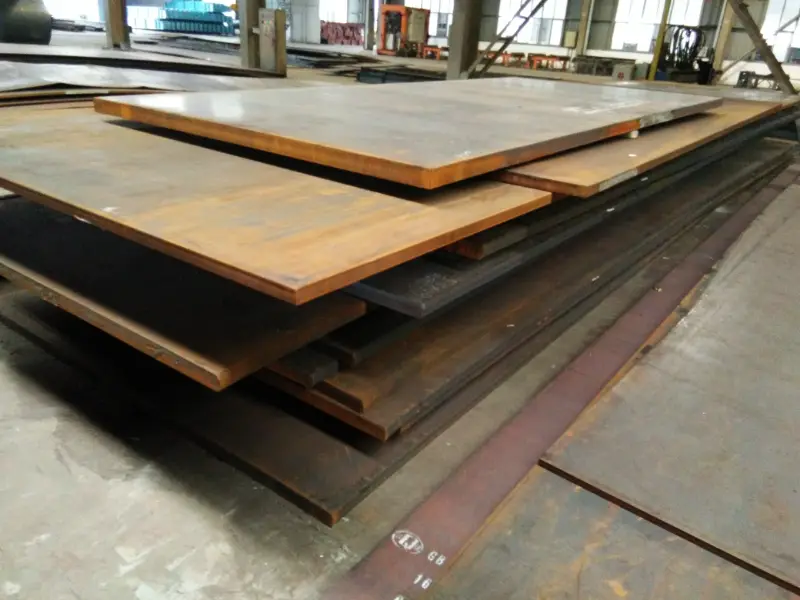
NK Grade A Shipbuilding Steel Plate
NK Grade A Shipbuilding Steel Plate: Composition, Properties & Global Equivalents
Comprehensive material data for NK Grade A ordinary-strength shipbuilding steel, including chemical composition, mechanical & thermal properties, equivalent grades and applications.
Hot rolling, normalizing, thermomechanical controlled processing (TMCP) for heavier sections
- Phone : +8618037372205
- Email : [email protected]
- WhatsApp: Contact via Whtsapp
- WeChat: +8618037372205
NK Grade A Shipbuilding Steel Plate Introduction
NK Grade A is an ordinary-strength hull structural steel certified by ClassNK (Nippon Kaiji Kyokai). It is the most widely used grade in shipbuilding for moderate service conditions, offering good weldability and formability. Key features:
- Minimum yield strength of 235 MPa at ambient temperature
- Excellent weldability with standard shipyard practices
- Good notch toughness at +20°C (impact energy ≥27 J)
- Available in hot-rolled or normalized condition up to 200 mm thickness
- Cost-effective for general ship structure, deckhouses, and non-critical members
NK Grade A Shipbuilding Steel Plate Chemical Composition
The composition of NK Grade A is controlled to ensure good weldability and strength. The carbon equivalent (CEV) is typically kept ≤0.40% to avoid cold cracking. General limits are based on ladle analysis per ClassNK rules.
- Carbon content is limited to 0.21% max.
- Manganese provides solid solution strengthening and compensates for sulfur.
- Phosphorus and sulfur are restricted to enhance toughness and avoid hot shortness.
- Residual elements (Cr, Ni, Cu, Mo) may be present but must be reported.
| Element | Specified Value (max unless range) | Remarks |
|---|---|---|
| C | ≤0.21% | Ladle analysis |
| Mn | ≥2.5×C | Typically 0.80–1.40% |
| Si | ≤0.50% | |
| P | ≤0.035% | |
| S | ≤0.035% | |
| Als (acid-soluble Al) | ≥0.015% | If grain refinement is required |
| Cr | ≤0.25% | Residual; sum Cu+Cr+Ni ≤0.70% |
| Ni | ≤0.30% | Residual |
| Cu | ≤0.30% | Residual |
| Mo | ≤0.08% | Residual |
| Nb | 0.02–0.05% | Optional for grain refinement |
| V | 0.05–0.10% | Optional for grain refinement |
| Ti | 0.005–0.02% | Optional for grain refinement |
| N | ≤0.012% | If not protected by Ti/Al |
NK Grade A Shipbuilding Steel Plate Thermal and Electrical Physical Properties
Physical properties are typical for carbon-manganese steel. Values are provided for general engineering calculations. Variations may occur depending on exact composition and final processing.
- Density is virtually constant at 7.85 g/cm³.
- Modulus of elasticity decreases slightly with temperature (approximately 205 GPa at 200°C).
- Thermal expansion is linear up to 600°C, with an average coefficient of about 12×10⁻⁶ K⁻¹.
- Thermal conductivity is moderate, typical of ferritic steels.
| Property | Typical Value | Unit | Test Condition |
|---|---|---|---|
| Density (ρ) | 7.85 | g/cm³ | 20°C |
| Elastic Modulus (E) | 210 | GPa | 20°C |
| Shear Modulus (G) | 81 | GPa | 20°C (calculated) |
| Poisson's Ratio (ν) | 0.29 | - | 20°C |
| Thermal Expansion Coefficient (α) | 11.7 | 10⁻⁶/K | 20–100°C |
| Thermal Expansion Coefficient (α) | 12.2 | 10⁻⁶/K | 20–200°C |
| Thermal Expansion Coefficient (α) | 12.8 | 10⁻⁶/K | 20–300°C |
| Thermal Conductivity (λ) | 52 | W/(m·K) | 20°C |
| Thermal Conductivity (λ) | 48 | W/(m·K) | 200°C |
| Specific Heat Capacity (cₚ) | 486 | J/(kg·K) | 20°C |
| Specific Heat Capacity (cₚ) | 519 | J/(kg·K) | 200°C |
| Electrical Resistivity (ρₑ) | 0.18 | Ω·mm²/m | 20°C |
NK Grade A Shipbuilding Steel Plate Mechanical Properties
Mechanical properties are determined on tensile and impact test specimens taken in accordance with ClassNK requirements. Tests are carried out at ambient temperature (though impact test temperature is +20°C).
- Yield strength is defined as ReH (upper yield) or Rp0.2 for thicknesses where yield point is not pronounced.
- Elongation is measured on a gauge length of 5.65√S₀ (L₀=50 mm for standard specimens).
- Impact energy applies to longitudinal specimens for thicknesses >12 mm; transverse values are typically 3/4 of longitudinal.
- Bend test: 180° bending over a mandrel of 2×thickness (2t) for t≤25 mm.
| Property | Required Value | Unit | Test Condition |
|---|---|---|---|
| Yield Strength (ReH) | ≥235 | MPa | t ≤ 100 mm, ambient temp. |
| Yield Strength (ReH) | ≥215 | MPa | 100 < t ≤ 200 mm, ambient temp. |
| Tensile Strength (Rm) | 400 – 520 | MPa | t ≤ 100 mm |
| Tensile Strength (Rm) | 400 – 520 | MPa | 100 < t ≤ 200 mm |
| Elongation (A) | ≥26 | % | L₀=200 mm, t ≤ 5 mm |
| Elongation (A) | ≥28 | % | L₀=50 mm, 5 < t ≤ 20 mm |
| Elongation (A) | ≥24 | % | L₀=50 mm, 20 < t ≤ 40 mm |
| Elongation (A) | ≥23 | % | L₀=50 mm, 40 < t ≤ 60 mm |
| Elongation (A) | ≥22 | % | L₀=50 mm, 60 < t ≤ 200 mm |
| Charpy Impact Energy (KV₂) | ≥27 (longitudinal) | J | +20°C, t > 12 mm |
| Charpy Impact Energy (KV₂) | ≥20 (transverse) | J | +20°C, t > 12 mm |
| Bend Test (180°) | No cracks | - | Mandrel 2t, t ≤ 25 mm |
| Bend Test (180°) | No cracks | - | Mandrel 3t, 25 < t ≤ 200 mm |
NK Grade A Shipbuilding Steel Plate Fully Equivalent Material Standards and Replacement Grades
| Country/Region | Standard (Class) | Grade | Remarks |
|---|---|---|---|
| International | IACS (Unified Requirement) | UR W11 – Grade A | Same composition and mechanical limits |
| USA | ABS (American Bureau of Shipping) | ABS Grade A | Identical yield/tensile/impact |
| France | BV (Bureau Veritas) | BV Grade A | Matched specifications |
| China | CCS (China Classification Society) | CCS A | Same mechanicals, chemistry adjusted to Chinese practice |
| Norway/Germany | DNV (Det Norske Veritas) | DNV NV A | Fully equivalent, impact at 20°C |
| South Korea | KR (Korean Register) | KR Grade A | Identical to NK Grade A |
| UK | LR (Lloyd's Register) | LR Grade A | Same property requirements |
| Italy | RINA (Registro Italiano Navale) | RINA Grade A | Fully interchangeable |
NK Grade A Shipbuilding Steel Plate Application Introduction
NK Grade A is the backbone of ship construction, widely applied wherever ordinary strength is sufficient. It is especially suitable for welding with common shields (SMAW, GMAW, SAW) without post-weld heat treatment. Typical usage includes:
- Bottom shell and side shell plating in mild service conditions.
- Longitudinals, frames, beams, and stiffeners in ordinary strength zones.
- Superstructure plating, hatch coamings, and internal decks.
- Smaller craft, barges, and port infrastructure.
Product Applications: Bulk carriers, tankers, container ships, Passenger ferries and Ro-Ro vessels, Floating docks and pontoons, Coastal defense structures
Processed into products: Hull plates (bottom, bilge, side), Main deck and superstructure plating, Stiffeners, frames, and brackets, Watertight bulkheads, Hatch covers and coamings, Casings and ventilation trunks, Non-critical machinery foundations
Application industries: Shipbuilding and marine engineering, Offshore structures (secondary members), Port and harbor construction, Barge and inland waterway vessel fabrication
NK Grade A Shipbuilding Steel Plate Similar or Closely Related Steel Grades
| Country/Region | Standard (Class) | Grade | Remarks |
|---|---|---|---|
| International | IACS UR W11 | Grade B | Same strength, impact test at 0°C (tougher than A) |
| International | IACS UR W11 | Grade D | Same strength, impact test at -20°C; used in thicker/critical hull parts |
| International | IACS UR W11 | Grade E | Same strength, impact test at -40°C; fully killed, fine-grain steel |
| International | IACS UR W31 | AH 32 | Higher strength (yield ≥315 MPa), Arctic-grade toughness options |
Notes:
For thicknesses above 12.5 mm, normalizing or thermomechanical control (TMCP) may be mandatory to meet toughness requirements. When plates are to be cold formed, a strain-ageing impact test may be required by the classification society. Welding consumables should be selected to match the CEV of the plate to avoid hydrogen cracking. CEV = C + Mn/6 + (Cr+Mo+V)/5 + (Ni+Cu)/15, typically ≤0.40 for Grade A. The steel is not intended for service below -5°C without additional testing; for such applications, Grades B, D, or E should be used.
- Share



