
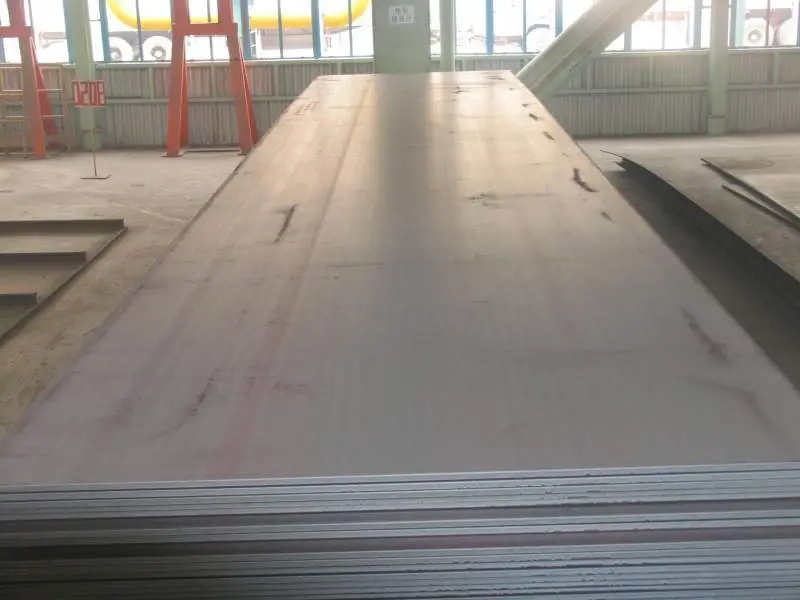
NK Grade B Shipbuilding Steel Plate
NK Grade B Shipbuilding Steel Plate - Material Properties & International Equivalents
Full technical data for NK Grade B ordinary strength hull structural steel: chemical composition, mechanical and thermal physical properties, exact international equivalents, similar substitutes, and application guidance.
Hot rolling, Normalising, TMCP, Welding, Flame cutting, Forming, Bending, Machining
- Phone : +8618037372205
- Email : [email protected]
- WhatsApp: Contact via Whtsapp
- WeChat: +8618037372205
NK Grade B Shipbuilding Steel Plate Introduction
NK Grade B is an ordinary strength hull structural steel grade certified by Nippon Kaiji Kyokai (ClassNK), one of the world's leading classification societies. It is intended for welded structures in shipbuilding and marine construction. The steel is characterised by a minimum yield strength of 235 MPa, moderate tensile strength (400–520 MPa), and specified impact toughness at 0°C (Charpy V-notch ≥27 J). Its chemical composition is tightly controlled to ensure excellent weldability and toughness:
- Carbon ≤0.21%, Manganese ≥0.80% (or ≥2.5×C)
- Fully killed and supplied with a fine grain practice (e.g. Al ≥0.015% acid soluble)
Typical delivery conditions include hot‑rolled, normalised, or thermo‑mechanical control process (TMCP) depending on plate thickness. NK Grade B is fully equivalent to Grade B of all IACS member societies (ABS, LR, DNV, BV, CCS, KR, RINA etc.) and is widely used for hull plates, decks, bulkheads and structural elements.
NK Grade B Shipbuilding Steel Plate Chemical Composition
The following chemical requirements are in accordance with NK Rules and IACS UR W11 for ordinary strength hull structural steel Grade B. Fine grain practice is mandatory; if aluminium is used as the grain refining element, the acid soluble aluminium content shall not be less than 0.015%. When other grain refiners are employed, equivalent effect must be demonstrated. Residual elements are controlled to preserve weldability and toughness.
| Element | Specified Value | Remarks |
|---|---|---|
| Carbon (C) | ≤0.21 | Ladle analysis |
| Silicon (Si) | ≤0.50 | Ladle analysis |
| Manganese (Mn) | ≥0.80 (min. 2.5×C) | Typical range 0.80–1.20; higher values for thick plates |
| Phosphorus (P) | ≤0.035 | |
| Sulfur (S) | ≤0.035 | |
| Aluminium (acid soluble) | ≥0.015 | Grain refining element; if not used, other grain refiners (Nb, V, Ti) applicable |
| Nitrogen (N) | ≤0.009 (if applicable) | When Al is used as grain refiner |
| Residual elements (Cu, Cr, Ni, Mo) | ≤0.30 each; Cu≤0.35 | Sum of residuals ≤0.70 typically |
NK Grade B Shipbuilding Steel Plate Thermal and Electrical Physical Properties
The data provided below are typical values for carbon‑manganese structural steel and are applicable to NK Grade B. These properties are not normally required by the classification society but are useful for engineering calculations such as heat transfer and structural analysis.
| Property | Typical Value | Unit | Conditions |
|---|---|---|---|
| Density (ρ) | 7.85 | g/cm³ | At 20°C |
| Modulus of Elasticity (E) | 205 | GPa | At 20°C |
| Shear Modulus (G) | 79.3 | GPa | Calculated from E and Poisson's ratio |
| Poisson's Ratio (ν) | 0.30 | — | Typical for carbon steel |
| Thermal Expansion Coefficient (α) | 11.7 | ×10⁻⁶/K | Between 20°C and 100°C |
| Thermal Conductivity (λ) | 50 | W/(m·K) | At 20°C |
| Specific Heat Capacity | 460 | J/(kg·K) | At 20°C |
| Electrical Resistivity (ρ_e) | 0.20 | ×10⁻⁶ Ω·m | At 20°C |
NK Grade B Shipbuilding Steel Plate Mechanical Properties
Properties are for plates of thickness ≤50 mm in the as‑delivered condition. Transverse test pieces are used for tensile and bend tests; longitudinal Charpy V‑notch specimens are required for impact tests. For plates over 50 mm, property requirements may be subject to special agreement. All values comply with NK Rules Part K and IACS UR W11.
| Property | Specified Value | Unit | Test Conditions |
|---|---|---|---|
| Yield Strength (ReH) | ≥235 | MPa | Transverse, room temperature, thickness ≤100 mm |
| Tensile Strength (Rm) | 400 – 520 | MPa | Transverse, room temperature |
| Elongation (A) | ≥22 | % | Longitudinal, gauge length 5.65√S0, thickness ≤50 mm |
| Charpy V‑notch Impact Energy (KV2) | ≥27 (average) / ≥20 (single) | J | At 0°C, longitudinal specimens, thickness ≤50 mm |
| Bend Test | d=3a, 180° | — | Mandrel diameter = 3 × specimen thickness (a); no cracks |
NK Grade B Shipbuilding Steel Plate Fully Equivalent International Standards and Replacement Grades
| Country / Region | Standard | Grade | Remarks |
|---|---|---|---|
| International (IACS) | IACS UR W11 | Ordinary Strength Grade B | Unified requirement adopted by all IACS members; identical to NK Grade B |
| USA | ABS Rules | Grade B | Fully equivalent; same chemical, tensile and impact requirements |
| UK | Lloyd's Register Rules | Grade B | Fully equivalent |
| Norway / Germany | DNV Rules | B | Fully equivalent |
| France | BV Rules | B | Fully equivalent |
| China | CCS Rules | B | Fully equivalent |
| Korea | KR Rules | Grade B | Fully equivalent |
| Italy | RINA Rules | Grade B | Fully equivalent |
NK Grade B Shipbuilding Steel Plate Application Introduction
NK Grade B is one of the most common structural steel grades employed in marine and offshore environments. Its guaranteed toughness at 0°C makes it suitable for above‑water line structures and many internal members in temperate and tropical waters. It can be fabricated using standard shipyard processes including welding (with appropriate consumables), flame cutting, and cold forming.
Product Applications: Hull plates (shell, bottom, side), Deck plating, Bulkheads and tank boundaries, Keels and garboard strakes, Web frames, stiffeners and girders, Superstructure panels, Hatch coamings and covers
Processed into products: Shell plating – outer hull sections, Longitudinal stiffeners and stringers, Floor plates and transverse frames, Rudder plates and pintle connections, Bulwark and bulwark stays, Mast houses and deck houses, Brackets and gusset plates
Application industries: Shipbuilding (commercial, naval), Offshore oil & gas platforms, Wind turbine support structures (fixed/floating), Barge and pontoon construction, Port and harbour infrastructure
NK Grade B Shipbuilding Steel Plate Similar or Closely Related Material Substitutes
| Country / Region | Standard | Grade | Remarks |
|---|---|---|---|
| China | GB/T 712 | B | Chinese shipbuilding steel; essentially identical except for possible minor differences in impact test temperature options |
| USA | ASTM A131 / A131M | Grade B | Shipbuilding steel under ASTM; same IACS requirements; fully interchangeable |
| Europe | EN 10025-2 | S235JR | Similar yield strength (235 MPa), but no mandatory 0°C impact requirement; not accepted for ship classification without additional verification |
| Japan | JIS G3101 | SS400 | Similar strength range; impact toughness not guaranteed; should not be used as direct substitute for classed ship structures |
Notes:
All properties are based on NK Rules Part K (current edition) and IACS UR W11. Actual mechanical properties may vary with plate thickness and supply condition. For thickness >50 mm, tensile and impact property requirements should be agreed between purchaser and manufacturer. Material certification normally includes a works test certificate (3.1 according to EN 10204) with chemical composition, tensile, impact and bend test results. When ordering, the required delivery condition (AR, N, TMCP) and any supplementary testing (e.g. through‑thickness properties, ultrasonic examination) must be specified.
- Share



