
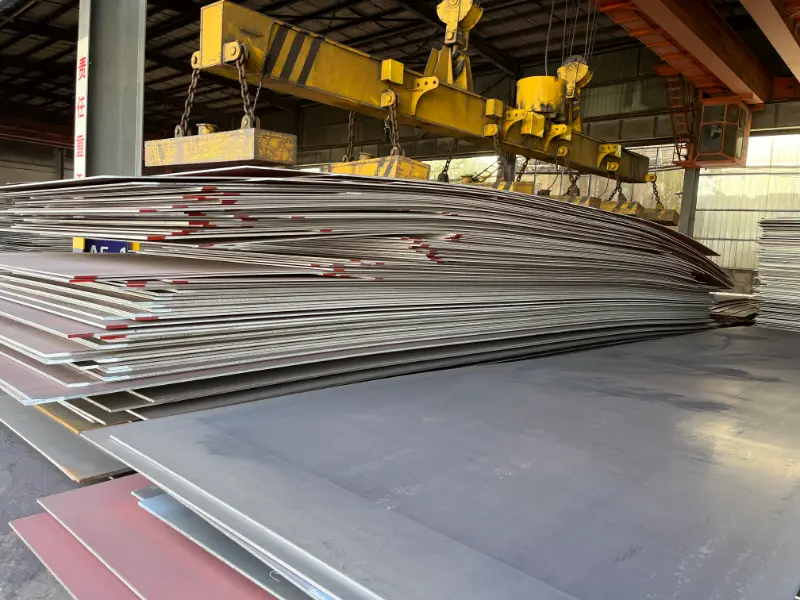
NK Grade D Shipbuilding Steel Plate
NK Grade D Shipbuilding Steel Plate – Full Material Specifications & Properties
Complete analysis of NK Grade D shipbuilding steel: chemical composition, mechanical properties, thermal/electrical data, international equivalents, and application guide for marine and offshore structures.
Hot rolling, Normalizing (optional), Welding, Cutting, Bending, TMCP
- Phone : +8618037372205
- Email : [email protected]
- WhatsApp: Contact via Whtsapp
- WeChat: +8618037372205
NK Grade D Shipbuilding Steel Plate Introduction
NK Grade D is a normal strength hull structural steel certified by ClassNK (Nippon Kaiji Kyokai). It conforms to the IACS UR W11 unified requirements for ordinary strength ship steels. This grade offers a minimum yield strength of 235 MPa, good weldability, and reliable notch toughness at -20°C, making it widely used in ship hulls and offshore structures. Delivery conditions include as-rolled, normalized, or TMCP, depending on thickness and customer requirements. The material is fully equivalent to all IACS member society Grade D plates and is primarily supplied as plates, sheets, and coils for fabrication by hot rolling, bending, welding, and cutting.
NK Grade D Shipbuilding Steel Plate Chemical Composition
Chemical composition requirements according to NK Rules and IACS UR W11 for Grade D steel. Fine grain practice is mandatory; acid soluble aluminium (Als) or other grain refining elements shall be present. Residual elements are controlled to ensure weldability and toughness.
| Element | Required Value | Remarks |
|---|---|---|
| C | ≤0.21 | Thickness ≤50 mm |
| C | ≤0.20 | Thickness >50 mm (if normalized) |
| Mn | ≥2.5×C or ≥0.60 (whichever higher) | Typically 0.60–1.00 |
| Si | ≤0.50 | - |
| P | ≤0.035 | - |
| S | ≤0.035 | - |
| Als (acid soluble) | ≥0.015 | Fine grain requirement |
| Cu, Cr, Ni, Mo | Residuals ≤0.35 each | As agreed |
NK Grade D Shipbuilding Steel Plate Thermal & Electrical Physical Properties
Typical physical properties for normal strength carbon-manganese shipbuilding steel. Actual values may vary slightly with composition and heat treatment. Data are given for ambient temperature unless otherwise noted.
| Property | Typical Value | Unit | Test Condition |
|---|---|---|---|
| Density (ρ) | 7.85 | g/cm³ | 20°C |
| Elastic Modulus (E) | 210 | GPa | Room temperature |
| Shear Modulus (G) | 80.8 | GPa | Estimated |
| Poisson's Ratio (ν) | 0.3 | – | Elastic range |
| Thermal Expansion Coeff. (α) | 12.0 | 10&supminus;⁶/K | 20–100°C |
| Thermal Conductivity (λ) | 50 | W/(m·K) | Room temperature |
| Specific Heat Capacity | 0.49 | kJ/(kg·K) | Room temperature |
| Electrical Resistivity (ρe) | 0.20 | μΩ·m | Room temperature |
NK Grade D Shipbuilding Steel Plate Mechanical Properties
Mechanical properties depend on plate thickness. Values are for longitudinal test specimens. Charpy V-notch impact test is performed at -20°C (Grade D requirement). Bending test to 180° with specified mandrel diameter.
| Property | Required Value | Unit | Test Conditions / Thickness Range |
|---|---|---|---|
| Yield Strength (ReH) | ≥235 | MPa | t ≤ 100 mm |
| Tensile Strength (Rm) | 400–520 | MPa | t ≤ 100 mm |
| Elongation (A5) | ≥24 | % | t ≤ 50 mm, L0=5.65√S0 |
| Elongation (A5) | ≥23 | % | 50 < t ≤ 70 mm |
| Elongation (A5) | ≥22 | % | 70 < t ≤ 100 mm |
| Bend Test | d=1.5t | – | t ≤ 25 mm, 180° |
| Bend Test | d=2t | – | 25 < t ≤ 50 mm, 180° |
| Bend Test | d=2.5t | – | t > 50 mm, 180° |
| Charpy Impact (KV2) | ≥27 (average), ≥20 (single) | J | -20°C, longitudinal, 10×10 mm |
NK Grade D Shipbuilding Steel Plate Exact International Equivalents & Substitute Grades
| Country / Region | Standard | Grade / Designation | Remarks |
|---|---|---|---|
| USA | ASTM A131 / ABS Rules | ABS Grade D / ASTM A131 D | IACS member, identical requirements |
| France | BV Rules | BV Grade D | IACS member |
| China | CCS Rules / GB 712 | CCS D | IACS member |
| Norway / Germany | DNV Rules | DNV D | IACS member |
| Germany | GL Rules (historical) | GL D | IACS member |
| South Korea | KR Rules | KR Grade D | IACS member |
| United Kingdom | LR Rules | LR Grade D | IACS member |
| Italy | RINA Rules | RINA Grade D | IACS member |
| Russia | RS Rules | RS D | IACS member |
| International | IACS UR W11 | Grade D | All IACS societies |
NK Grade D Shipbuilding Steel Plate Application Introduction
NK Grade D steel is designed for welded structures in shipbuilding and offshore engineering. It can be formed, cut, and welded using conventional methods. Proper preheat may be required for thick sections or low ambient temperatures. The material is typically used in the as-rolled condition for moderate thicknesses, while thicker plates may be normalized or TMCP to guarantee properties.
Product Applications: Hull plates and stiffeners, Decks and deckhouses, Bulkheads and transverse webs, Offshore module structural components, Ship frames, brackets, and girders
Processed into products: Longitudinal stiffeners (flat bar, bulb profiles), Transverse frames and floors, Bracket plates and collar plates, Wind and watertight doors, Shell plating and bottom plates
Application industries: Shipbuilding (merchant, naval, passenger vessels), Offshore oil & gas platforms, Marine equipment manufacturing, Port & harbor construction, Barge and dredger construction
NK Grade D Shipbuilding Steel Plate Similar / Substitute Material Recommendations
| Country / Region | Standard | Grade / Designation | Remarks |
|---|---|---|---|
| Japan | JIS G3106 | SM400B | Similar yield and tensile, but impact test at 0°C; not automatically certified for shipbuilding |
| EU | EN 10025-2 | S235J2 (+N) | Close mechanical properties, J2 requires -20°C impact; not specifically for marine |
| China | GB 712 | B | Grade B has lower toughness requirements (0°C); D requires -20°C |
| USA | ASTM A36 | A36 | No mandatory impact test; often substituted only when toughness is not critical |
Notes:
NK Grade D plates are usually supplied with ClassNK survey and certification. Ultrasonic testing may be specified. Dimensions and tolerances conform to NK Rules or applicable international standards such as EN 10029. This grade is suitable for cold forming and welding with standard shipyard practices.
- Share



